


Open Enrollment 2027: Your Deductible Is the Number That Matters on the Mat
Most people pick a health plan by the premium, but on the mat your deductible decides what an injury costs you. Here are the 2027 open enrollment dates, how to find your total exposure, and how to match an accident benefit to your deductible gap.
By Chris Martin, Founder, JiuJitsuInsurance.com | Covering The Mats Blog
One bad roll, one big bill
I've trained jiu-jitsu since 2008, and I've always carried major medical insurance. Even so, I've still paid somewhere between $2,000 and $6,000 a year out of my own pocket for medical bills. Having health insurance and being protected from a big injury bill are two different things.
Open enrollment is the one time each year most of us pick a health plan, and most people pick by the monthly premium. On the mats, the number that actually decides how much an injury costs you is your deductible, and your out-of-pocket maximum right behind it.
Give me five minutes and you'll know your 2027 exposure and how to cover it.
Open enrollment 2027: the dates that matter
- Nov 1, 2026: Open enrollment opens on HealthCare.gov.
- Dec 15, 2026: Deadline to pick a plan that starts Jan 1, 2027.
- Jan 15, 2027: Open enrollment ends. Plans picked Dec 16 through Jan 15 start Feb 1.
- State-run exchanges may have different dates, so check yours.
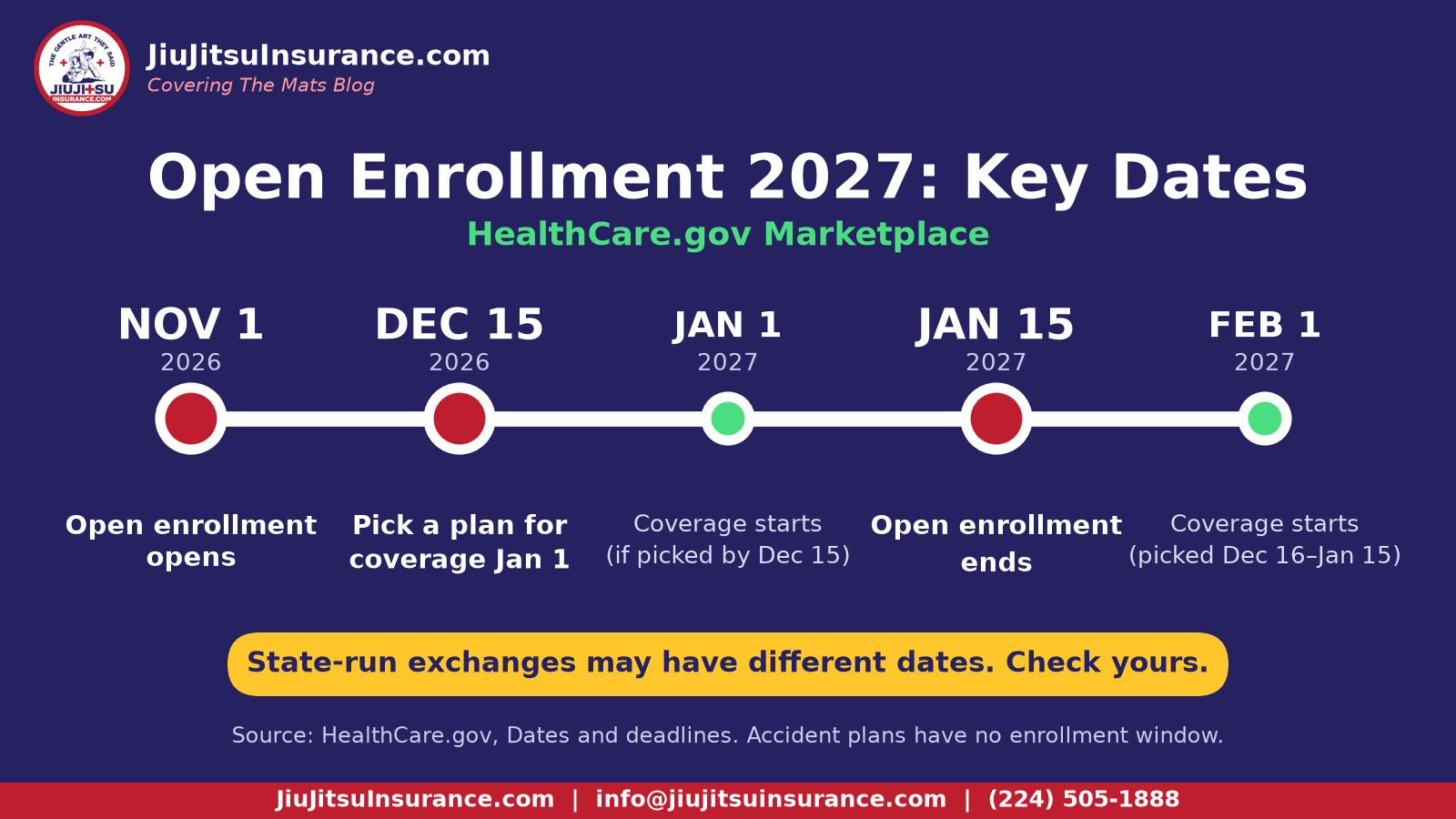
HealthCare.gov open enrollment dates for 2027 coverage. State-run exchanges may have different dates, so check yours.
A quick note on who we are: JiuJitsuInsurance.com is an accident and injury insurance brokerage. We don't enroll Marketplace health plans. Choose your health plan through HealthCare.gov, your state's exchange, or your employer. What we help with is the gap that plan leaves behind.
The number nobody checks: your total exposure
- Deductible: what you pay before your health plan starts sharing the cost.
- Out-of-pocket maximum: the most you'll pay in a year for covered care. After you hit it, the plan pays 100%.
Here's an illustrative example:
$6,000 deductible + $3,000 more in coinsurance and copays = $9,000 out of your pocket before your plan pays 100%.
Deductibles of $2,500 to $8,000 or more are common. The injuries that blow through them are the ones we see every week in the academy: torn ACLs, shoulder dislocations, fractures, and the ER visit, imaging, and physical therapy that come with them.

Hypothetical example: a $6,000 deductible plus $3,000 in coinsurance and copays equals $9,000 in total exposure. Actual deductibles and benefits vary by plan and state.
Callout: A lower premium usually means a higher deductible, and a higher deductible means a bigger gap.
How accident injury insurance fills the gap
The plans we offer are 24-hour accident plans. They're not built only for jiu-jitsu. We call it "jiu-jitsu insurance" because these plans don't exclude jiu-jitsu or other recreational martial arts, so they cover you on and off the mats: training, at home, on the weekend.
One important difference on work injuries usig two programs that we write insurance coverage with:
- Washington National accident plans cover injuries on or off the job.
- Companion Life Flex doesn't cover work injuries that workers' comp covers.
Pairing the two fills that gap.
There are two kinds of accident plans:
- Reimbursement (Companion Life Flex): an excess plan that pays after your health insurance, toward what you owe.
- Cash, or indemnity (Washington National, AFLAC): pays you directly, and you decide where the money goes: deductible, rent, or lost time off work.
These are accident-only plans. They don't cover illness, routine care, or ongoing conditions, and they're not a replacement for major medical. They're built to sit next to it.
Match your benefit to your 2027 deductible
The simple rule: choose an accident benefit close to your deductible, or close to your total exposure if you want the whole gap covered.
| Your 2027 deductible / exposure (example) | Accident benefit to consider (example) |
|---|---|
| About $5,000 | $5,000 |
| About $6,000 | $6,000 |
| About $9,000 ($6k deductible + $3k out-of-pocket) | $9,000 |
| $10,000 or more | $10,000 |
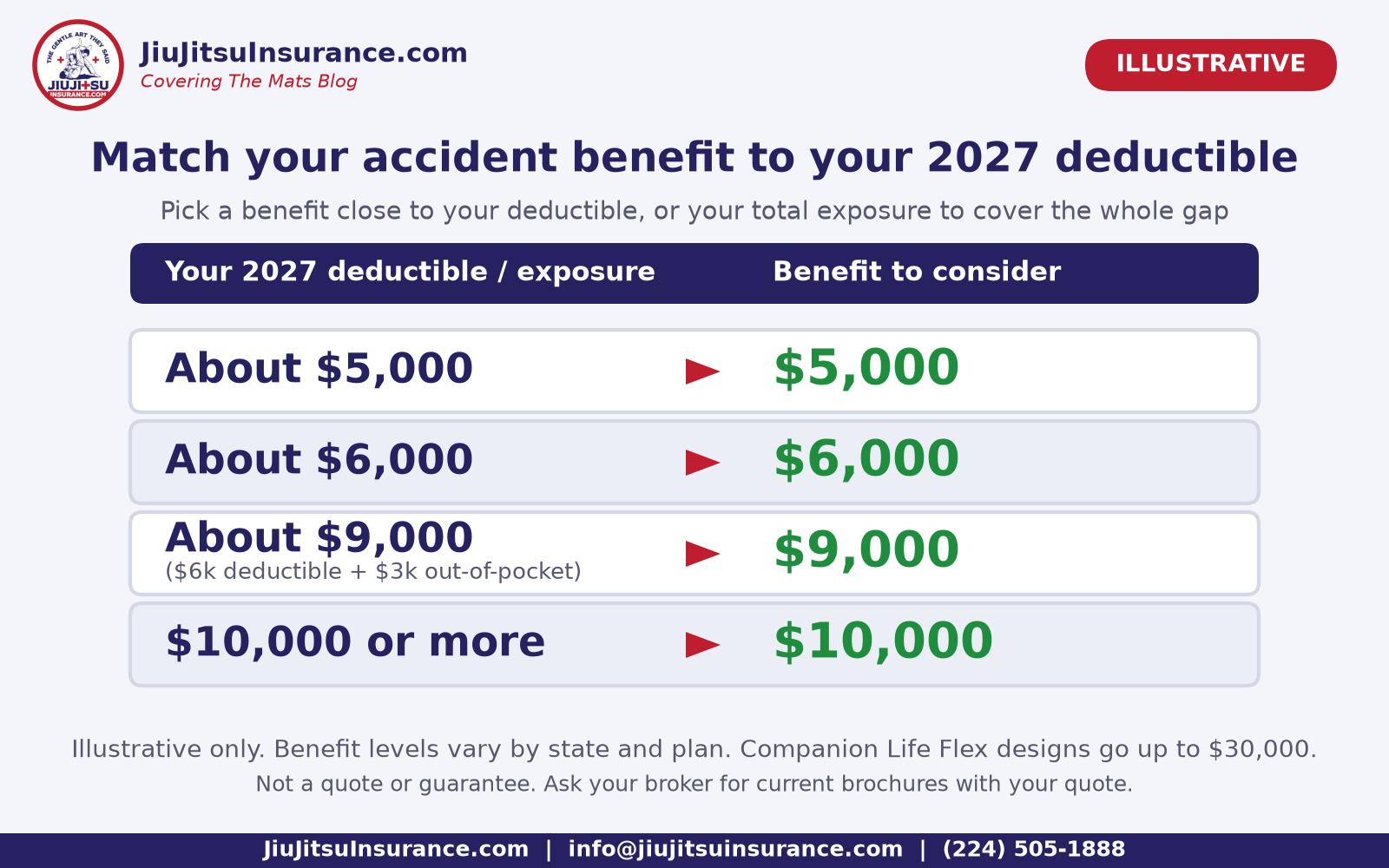
Illustrative benefit matching. Benefit levels vary by state and plan, and Companion Life Flex designs go up to $30,000.
*Illustrative only. Benefit levels vary by state and plan, and Flex designs go up to $30,000.
Using the example above, a $9,000 benefit lines up with the $9,000 exposure, so a covered accident doesn't come out of your savings.
Want more protection? You can stack plans. A Companion Life Flex plan plus a Washington National plan plus AFLAC can cover the bill and put cash in your hand at the same time. I walk through a forearm fracture example in Best-Paying Accident Plans for Martial Artists in 2027, and the two-plan setup in BJJ Accident Insurance with a Flexible Health Plan.
Your situation, your stack
- High-deductible plan: match your accident benefit to the gap, then add a cash plan for lost time.
- No health insurance: strongly consider getting major medical during open enrollment. In the meantime, higher accident limits (up to $30,000) can help with accidents only. More in Martial Arts Injury Insurance for Uninsured Athletes.
- Coach or self-employed: protect your income with accident disability and cash plans. See Insurance for Independent Jiu-Jitsu Coaches.
- You compete for pay: start with AFLAC. Companion Life Flex and the Washington National accident plans cover recreational martial arts but not paid competitors.
State availability and timing
Companion Life Flex is available in 30 states plus DC, and Washington National and AFLAC cover most of the others.
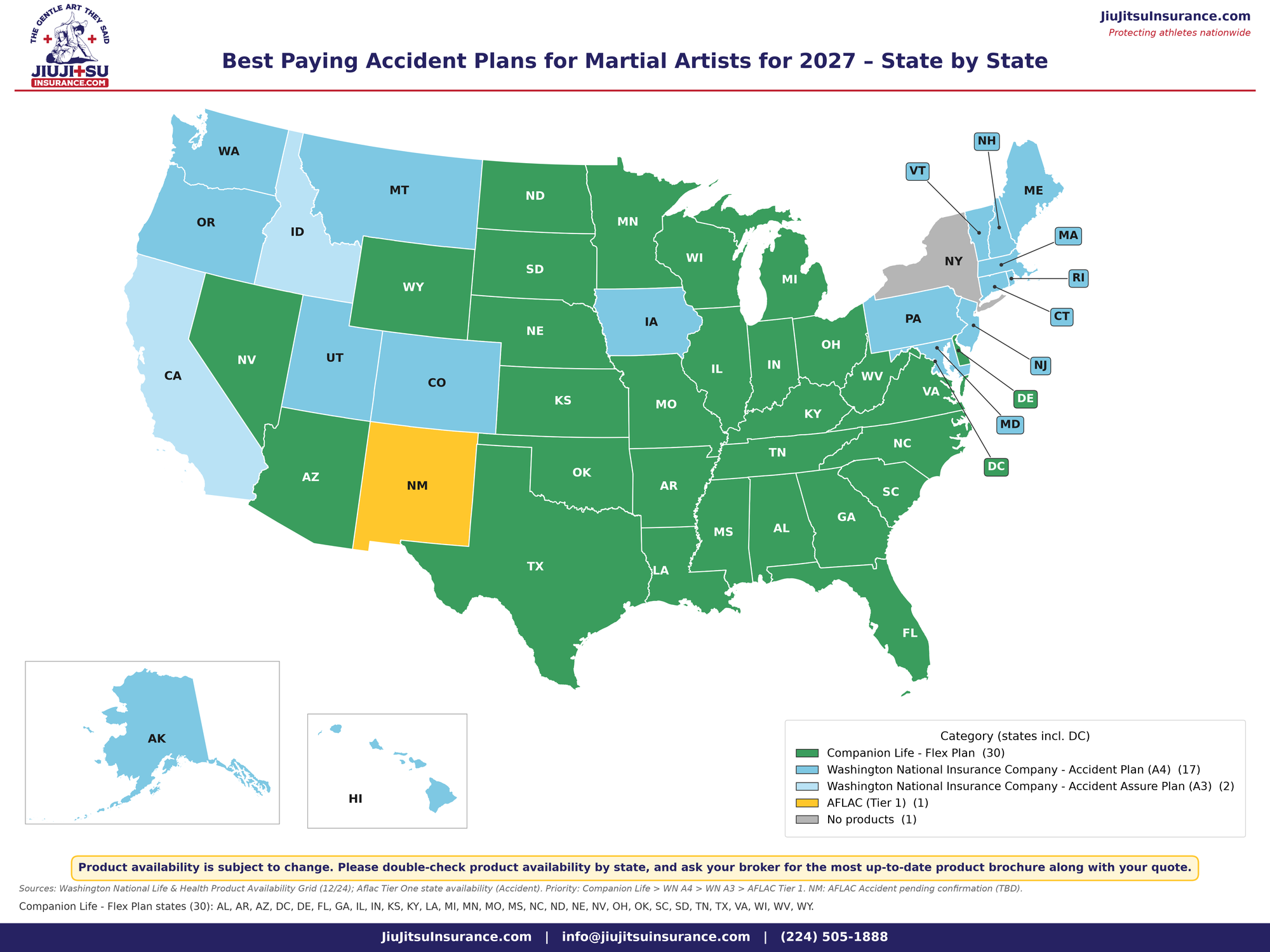
Best Paying Accident Plans for Martial Artists for 2027, state by state. Availability varies and is subject to change.
There's no open-enrollment window for accident plans. Coverage typically starts 24 to 72 hours after you enroll, so you can line it up to start Jan 1 alongside your new health plan, or start any time of year. Details in our insurance plan FAQ.
For gym owners: protect your members, too
If you run an academy, there are group gym accident policies that a lot of owners don't know about. Learn more on our group gym policy page . And please share this post with your members before Dec 15. Our gym share kit makes it easy.
FAQ
Do I need health insurance to buy an accident plan? No. But accident plans cover accidents only, so major medical is still the foundation.
Can I have both? Yes. Cash plans pay regardless of your other coverage, and Flex is excess coverage that pays after your health insurance.
Are tournaments covered? Amateur competition generally isn't excluded. Paid competition is excluded on Companion Life Flex and Washington National, so paid competitors should look at AFLAC. Confirm the details for your state.
What if I miss Dec 15? On HealthCare.gov, you can still enroll until Jan 15 for coverage starting Feb 1. Accident plans are available year-round.
Do you sell ACA plans? We focus on accident and injury coverage.
Get your 2027 deductible check
Tell us your 2027 deductible and out-of-pocket max, and we'll show you the accident benefit that covers your gap.
Prefer to talk? Call (224) 505-1888 or email info@jiujitsuinsurance.com.
While you're here, enter our Fuji raffle.
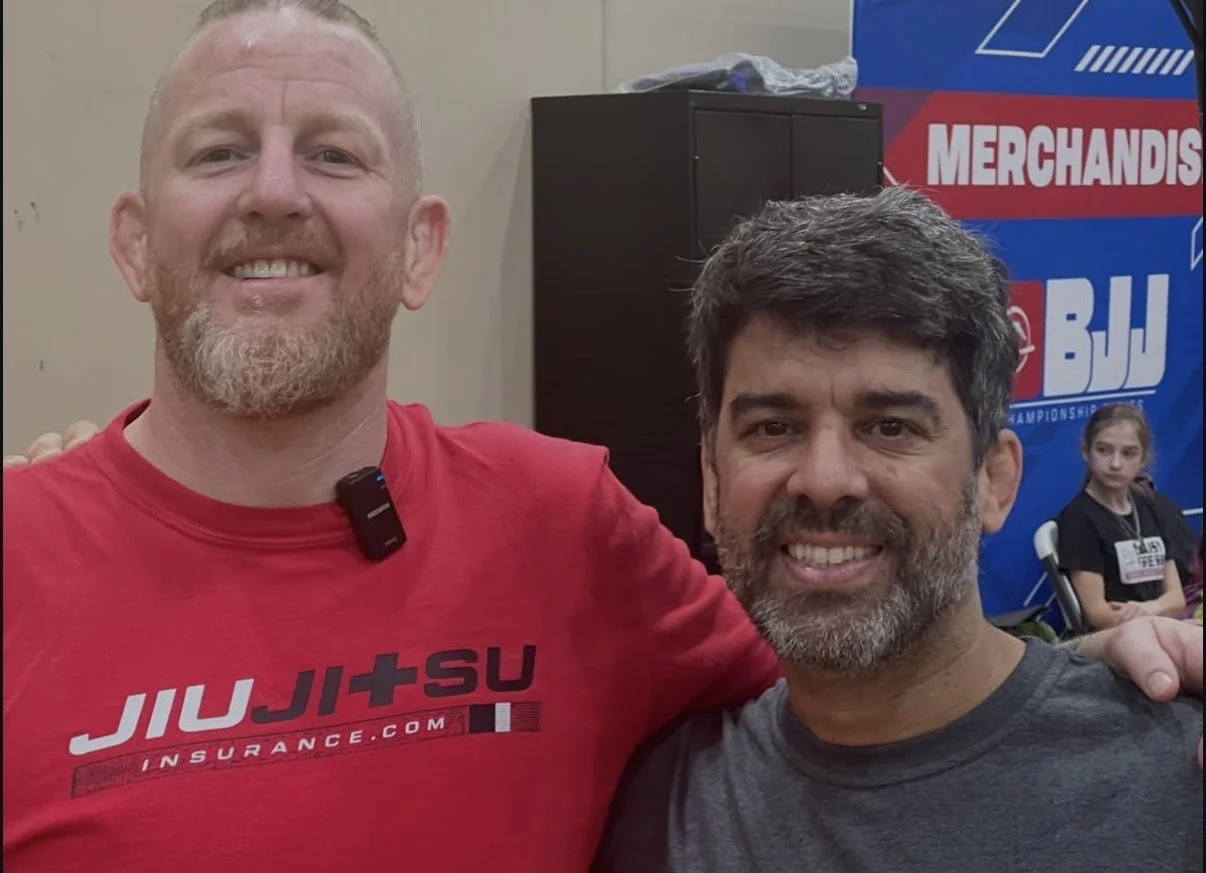
Chris Martin at a Fuji BJJ event with Felipe Costa in Illinois.
Product availability varies by state and is subject to change. Ask your broker for an up-to-date product brochure with your quote. This post is general information, not a contract or a quote. Benefits, availability, exclusions, and prices vary by state, age, and plan. JiuJitsuInsurance.com is a licensed insurance brokerage, not an insurer. NPN 7335986.

Best Paying Accident Plans for Martial Artists for 2027 – State by State
Our 2027 ranking of high-paying, low-cost accident plans for martial artists and BJJ students, how to stack them, and which are available in your state.
Covering The Mats Blog · JiuJitsuInsurance.com
Every academy has the same story on repeat: someone posts on a bad arm, gets stacked in a scramble, or catches a heel hook a beat too late, and suddenly they're in the ER instead of at open mat. The injury heals. The bills and missed work are what linger. This guide is our 2027 ranking of the highest-paying, low-cost accident plans that martial artists can buy on their own or stack together, plus a state-by-state map so you can see what's likely available where you train.
These are 24-hour injury plans. They don't just cover jiu-jitsu. They cover accidental injuries on and off the mats, at work, at home, or out on the weekend. What makes them different is that they don't exclude jiu-jitsu or other martial arts training, and that's exactly why we call it Jiu-Jitsu Insurance.
On the job vs. off the job: The Washington National accident plans cover injuries whether they happen on the job or off. The Companion Life Flex plan does not pay for work injuries that are covered by workers' compensation, so it's best for injuries off the clock, like training, sports and everyday life. Pairing Flex with a Washington National plan helps fill that gap.
Availability varies by state. Benefits, prices, availability and exclusions vary by state, age, plan design and benefit level, and they can change. Use this guide as a starting point, then confirm with your broker.
The 2027 ranking: highest potential payout
We ranked these plans by potential payout on a covered injury, with monthly prices that keep them within reach for most students, coaches and competitors. Prices are estimates for illustration only.
1. Companion Life – Flex Plan (accident medical expense)
- How it pays: Reimburses actual covered accident medical bills, after a deductible, up to a yearly maximum. It's an excess plan, so it pays after any health insurance you have, or first if you don't have any.
- Why it ranks #1: It can be designed with up to a $30,000 yearly maximum, the biggest potential payout on this list for a serious injury with surgery, imaging and lots of PT.
- Estimated cost: roughly $25–$29/month for a $30,000 accident-only design (an estimate that varies by state, age and plan design).
- Watch for: In the version we reviewed, ER care may be covered only when followed by a hospital admission. If you're treated in the ER and released, ask how ER visits are handled in your state.
2. Washington National – Accident Plan (A4)
- How it pays: Fixed cash (indemnity) for covered events like fractures, dislocations, ER visits, imaging, physician visits and physical therapy. It's paid directly to you, regardless of other insurance.
- Why it ranks #2: Several benefit levels, with the higher levels paying meaningful cash for the injuries we see most on the mats.
- Estimated cost: about $35/month.
3. Washington National – Accident Assure Plan (A3)
- How it pays: Fixed cash per covered event, much like A4, paid regardless of other coverage.
- Why it ranks #3: Solid scheduled benefits for fractures, dislocations, ER and therapy. It's offered in a smaller group of states and is often the Washington National option where A4 isn't available.
- Estimated cost: about $35/month.
4. AFLAC – Tier One Accident
- How it pays: Fixed cash for covered accident treatment, fractures, dislocations, concussion, imaging, follow-up care and therapy, paid regardless of other coverage.
- Why it's on the list: It's widely available, and it's a strong option for competitors (more on that below).
- Estimated cost: about $36/month.
Monthly prices are estimates only and vary by state, age, plan design and benefit level. Your actual premium comes from your quote.
Are martial arts covered?
This is the question we get most, so here it is plainly. Based on the sample materials we reviewed, these plans do not exclude recreational martial arts (jiu-jitsu, judo, wrestling, kickboxing, Muay Thai and the like) as long as you're not paid to compete. The Companion Life and Washington National materials we reviewed exclude professional, semi-pro or paid competition and events for pay or prize money. Flex's sample certificate also excludes intercollegiate sports.
If you compete for pay or prize money, AFLAC is the plan to look at. The sample AFLAC policy we reviewed has no general sports exclusion. It even adds a bonus benefit for injuries in organized amateur competition or supervised practice for it, though that bonus doesn't apply to paid competition. Wording varies by state, so confirm with your broker how your state's plan treats your situation, especially if you fight for purses, coach for pay or compete in professional events.
How stacking works
Here's the fun part: you don't have to pick just one. You can generally hold up to three of these plans at once:
- Companion Life Flex, which handles the bills,
- plus ONE Washington National plan (A4 or A3), which pays cash,
- plus AFLAC Tier One, which pays more cash.
The two types work differently, and that's why they pair well. Flex reimburses covered medical expenses. The Washington National and AFLAC plans pay fixed cash directly to you, regardless of other insurance. You can use that cash for deductibles, rent, lost wages, gas to PT or groceries while you heal. (New to these terms? Read our explainer, Reimbursement vs. Indemnity Accident Insurance.)
A hypothetical forearm fracture
Hypothetical illustration, not a quote or guarantee. Bills and benefits are made up for illustration using sample plan materials. Actual benefits vary by state, plan, level and claim review.
A BJJ student with no health insurance fractures a forearm in class. The ER, X-rays, fracture care, an MRI, two ortho follow-ups, six PT sessions and a prescription total $7,550.
- Step 1, Flex only: Flex reimburses $7,300 (bills minus a $250 deductible). Net: –$250 out of pocket. That assumes the ER visit is covered. If it isn't, because of the admission wording, out of pocket is about $3,150.
- Step 2, + AFLAC: about $1,120 in fixed cash. Net: +$870.
- Step 3, + WN A4 (Level 4): about $3,780 in fixed cash. Net: +$4,650 left over for the weeks you're off the mats.
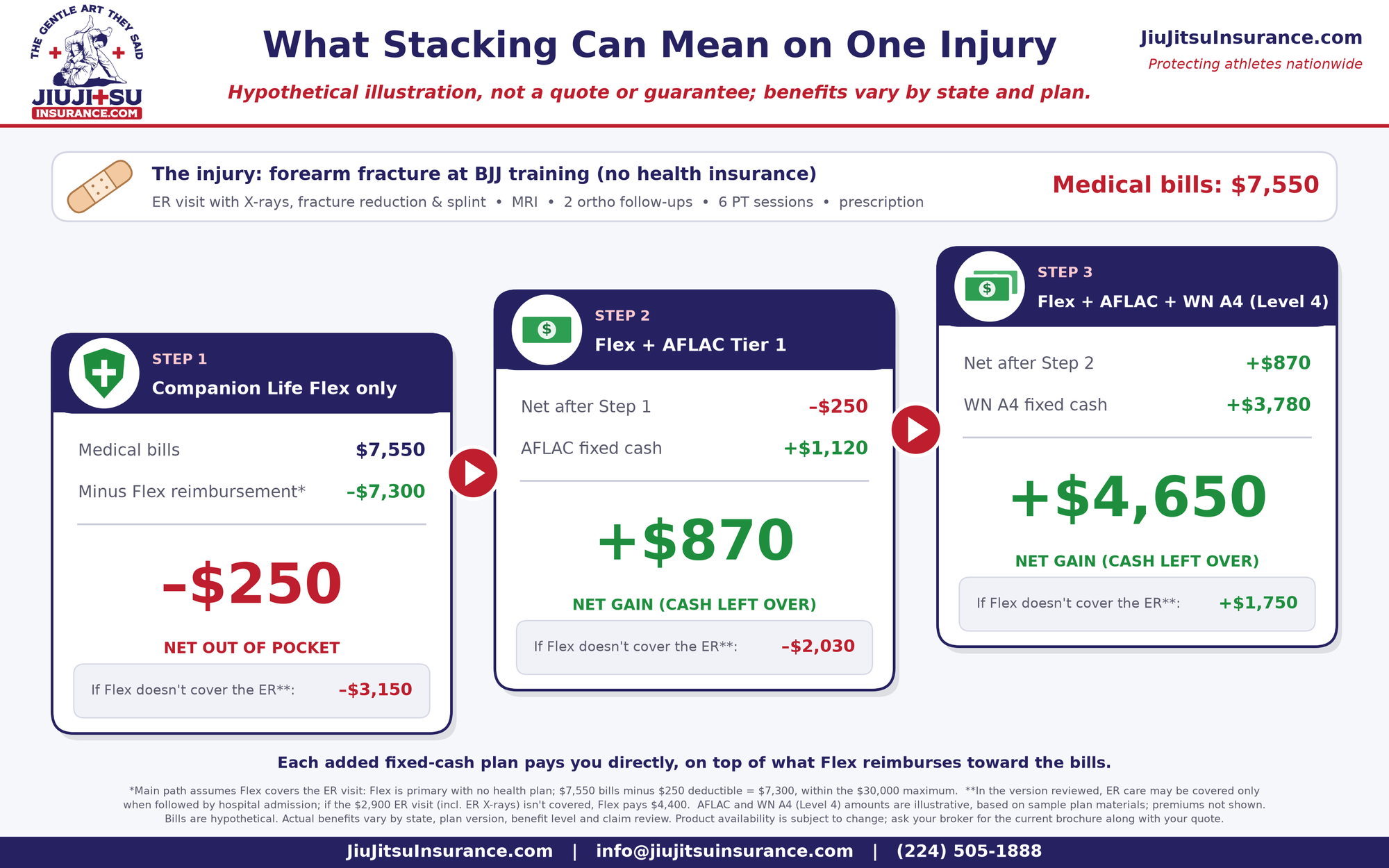
Hypothetical example: how one, two and three stacked plans might pay on a single forearm fracture. If Flex doesn't cover the ER visit, the final result is +$1,750.
State by state: reading the map
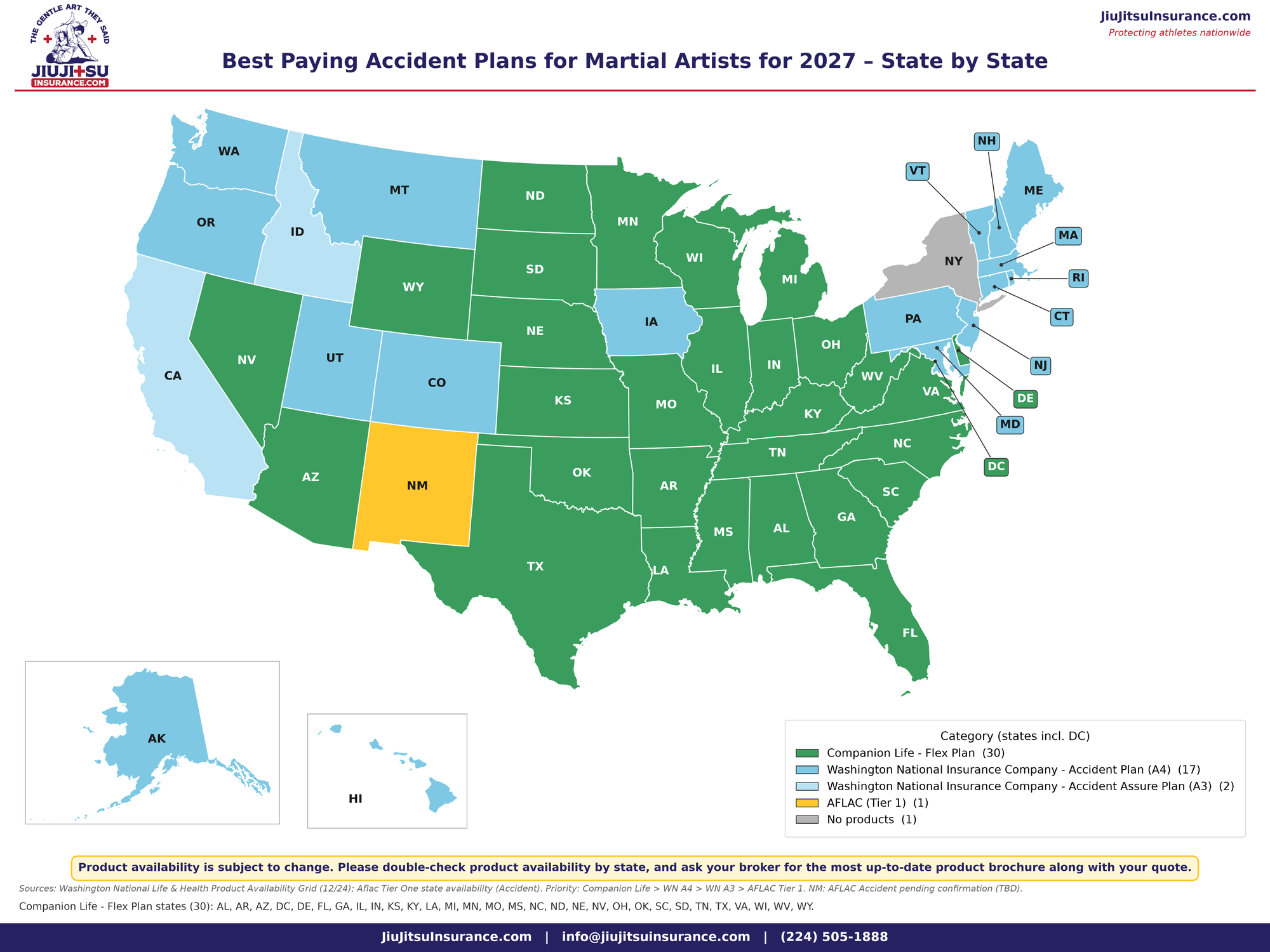
Our 2027 combined map. Each state shows the highest-ranked plan generally available there.
The combined map shows one color per state, following the ranking above. It shows Companion Life Flex where it's available, otherwise Washington National A4, otherwise A3, otherwise AFLAC. Most states have more than one option, so check the individual product maps below to see everything you could stack.
- Companion Life – Flex (30 states plus DC): AL, AR, AZ, DC, DE, FL, GA, IL, IN, KS, KY, LA, MI, MN, MO, MS, NC, ND, NE, NV, OH, OK, SC, SD, TN, TX, VA, WI, WV, WY.
- Washington National – Accident Plan A4 (17 states shown as top pick): AK, CO, CT, HI, IA, MA, MD, ME, MT, NH, NJ, OR, PA, RI, UT, VT, WA.
- Washington National – Accident Assure A3 (2 states shown as top pick): CA, ID. In California, the Washington National accident product may be offered under a different plan name, so ask your broker.
- AFLAC – Tier One: NM, shown as AFLAC for now while availability is pending confirmation.
- No products currently shown: NY.
Individual product maps
Each map shows every state where that product is generally available, regardless of the ranking.

Companion Life – Flex Plan: available in 30 states plus DC (mainly the South and Midwest).
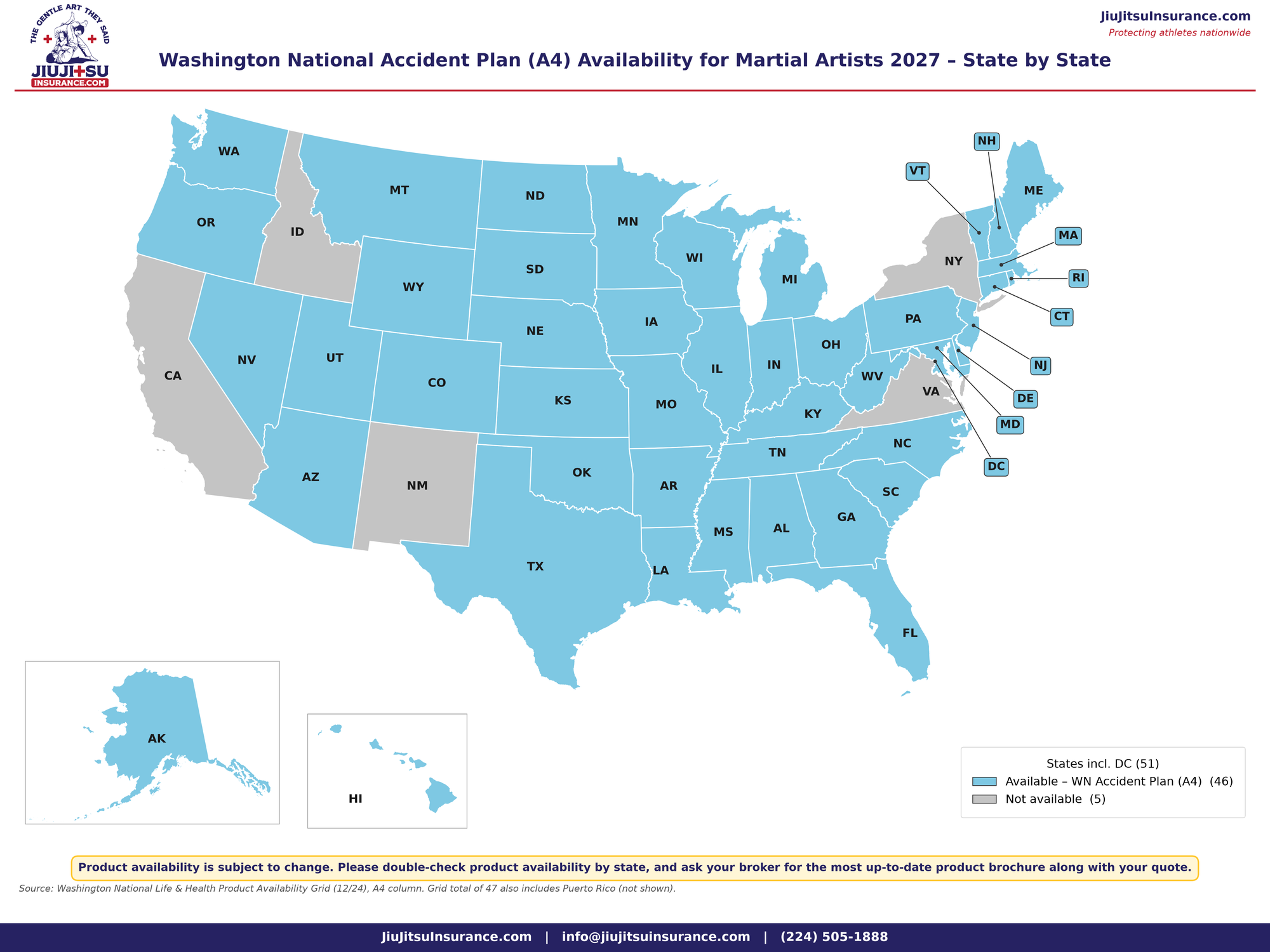
Washington National – Accident Plan (A4): available in most states. Not shown in CA, ID, NM, NY or VA.
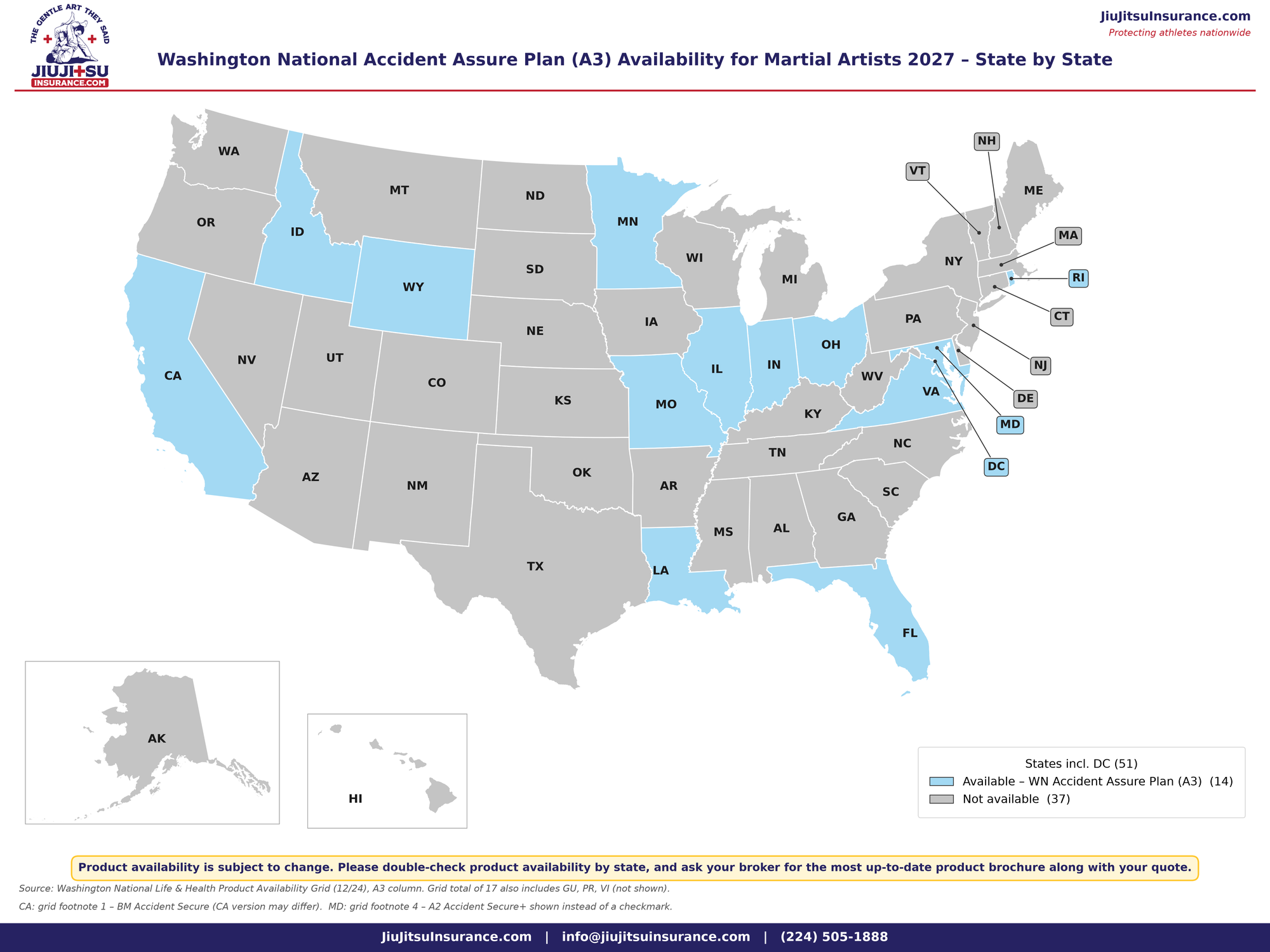
Washington National – Accident Assure (A3): available in a smaller group of states, including CA and ID, where A4 isn't offered.
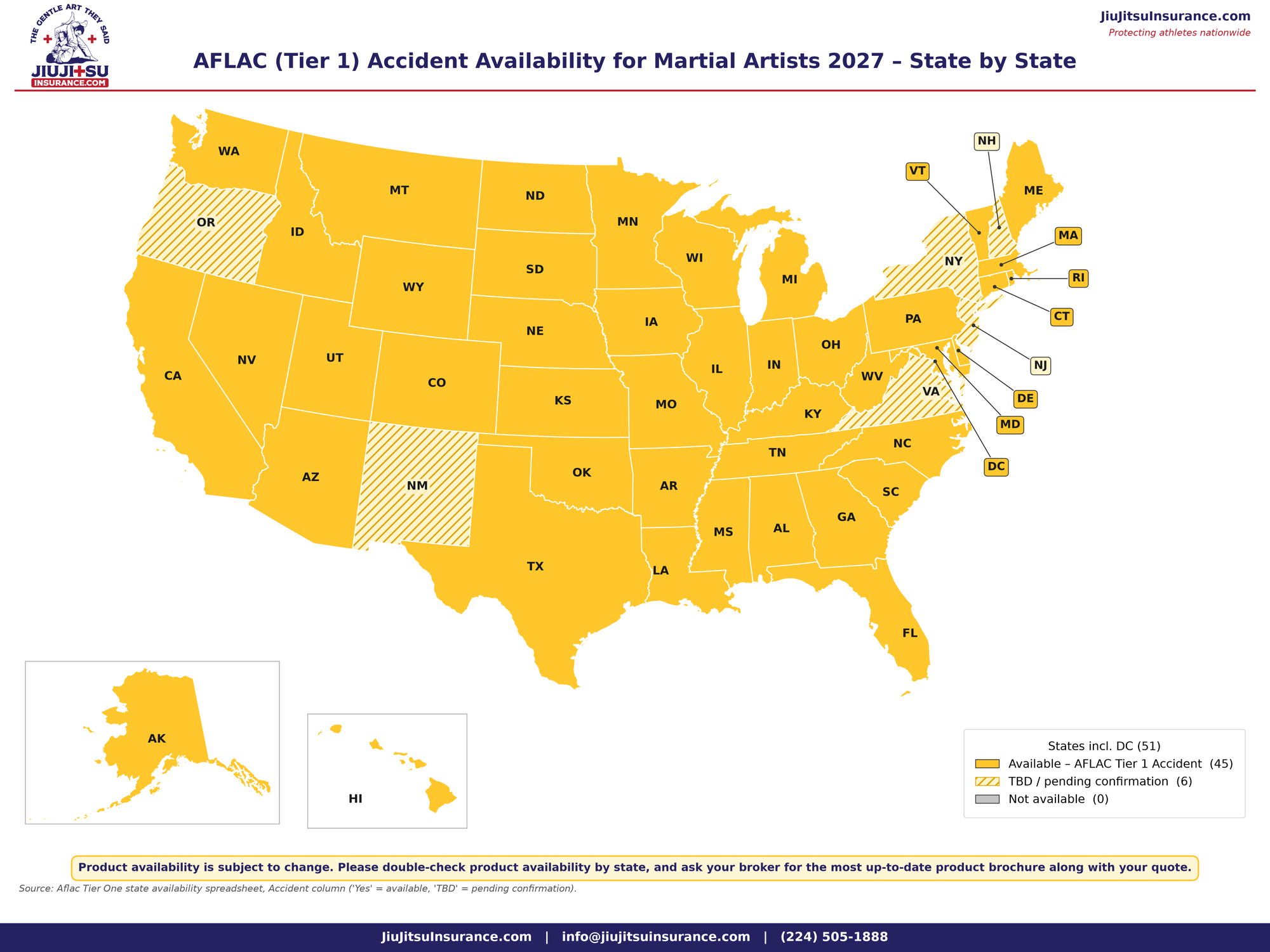
AFLAC – Tier One Accident: widely available. Hatched states (NH, NJ, NM, NY, OR, VA) are pending or to be confirmed.
Quick picks by situation
- You have health insurance with a big deductible: Flex (where available) can help with what your health plan leaves behind, and a cash plan adds money for lost time.
- You don't have health insurance: Flex pays first on accident bills, and stacking a cash plan or two helps cover the gaps. Remember, these are accident-only plans. They don't cover illness.
- You coach, teach or are self-employed: The cash plans (WN and AFLAC) matter most, because they help replace income while you can't work.
- You compete for pay or prizes: Start with AFLAC and confirm the details with your broker.
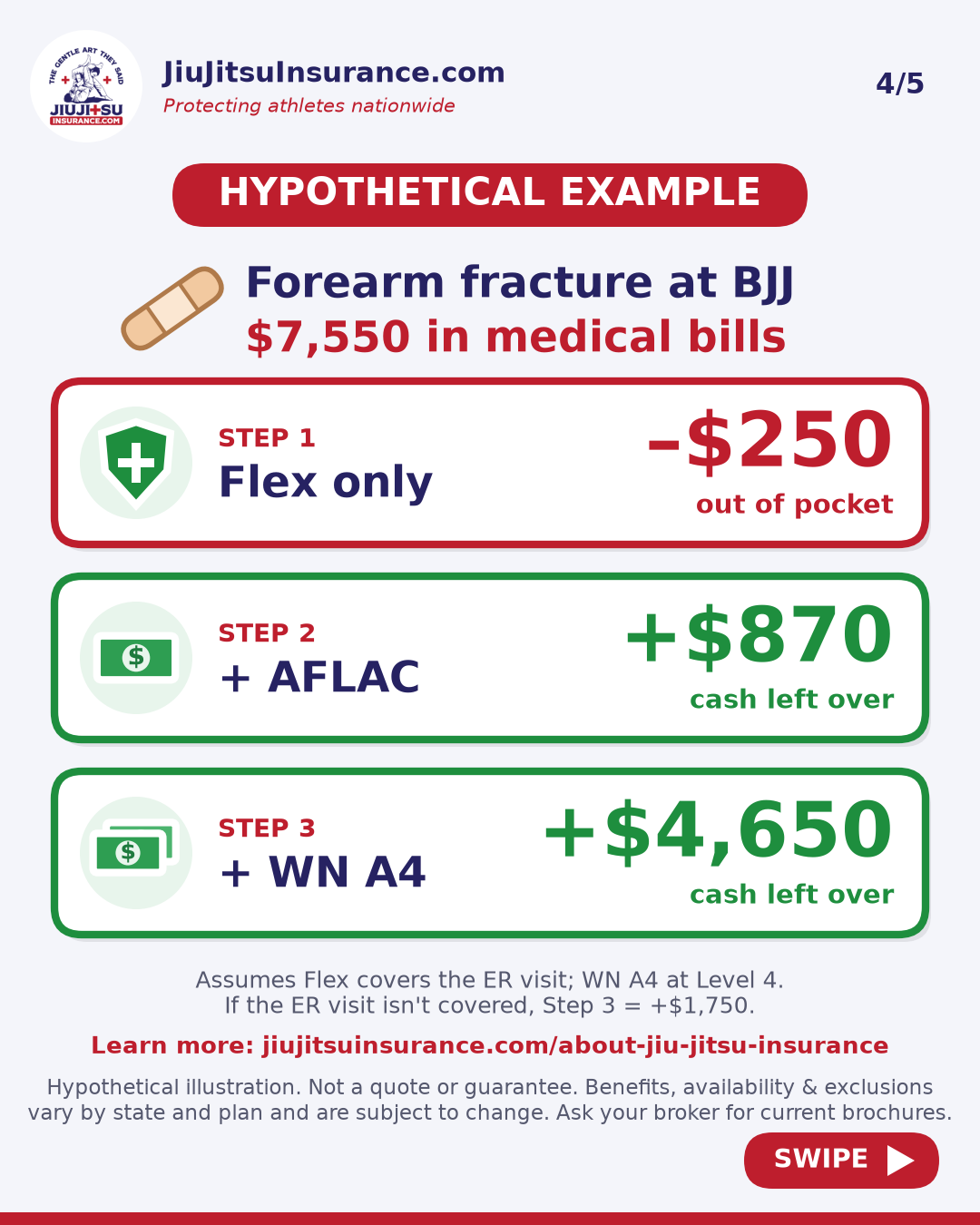
Share it with your team: the stacking example from our Instagram carousel (hypothetical).
FAQ
Can I really have three plans at once? Generally, yes: Companion Life Flex, plus one Washington National plan (A4 or A3), plus AFLAC. They pay in different ways. Owning two similar plans from the same carrier may be limited, so your broker will design the right combination.
Do these plans pay if I have health insurance? Yes. The WN and AFLAC plans pay fixed cash regardless of other coverage. Flex is excess, so it pays after your health plan.
Are tournaments covered? Based on the sample materials we reviewed, amateur competition isn't excluded by name, and AFLAC adds a bonus for organized amateur events. Paid competition is typically excluded under Flex and the WN plans. Confirm with your broker.
How accurate are the prices? They're estimates for illustration. Your premium depends on your state, age, plan design and benefit level.
What if my state isn't shown for a plan? Availability changes. Ask us. A plan may be pending, offered under a different name, or replaced by another option.
Find the right mix for your state
Every training partner's situation is different. We'll show you what's available in your state and help you stack coverage that fits how you train and compete.
Learn more about injury plans for martial artists →
Email info@jiujitsuinsurance.com or call (224) 505-1888.
Product availability is subject to change. Please double-check product availability by state, and ask your broker for the most up-to-date product brochure along with your quote. Prices shown are estimates only and vary by state, age, plan design and benefit level. This article is general information based on sample carrier materials. It is not a contract, a quote or a guarantee of benefits, and the policy or certificate issued in your state governs all benefits, limitations and exclusions.

I Get This Call a Lot: What Uninsured Athletes Want to Know About Martial Arts Injury Insurance
A 30-year-old with no health insurance wanted to start jiu-jitsu, but the gym waiver asked for proof of coverage. Here is what we walked him through.

The gym waiver is often where uninsured athletes first get stuck.
Stuck on a Gym Waiver That Asks for Proof of Insurance?
A guy called me the other night. Born in 1996, so right around 30 years old. No health insurance at all. Software professional. He’d been thinking for a long time about trying jiu-jitsu, boxing, or Muay Thai. The gym waiver asked for proof of insurance, and that stopped him. He’d never carried coverage in the U.S. before and didn’t know where to start.
That demographic shows up often. A lot of people in their late 20s and early 30s — especially if they’re self-employed or simply don’t have an employer plan — either can’t find affordable major medical or don’t want to pay several hundred dollars a month for coverage they feel they barely use. They’re healthy, active, and mainly worried about one risk: getting hurt and facing a large medical bill with no help.
He found our site while researching. Like many people, he assumed the name “Jiu-Jitsu Insurance” meant the coverage was only for Brazilian jiu-jitsu. That was the first thing we cleared up.
Not Just for BJJ: Why Jiu-Jitsu Insurance Exists
We are a brokerage, not an insurance company. Jiu-Jitsu Insurance is a 50-state brokerage. We hold contracts in every state and work with multiple carriers. Our focus is finding accident and injury plans that generally do not exclude the recreational combat sports and training most of our clients actually do.
Most standard policies carve out or limit martial arts. We specifically look for the ones written with a broader approach so hobbyists training in jiu-jitsu, boxing, Muay Thai, and similar activities are not automatically left out. That is the reason the brand exists and why people in this exact situation land on us.
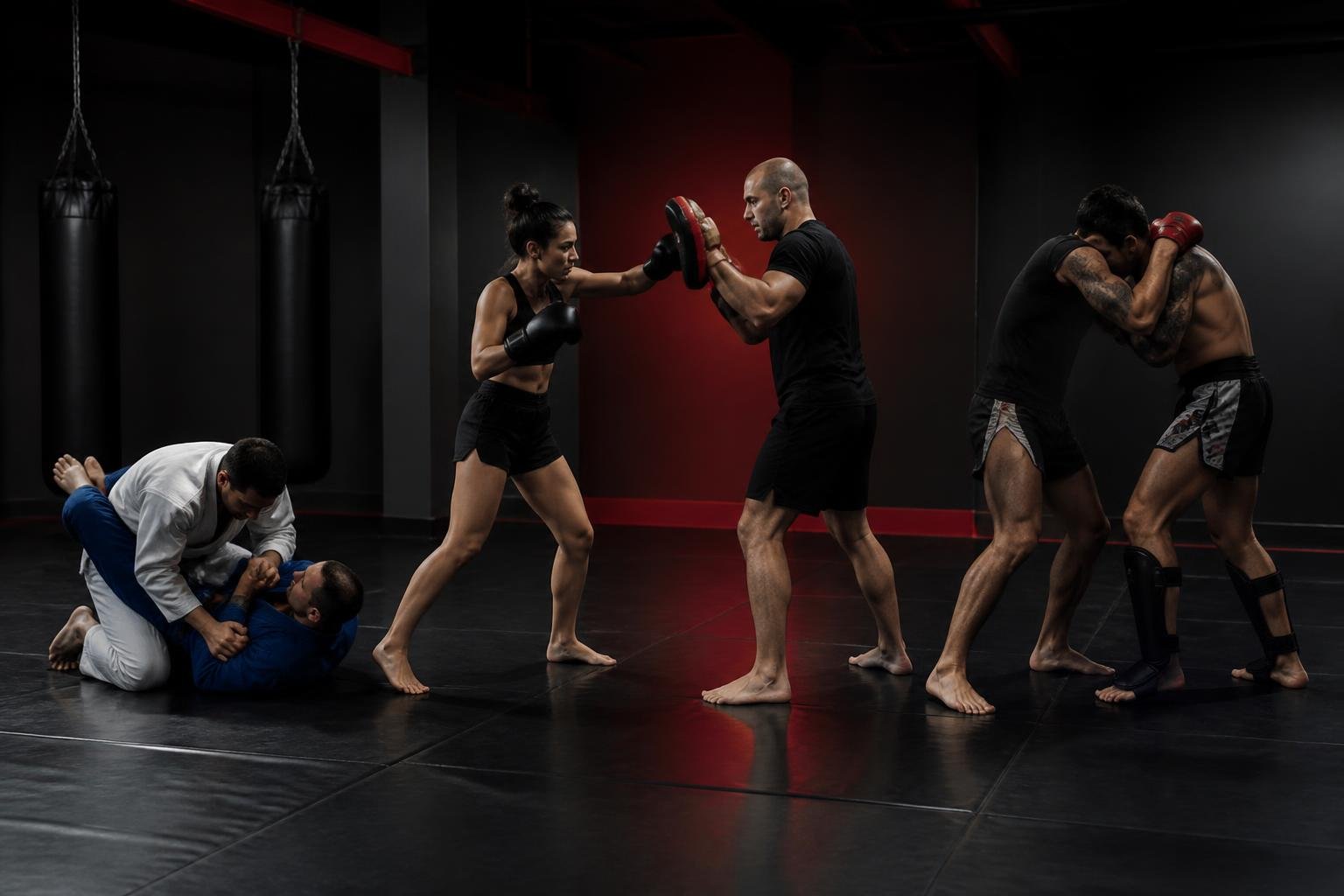
Combat Sports Accident Insurance Varies by State
Not every plan is available in every state. Options vary. The only way we can tell you what is currently offered is if you give us a ZIP code. From there we check the programs we have access to in that state and walk through the general features that fit recreational training.
We never quote or enroll anyone without first confirming what is actually available where they live.

Plans and pricing depend on what's offered in your state.
Accident Plan vs. Major Medical: What These Plans Are
On this call we walked through the same points I cover with most uninsured athletes.
These are supplemental accident and injury plans, not major medical. They generally focus on medical expenses that result from covered accidents and injuries. They are not designed for routine care, illness, or ongoing medical needs. That limited scope is also why they tend to cost far less than comprehensive health insurance.
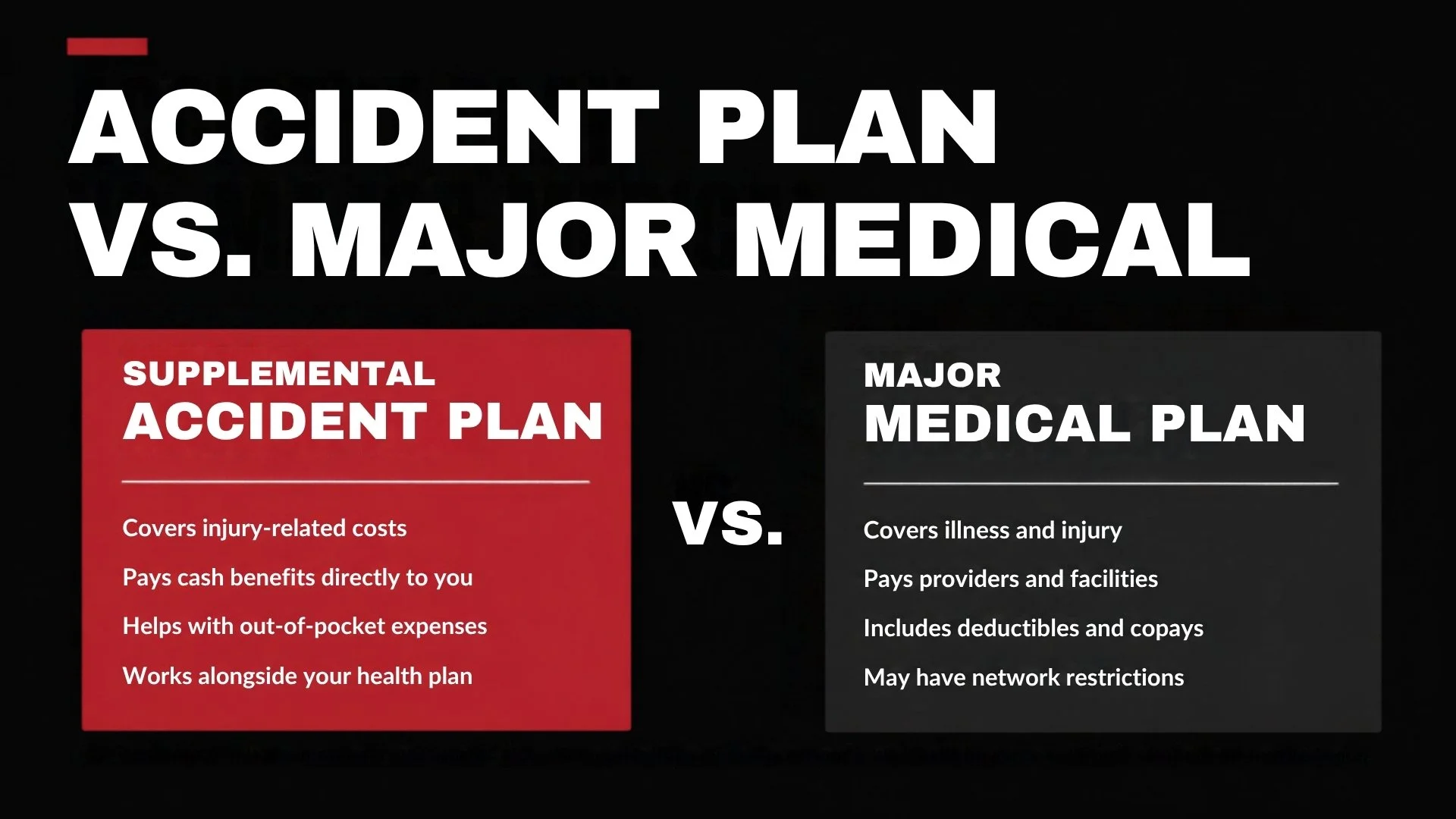
Accident plans focus on covered injuries, not routine care or illness.
How Much Accident Coverage Do You Need Without Health Insurance?
When someone has no other medical coverage, we often look at higher accident medical expense benefit amounts so the plan can respond to a larger portion of potential bills. If the person already has major medical, we can usually customize the accident benefit to better align with their deductible instead. Exact benefits and costs always depend on the products available in their state.
These plans can sometimes work alongside major medical if you add it later (for example, helping with a deductible).
How Claims Work: Treatment, Bills, Reimbursement
You can usually seek treatment where you choose.
After treatment you submit a claim with the medical bills. If the claim is approved under the plan’s terms, the company reimburses you and you use those funds toward your costs.
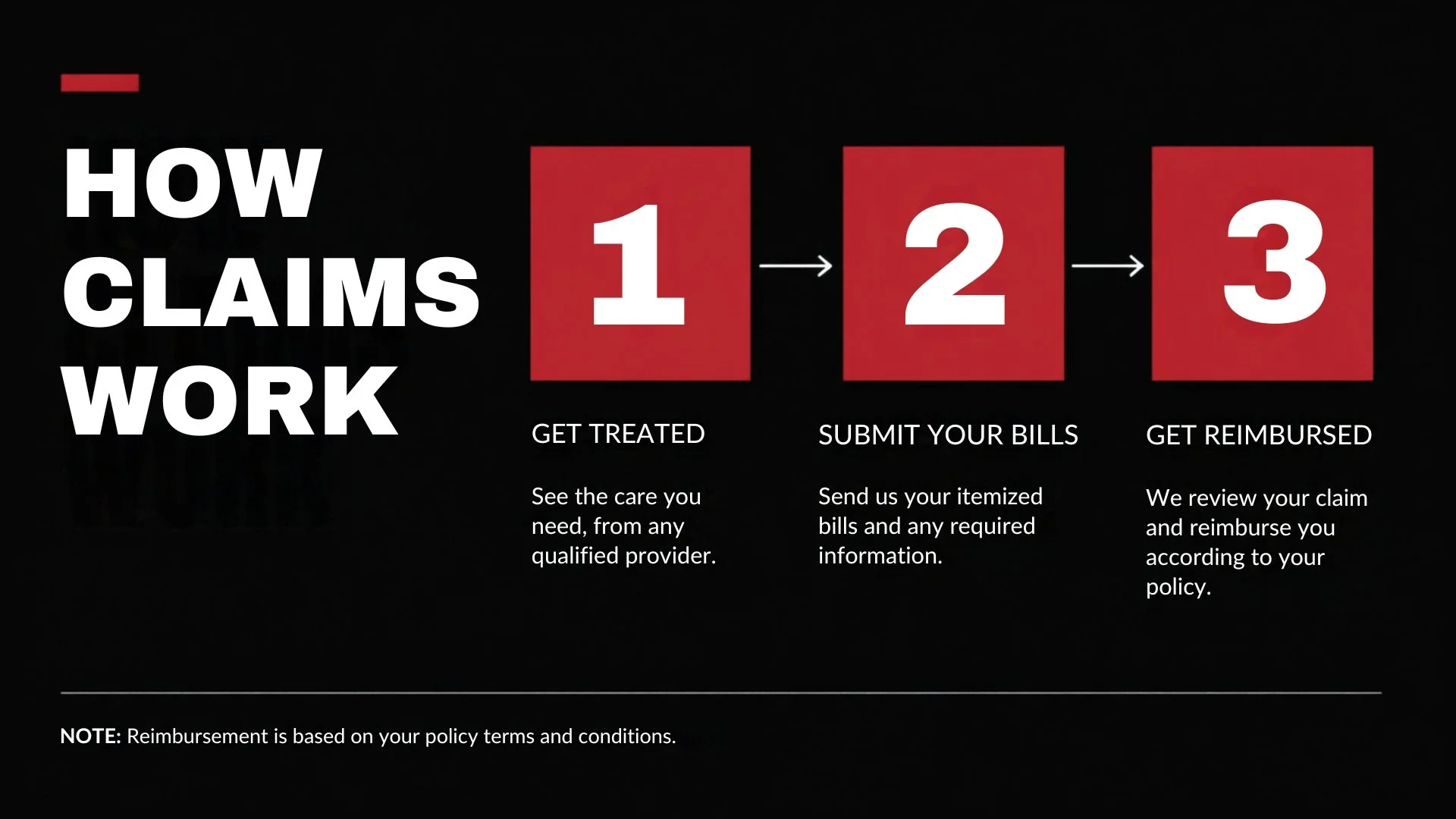
Approved claims reimburse you under the plan's terms.
What Martial Arts Injury Plans Generally Cover
For recreational athletes they generally respond to injuries that happen during training in jiu-jitsu, boxing, Muay Thai, and similar activities, as well as related fitness such as yoga or dance, and everyday accidents outside the gym.
He also asked whether the same type of coverage would apply if he tried different martial arts or even yoga and dance. These broader accident plans are generally written to respond to injuries from the activities recreational athletes actually do, not just one sport. That is the whole point of the search we do as a brokerage.
Pro Fighters and Other Exclusions
These plans generally do not cover professional athletes who are paid to compete, but we do have an injury plan from Aflac that does not exclude pro fighting. If that AFLAC plan is available in your state you can get the quote for that plan here:
Other high-risk activities are often excluded as well. Exact exclusions appear in each policy and can vary by carrier and state. No plan can guarantee that every injury will be covered. Coverage always depends on the specific terms, the facts of what happened, and the claim review process. Once we create your quote, we will send you a list of coverage exclusions based on the company and policy available in your state.
A Real Example: $30,000 in Accident Coverage for About $42 a Month
One example quote. Benefits, costs and availability vary by state, carrier and individual.
On this particular quote we also included access to 24/7 virtual urgent care, virtual primary care, and virtual mental health with no copay through the association membership.
That combination with the $30,000 accident medical expense benefit brought the total monthly cost to just over $42. The virtual care piece is useful for many people who want a way to talk to a provider quickly without always having to go into an office, and the accident plan is designed to help cover the first $30,000 in medical bills resulting from covered accidental injuries.
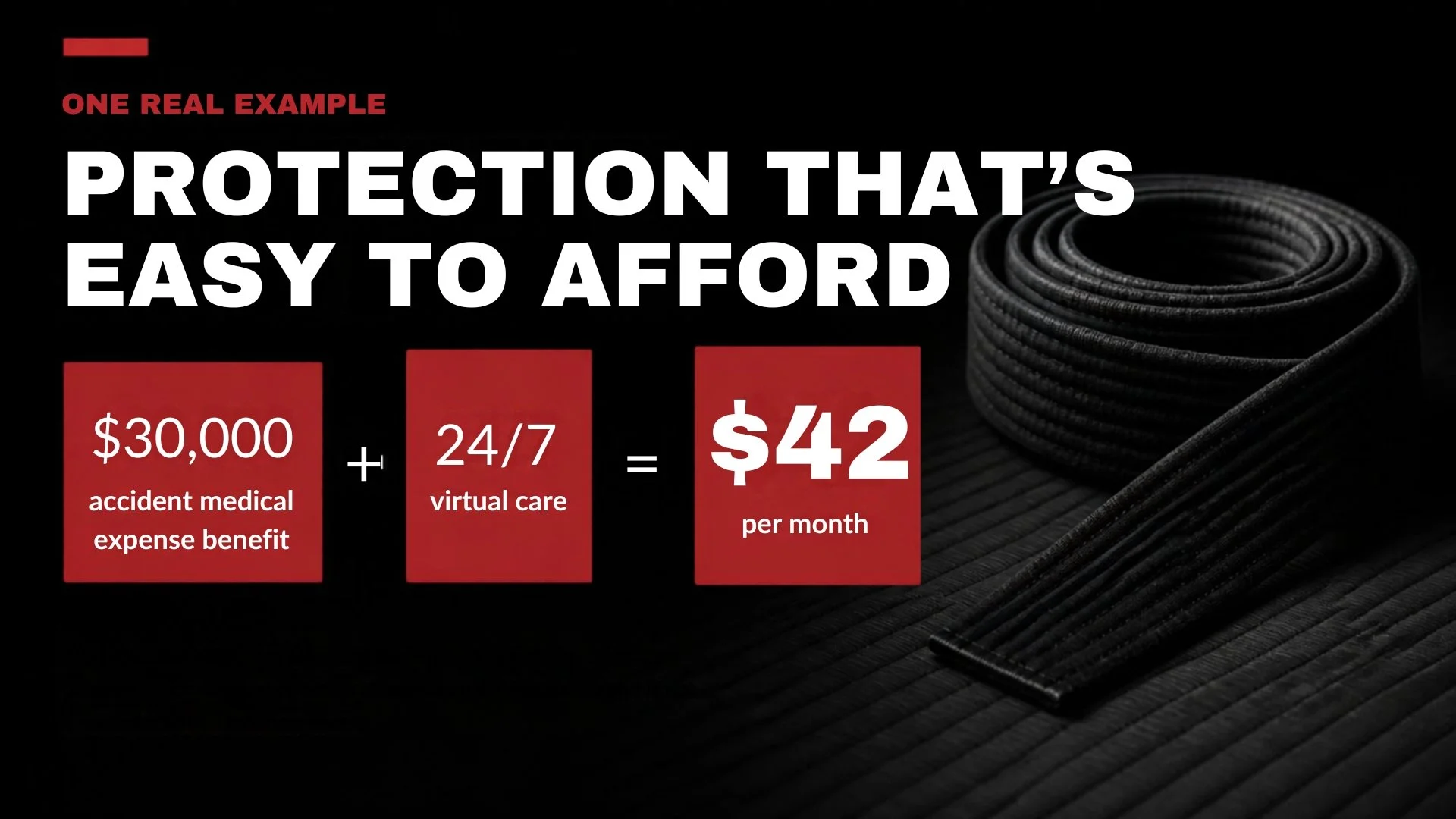
One example quote; your benefits and cost will vary.
Get Covered Before You Train
By the end of the call he understood the difference between major medical and these supplemental accident plans, why the brand name exists, that availability is state-specific, and how the benefit amount can be approached differently depending on whether someone already has other coverage. I told him I would email the information and the quote link so he could review everything when he was ready. He said that was all he needed and he would go through it.
That’s how most of these conversations end. Someone who was stuck on a gym waiver because they had no coverage and didn’t know where to look leaves with a clearer picture of the options that may be available in their state for recreational training.
If you’re in a similar spot — uninsured or under-insured, thinking about starting jiu-jitsu, boxing, Muay Thai, or another combat sport, and the waiver has you paused — the first step is simply giving us your ZIP code. We’ll check what’s currently available where you live and explain the general differences so you can decide what makes sense for you.
Getting the information before you train is the practical move. Once an injury has already happened, the options become much more limited.
If you'd like us to check what accident and injury options may currently be available in your state, start here:
Coach or gym owner? See insurance for BJJ coaches and gym liability coverage.
This article is for general informational purposes only and does not constitute insurance advice, an offer of coverage, or a guarantee that any specific plan, benefit, or coverage will be available to you. Accident and injury insurance products, benefits, exclusions, limitations, costs, and availability vary by state, carrier, and individual circumstances. Coverage is subject to the terms, conditions, and exclusions of the actual policy issued. Jiu-Jitsu Insurance is a licensed insurance brokerage and is not an insurance company. We do not underwrite policies. Nothing in this article should be interpreted as a promise or guarantee of coverage for any particular activity, injury, or claim. Always review the full policy documents and consult with a licensed agent regarding your specific situation.

Is This Accident Insurance Too Good to Be True for Jiu-Jitsu Athletes?
Every Brazilian Jiu-Jitsu athlete knows injuries are part of the journey, but many don't realize the financial impact can last longer than the recovery itself. In this article, Chris Martin of JiuJitsuInsurance.com explains how accident medical expense coverage works, why he personally enrolled in the plan, and how athletes can customize protection for training injuries, hospital stays, lost income, and more. Watch the video walkthrough and learn how to get a quote in just a few minutes.
Written By - Chris Martin (Founder of JiuJitsuInsurance.com)
If you've trained Brazilian Jiu-Jitsu for any length of time, you already know one thing:
Injuries happen.
Whether it's a dislocated shoulder, broken finger, torn meniscus, rib injury, or an unexpected trip to the emergency room, even the safest athletes can find themselves facing medical bills after an accident on the mats.
Most athletes assume their health insurance will take care of everything. Unfortunately, that's often not the case.
High deductibles, copays, coinsurance, physical therapy expenses, and time away from work can quickly turn a training injury into a financial burden.
That's why I recently enrolled in one of the new accident injury programs now available through JiuJitsuInsurance.com that we just started offering in 2026.
In the video below, I walk through exactly how the quoting process works and show you how to build a plan that fits your needs and budget.
Watch: How to Get a Quote
*This new program underwritten by Companion Life is now available in the following states: AL, AR, AZ, DC, DE, FL, GA, IL, IN, KS, KY, LA, MI, MN, MS, MO, NC, ND, NE, NV, OH, OK, SC, SD, TN, TX, VA, WI, WV, WY.
This is a video that shows how to get covered today.
In this video, I demonstrate how easy it is to:
Get an instant quote
Select your effective date
Choose your accident medical expense benefit level
Add optional disability coverage
Add optional hospital and critical illness benefits (where available)
What Is Accident Injury Insurance?
Accident injury insurance is designed to help pay covered medical expenses resulting from a new accidental injury.
Unlike traditional health insurance, these plans can help provide benefits from the first dollar of covered expenses, subject to policy terms and limits.
For many athletes, the goal is simple:
Protect yourself from the unexpected costs associated with training injuries.
Why This Matters for Jiu-Jitsu Athletes

Brad at Misfits BJJ in St. Charles learns about the new plans and can’t believe it.
Let's face it.
Jiu-Jitsu is one of the most physically demanding sports in the world.
Even if you're careful, accidents happen:
Torn ACLs
Shoulder dislocations
Broken hands and fingers
Knee injuries
Rib injuries
Neck injuries
Emergency room visits
Physical therapy
Many athletes carry health insurance with deductibles ranging from $2,500 to $8,000 or more.
That means even after paying monthly premiums, you may still owe thousands before your major medical plan begins paying.
Building Coverage Around Your Deductible
One strategy is to select an accident benefit level that aligns with your health insurance deductible.
For example:
If your health insurance deductible is $5,000, you might consider a $5,000 accident medical expense benefit.
If you experience a covered accident, the benefit may help offset medical expenses that would otherwise come out of your own pocket.
This can be especially valuable for athletes who train several times per week or compete regularly.
*This new program underwritten by Companion Life is now available in the following states: AL, AR, AZ, DC, DE, FL, GA, IL, IN, KS, KY, LA, MI, MN, MS, MO, NC, ND, NE, NV, OH, OK, SC, SD, TN, TX, VA, WI, WV, WY.
What If You Don't Have Health Insurance?
Many independent contractors, coaches, gym owners, and self-employed athletes either have limited health coverage or no major medical insurance at all.
In that situation, some athletes choose higher accident medical expense limits to provide additional protection against unexpected injuries.
Available benefit levels vary by state and may provide up to $30,000 in accident medical expense benefits.

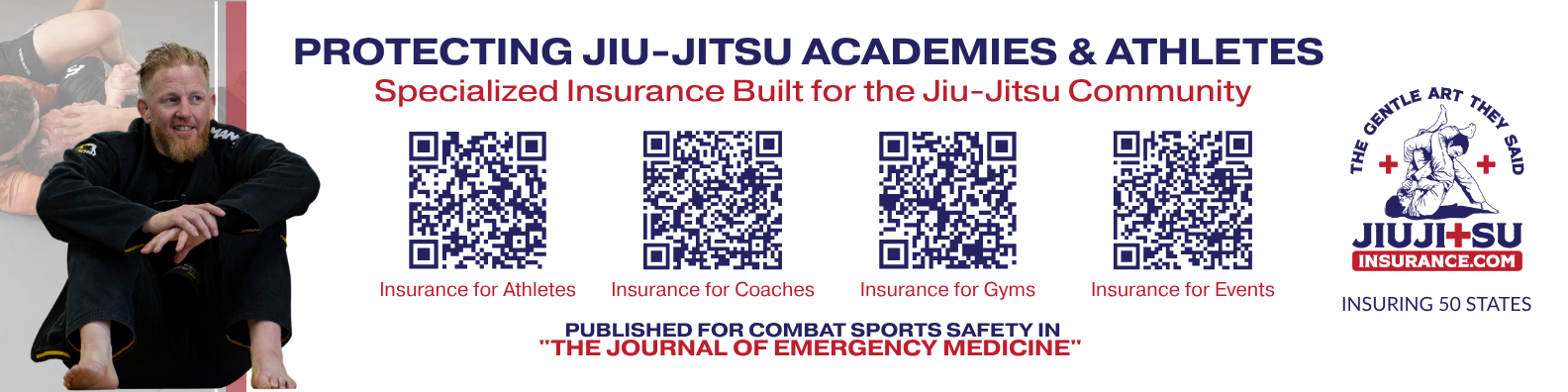
Jiu Jitsu Insurance Banner at Fuji BJJ event.
Don't Forget Income Protection
One of the most overlooked risks for athletes is lost income.
If an injury prevents you from working, the medical bills are only part of the problem.
You may also lose:
Coaching income
Personal training income
Business revenue
Contractor earnings
Teaching opportunities
Depending on your state and eligibility, optional accident disability benefits may be available to provide weekly income benefits if a covered injury prevents you from working.
Hospital Benefits and Critical Illness Coverage
Depending on your state, additional benefits may be available including:
Hospital Indemnity Benefits
These benefits may provide cash payments for covered hospital stays due to sickness.
For example, if you develop a serious infection requiring hospitalization, these benefits may help offset out-of-pocket costs and lost income.
Emergency Room Benefits
Cash benefits may be available for covered emergency room visits due to sickness.
Doctor Visit Benefits
Some plans include benefits for physician office visits and urgent care treatment.
Critical Illness Coverage
Depending on state availability, coverage may be available for certain critical illnesses including:
Heart Attack
Stroke
Invasive Cancer
Major Organ Transplant
These benefits can provide lump-sum cash payments that may be used however you choose.
Why I Purchased This Plan Myself
As someone who has trained Brazilian Jiu-Jitsu for years and works with martial artists every day, I understand that injuries are part of the journey.
While no insurance policy can prevent an injury from happening, having financial protection in place can make recovery much less stressful.
That's why I personally purchased this coverage for myself.
The enrollment process was straightforward, the monthly cost was affordable, and it gave me an additional layer of protection beyond my existing coverage.
Get Your Quote Today
If you're interested in seeing your options, you can get a quote online in just a few minutes.
*This new program underwritten by Companion Life is now available in the following states: AL, AR, AZ, DC, DE, FL, GA, IL, IN, KS, KY, LA, MI, MN, MS, MO, NC, ND, NE, NV, OH, OK, SC, SD, TN, TX, VA, WI, WV, WY. QUOTE LINK
All other states get a quote here by clicking here »
You can save your quote, review your options, and enroll entirely online.
If you have questions, feel free to contact our team.
Chris Martin
Founder, JiuJitsuInsurance.com
Phone: 224-505-1888
National Producer Number (NPN): 7335986
California License: 4116908

Chris Martin at Fuji Jiu Jitsu event educating the community about injury plans.


Important Disclosure
The information provided in this article and video is for educational purposes only and is not a contract of insurance, coverage guarantee, or binding quote.
Benefits, exclusions, limitations, waiting periods, state availability, eligibility requirements, and premium amounts vary by state and individual circumstances.
Please review all policy documents, certificates, and brochures carefully before enrolling. Coverage is subject to underwriting approval and policy terms and conditions.

Affordable Health Insurance for BJJ Athletes: How to Stack Two Plans Under $200/Month
One phone call after the Fuji BJJ event in St. Charles reminded me how exposed most grapplers really are. A coach from Gracie Barra Missouri faced a $4,000 ACL bill his insurance wouldn't touch — and it didn't have to happen. Here's how stacking two affordable indemnity plans could have covered every cent, and how you can protect yourself for under $200/month.
Most grapplers train hard but leave themselves financially exposed. Here's a simple two-plan stack that pays you cash when injuries happen — starting at just $30/month.

Filmed live at the Fuji BJJ Event in St. Charles — talking about the most affordable health coverage options for grapplers, martial artists, and BJJ athletes who either have no insurance or want to fill the gaps in their current plan.
The Insurance Gap in BJJ
After a recent event at the Fuji BJJ event in St. Charles, I got a call from an athlete who had no health insurance. He grabbed a flyer from our booth and asked about the $30/month accident insurance program. It's a conversation I have all the time — and the stakes couldn't be higher.
Consider this real-world example: a coach from Gracie Barra Missouri blew out what may have been his ACL. His medical insurance didn't cover his $4,000 deductible. He paid every cent out of pocket — when two simple, affordable plans could have covered it entirely and potentially put money back in his pocket.
That's the gap. And it's one that almost every BJJ athlete is vulnerable to.
Disclaimer: Coverage details, payouts, and limitations vary by program. Always review your policy certificate and benefit statements for exact details.

What Is Indemnity Insurance? (And Why Every Athlete Needs It)
Indemnity insurance is simple: it sends cash directly to you — not to a hospital, not to a provider network. You receive a check and use it however you need.
It's a fixed-cost benefit plan. You know exactly what you pay each month and exactly what triggers a payout. It doesn't replace comprehensive health insurance — it fills the gaps that comprehensive insurance leaves open, like high deductibles and out-of-pocket maximums.
Crucially, you can legally stack multiple indemnity plans and file separate claims to each. Both pay independently. Both send you cash.
Plan 1 — The Level 4 Indemnity Plan (~$30/Month)
This is the plan everyone who trains should have. At around $30/month, it's the foundation of any smart athlete insurance stack.
Cash sent directly to you for accident and injury treatment
Covers emergency room visits
No provider network restrictions
Works alongside any existing health insurance plan
Especially valuable for covering high deductibles ($2,000–$4,000 range)
Plan 2 — The Flexible Health Plan (~$94–$160/Month)
Underwritten by Companion Life, this plan is fully customizable. You choose your benefit levels to fit your needs and budget. Here's what a well-configured plan looks like:

How to Stack Both Plans — The Real Strategy
Here's where the math gets interesting. Both plans are indemnity contracts. Both pay cash directly to you. And you can file separate claims to each one independently.
Let's revisit the Gracie Baja coach's scenario with the stacked plans:
ACL surgery + rehab bill: ~$4,000 out-of-pocket (after insurance deductible)
Level 4 indemnity plan payout: $2,000–$4,000+ in cash directly to him
Flexible health plan accidental medical payout: up to $30,000 (in his case $4000)
Net result: He would have covered his entire bill — and potentially profited from having the indemnity plan in addition to the flexible health plan.
This is completely legal. Indemnity contracts pay you regardless of what other coverage you have. Stacking is a smart, legitimate strategy — not a loophole.
Disclaimer: Coverage details, payouts, and limitations vary by program. Always review your policy certificate and benefit statements for exact details.
Who Should Get This Coverage?
This stack is ideal for:
BJJ athletes and grapplers with no current health insurance
Athletes with high-deductible health plans ($2,000+ deductibles)
Gym owners and coaches who want to protect their income if injured
Anyone training in a contact sport who wants financial peace of mind


Frequently Asked Questions
-
Indemnity plans are event-triggered — they pay when an accident occurs, not based on your health history. Most do not require medical underwriting for the accident and injury benefits.
-
Yes. Indemnity plans are supplemental by design. They pay you directly and do not interfere with other coverage. You can stack them with employer plans, marketplace plans, or Medicare.
-
That alone provides meaningful protection and is a great starting point. You can add the flexible health plan later or customize it as your needs change.
Get Your Free Custom Quote Today
Under $200/month. Fully customizable. Cash payouts when you need them most.
I just need your name, phone number, and email to build your quote.
Disclaimer: Coverage details, payouts, and limitations vary by program. Always review your policy certificate and benefit statements for exact details.


Protecting Yourself and Your Gym: Insights from the Fuji BJJ Missouri State Championships
A behind-the-scenes look at the Fuji BJJ Missouri State Championships and what it reveals about injury risk, tournament safety, and the importance of BJJ insurance. This guide breaks down real event insights, injury data, and practical tips to help parents, athletes, and gym owners stay protected and prepared.
The Fuji BJJ Missouri State Championships brought together athletes, coaches, and families for an action-packed weekend of Brazilian Jiu-Jitsu. As day two unfolded, the venue was buzzing with excitement, competitors were pushing their limits, and the importance of proper accident and injury insurance became evident.
Inside the Pit
Entering the coaches’ pit, the intensity was palpable. Winners and losers lined the mats, and medics were called several times. The sheer pace of these competitions increases the probability of injury, making insurance coverage not just a recommendation, but a necessity.
Why Accident & Injury Insurance Matters
At the Jiujitsu Insurance booth, many parents had questions about coverage. Key takeaways:
Accident and injury insurance covers injuries sustained during BJJ competitions, including those requiring x-rays.
Policies pay cash back directly after medical treatment.
There are no exclusions for non-cash competitions like state championships.
Family plans are available in all 50 states, with quotes as low as $45/month.
For parents, having coverage means peace of mind while your child competes for medals rather than cash prizes.
Real Stats: Injuries and X-rays
During day two, the loudspeaker announced “Call for a medic” approximately eight times. Out of those, three athletes required x-rays. Accident and injury insurance ensures that such unexpected costs are handled promptly, minimizing disruption to training and competition schedules.
Risk Management Tips for Parents and Gyms
Fuji and Jiujitsu Insurance work together to manage risks on-site, including controlled entry points, safety barriers, and clear signage. Key recommendations:
Parents should ensure kids are insured before competitions.
Gyms can adopt risk mitigation strategies to protect both athletes and staff.
Proper signage and safety measures help prevent accidents and maintain smooth operations.

Stay Protected and Informed
Whether you’re a parent, athlete, or gym owner, staying prepared is essential. You can:
Scan the QR codes displayed at events
Visit jiujitsuinsurance.com
Send a message on Instagram: @jiujitsuinsurance
Don’t leave your BJJ journey to chance—protect yourself, your athletes, and your gym today.

Protecting Yourself and Your Gym: Key Insights from Chris Martin on the 800-Help-BJJ Podcast
JiuJitsuInsurance.com founder Chris Martin discusses BJJ risks and protection on the 800-Help-BJJ podcast.
Highlights:
Personal 2017 stroke from carotid dissection in training—common from chokes/torque; watch for blurry vision, headaches, vertigo.
Accident injury insurance ($25–$35/mo): No martial arts exclusions, 24/7 cash payouts for covered injuries, fills deductible gaps, simple claims.
Gyms: Waivers don’t stop negligence suits (rising post-Del Mar $70M case); need proper liability + strong onboarding/risk management.
At JiuJitsuInsurance.com, we're passionate about helping the Jiu Jitsu community train smarter, safer, and longer. Recently, our founder Chris Martin joined Josh on the 800-BJJ-HELP podcast for an in-depth conversation about the realities of injuries in our sport, the gaps in traditional insurance, and practical ways to manage risks—for athletes and gym owners alike.

Chris Martin and JiuJitsuInsurance.com partnership with Fuji BJJ in 2026 at the EXPO in Kansas City.
If you're a grappler who's ever rolled with a high-deductible health plan (or no insurance at all), a gym owner dealing with liability concerns, or anyone curious about why "it's not if, but when" injuries happen in BJJ, this episode is a must-listen.
Chris Martin's Journey: From Stroke Survivor to Jiu Jitsu Insurance Advocate
Chris shared his personal story of a life-changing injury in 2017: a carotid artery dissection leading to an ischemic stroke during a north-south choke. What started as years of aggressive training and not tapping soon enough built up damage, culminating in partial paralysis and a long recovery. This wasn't a one-off; Chris has documented hundreds of similar cases in BJJ, including strokes, dissections, and long-term disabilities.
The key takeaway? BJJ's neck compression and torque (from chokes, lapel work, triangles, bow-and-arrows) can cause vertebral or carotid issues—often misdiagnosed as vertigo or dehydration by unaware medical pros. Chris emphasized awareness: watch for blurry vision, severe headaches, or unusual neurological signs, and seek prompt treatment (like CTA /w contrast scans) to prevent worse outcomes.
This experience shifted his focus from gym ownership to education and protection, leading to JiuJitsuInsurance.com.
Accident Injury Insurance: A No-Brainer for Grapplers
A core topic was supplemental accident injury insurance—cash payouts directly to you for injuries, no network restrictions, and no exclusions for martial arts like BJJ.
Why it matters: Many have employer health plans with high deductibles ($1,000s out-of-pocket) or none at all, especially competitors. These plans fill the "donut hole" with first-dollar coverage.
How it works: ~$25–$35/month premium for 24/7 coverage (on/off mats, not just BJJ). Payouts for fractures, MRIs , office visits , surgeries, PT, and more. Some clients pocket extra cash after bills (e.g., one client got $7,500 paid dorectly to him vs. his $2,000 deductible).
Even better with existing coverage: VA users or those with major medical often profit, as payouts come regardless. Includes built-in accidental death benefit for family protection.
Process: Treat anywhere, submit bills + simple claim form → check in 1–3 weeks, often before the bill arrives.
Chris stressed it's not just for BJJ—family members (e.g., kids in volleyball) claim more sometimes. It's affordable peace of mind: "We spend more on breakfast."
Disclaimer: Coverage details, payouts, and limitations vary by program. Always review your policy certificate and benefit statements for exact details.

Flyer for insurance programs that cover injuries on or off the jiujitsu mats.
Gym Owners: Beyond the "Rock-Solid" Waiver
Chris covered commercial liability for gyms (now serving 500+ nationwide). Waivers help but don't prevent lawsuits—negligence claims (e.g., Del Mar case, $70M settlement paid by insurance) often succeed if onboarding skips key steps.
Common mistakes:
Not having students initial assumption-of-risk sections (not just sign at bottom).
Allowing drop-ins without immediate waivers.
No risk management: poor student assessment before techniques, no incident reporting, or inadequate procedures.
Recommendations:
Heighten assumption-of-risk onboarding: Explain dangers (paralysis, breaks), discuss insurance gaps, offer accident injury brochures.
Include accident medical coverage in gym policies to help injured students (reducing lawsuit risk).
Proper liability defends you in court and covers settlements.
With BJJ's growth, lawsuits are rising—good insurance + procedures mitigate that.

JiuJitsuInsurance.com sign and banner at a fuji event.
Why This Matters for the Community
Nobody likes thinking about worst-case scenarios, but ignorance increases danger. Chris's mission: Educate so you train informed—tap when needed, get treated early, protect finances. Jiu Jitsu is life-changing; let's keep it sustainable.
Listen to the full episode here: 800-Help-BJJ Podcast – Chris Martin Interview(search your podcast platforms like Spotify/Apple for "800-Help-BJJ Chris Martin").
Ready to explore coverage?
Athletes: Get a quick quote for accident injury insurance → JiuJitsuInsurance.com Athlete Plans
Gyms: Secure commercial liability → Contact Us or submit via our form.
Train hard, train safe—because Jiu Jitsu is painful enough already. Your medical bills don't have to be.
Questions? Reach out—Chris is always accessible to the community. Oss!


Posted by the JiuJitsuInsurance.com Team

Jiu-jitsu Accident Insurance: Protect Athletes & Gym Owners
Learn how Jiu-jitsu athletes and gym owners can prevent financial stress from injuries with affordable accident insurance, real-life success stories, and risk management tips.

Why Jiu-jitsu Athletes Need Accident Insurance
Jiu-jitsu is one of the most physically demanding martial arts, and injuries are part of the sport. Many grapplers don’t have health insurance, and even those who do often have high-deductible plans that make seeking medical care intimidating.
I’ve seen firsthand how accidents on the mat—ranging from sprains and cuts to fractures and nerve injuries—can affect athletes. Accident and injury insurance ensures that medical bills don’t derail training, finances, or health.
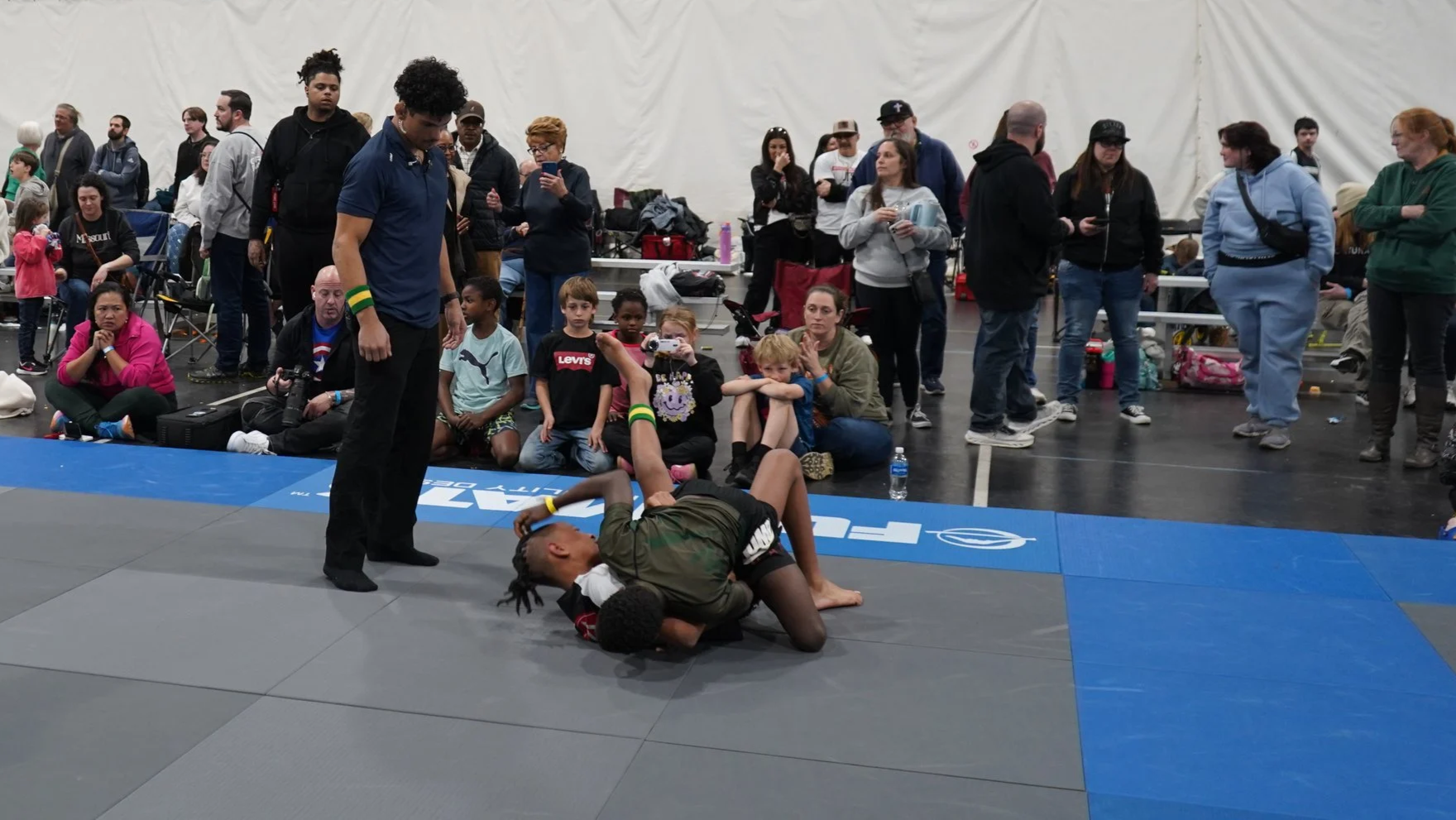
A jiu jitsu match at a local Fuji BJJ event.
The Risks for Grapplers Without Insurance
Many athletes either don’t have health insurance or have plans with high deductibles, which discourages them from seeking care for injuries. Without proper coverage, injuries can be ignored, leading to long-term damage or permanent setbacks.
Gym owners also face potential liability when members are uninsured or underinsured. Providing or encouraging accident insurance is one of the first steps toward responsible risk management in any martial arts gym.
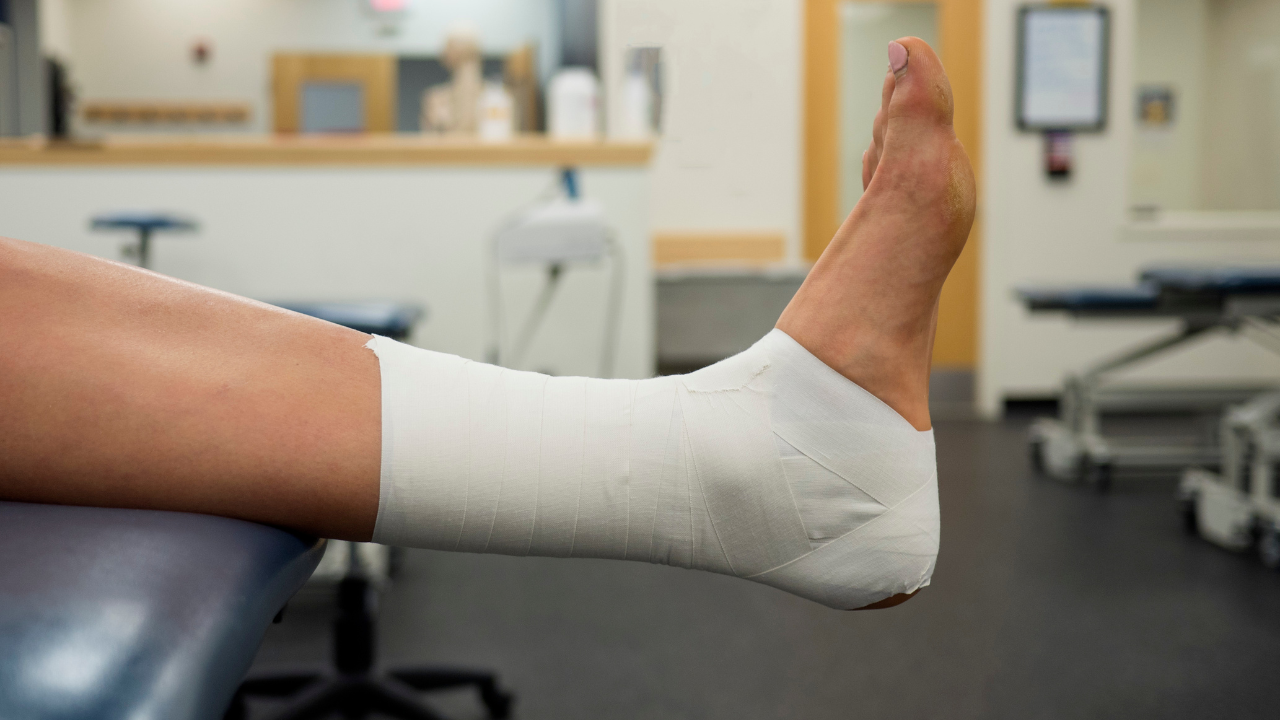
How Accident & Injury Insurance Works
Accident insurance covers medical expenses from unexpected injuries, both on and off the mat. These types of fixed-benefit, indemnity-style programs have actually been around for decades — companies like Aflac built their entire model on paying cash benefits directly to policyholders when covered accidents or illnesses occur. Unlike traditional major medical insurance that pays doctors and hospitals directly, indemnity plans typically pay set dollar amounts to you when specific events happen — such as an ER visit, ambulance ride, surgery, X-rays, or hospitalization.
The challenge is that many people in the martial arts community simply aren’t educated on how these programs work. Because the premiums are often affordable and the coverage can apply 24/7 — not just during training, but from any new covered accident on or off the mats — athletes sometimes assume it sounds “too good to be true.” In reality, these plans are not a replacement for comprehensive health insurance, but a supplement designed to offset deductibles, copays, lost income, and out-of-pocket costs. When understood properly, they can be a powerful financial safety net — especially for self-employed athletes, gym owners, independent contractors, or anyone carrying a high-deductible health plan.
Here’s how it works:
Affordable coverage under $30/month
Freedom to seek treatment anywhere
Direct payout to the athlete, often exceeding standard insurance reimbursements
Real-Life Examples:
One member received $250 for a physician visit with only a $10 copay.
Another member received $7,000 for surgery, despite already having a high-deductible health plan.
“It’s one of the best investments I’ve ever made,” says a satisfied policyholder.
Disclaimer: Coverage details, payouts, and limitations vary by program. Always review your policy certificate and benefit statements for exact details.

Risk Management Tips for Gym Owners
Gym owners play a crucial role in athlete safety and liability reduction. In high-contact sports like Brazilian Jiu-Jitsu, where injuries are an inherent risk, proactive risk management planning is essential. During the onboarding process, gym owners should clearly communicate the physical risks involved and the potential financial consequences of injuries, including high out-of-pocket costs, deductibles, or the absence of medical insurance coverage. Educating athletes about these realities fosters transparency and shared responsibility. Additionally, gyms can strengthen their risk management strategy by informing members about available options—such as injury insurance programs or supplemental coverage—that help mitigate financial exposure. Taking time to address these issues upfront not only protects athletes but also demonstrates professionalism and due diligence on the part of the gym.
Here’s what we recommend:
Educate athletes on injury risks and safety protocols
Encourage or provide accident insurance for all members
Understand waiver limitations—they don’t fully protect your gym from lawsuits
“Jiu-jitsu is dangerous. Injuries will happen. Insurance ensures athletes and gyms are financially protected.”
Fuji Sponsorship Program for Athletes
Beyond insurance, we sponsor athletes to participate in Fuji Jiu-jitsu tournaments. The program offers:
Exposure for rising athletes
Tournament experience in a safe, organized environment
Representation for the insurance program within the Jiu-jitsu community
Athletes like Jigen Nagata showcase how sponsorship programs support competitors and spread awareness about insurance benefits.
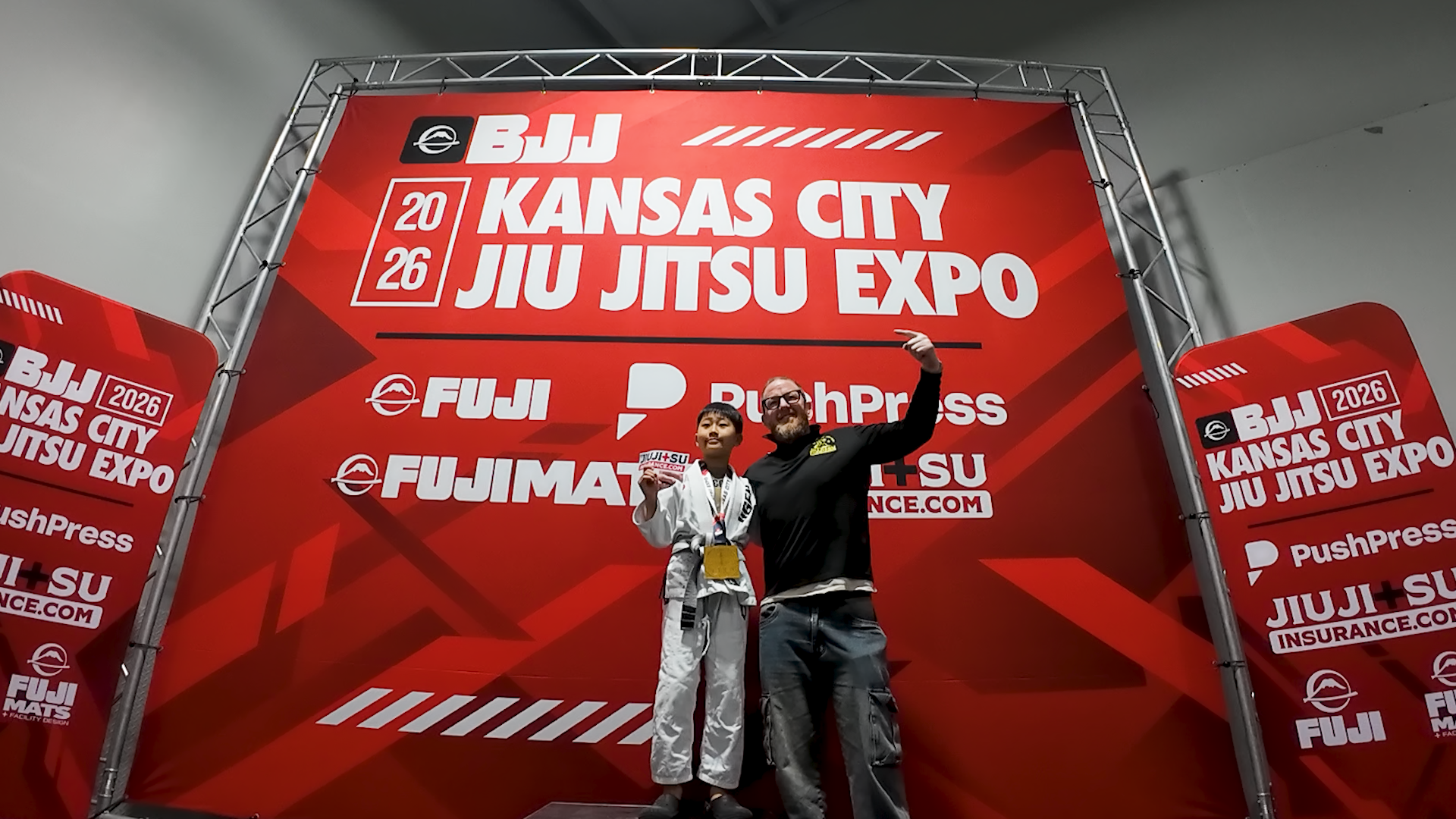
Chris Martin and Jigen Nagata at the Fuji BJJ expo January 2026.
Conclusion: Protect Your Health & Your Gym
Accidents are inevitable in martial arts, but financial stress doesn’t have to be. Whether someone trains in Brazilian Jiu-Jitsu, MMA, boxing, or any other combat sport, the reality is that injuries can happen — and not just on the mats. That’s why these programs protect grapplers 24 hours a day, not only during training, competitions, or open mats, but from any new covered accident on or off the mats. If a student slips at work, gets hurt in a car accident, or suffers an injury outside the academy, coverage can still apply. This makes it an especially strong solution for athletes who don’t currently have health insurance, are between jobs, are self-employed, or who carry high-deductible major medical plans and don’t want a single ER visit to turn into a financial setback. The goal is simple: let athletes focus on recovery and getting back to training — not worrying about how they’re going to pay the bill. Jiu-jitsu accident insurance is an affordable way to:
Protect athletes from unexpected medical bills
Mitigate liability for gym owners
Ensure injuries don’t derail training or finances
“We are promoting this program for the pure good of grapplers—so they can train with peace of mind.”
WATCH the Podcast Episode
For more insights on Jiu-jitsu insurance, risk management, and sponsorship programs, watch the full podcast episode where I explain how the program works and share real-life examples from athletes and gyms.
Podcast guesting at I Suck At Jiu-Jitsu Show with Josh McKinney

How Do Pro Grappling Athletes & Promoters buy Injury Insurance?
As professional grappling grows through promotions like UFC BJJ and the Professional Grappling Federation, more athletes and promoters are evaluating how injury insurance works beyond event day. While grappling may not be regulated like MMA, competing for prize money is often considered professional exposure by insurance carriers. Many athletes now carry supplemental accident coverage that does not exclude training or prize fighting — and often maintain it even after contracts expire. This article explains how that structure works, what it covers, and why 24/7 accident protection has become part of professional risk management in modern grappling.
A Practical Overview for Professional Competitors, Managers, and Event Organizers -

Professional grapplers who compete for cash money.
Professional grappling continues to mature as a business. Athletes are competing for prize money under promotions such as UFC BJJ, theProfessional Grappling Federation, and organizations connected to Scientific Wrestling. As the competitive level rises, so does the need for clearer conversations around injury exposure and insurance structure.
One of the most common questions from both athletes and promoters is simple:
Where do professional grapplers obtain injury insurance that applies to training, competition, and prize fighting?
This article outlines how that typically works from a risk management standpoint.
Regulation vs. Risk Classification -
In many states, submission-only grappling is not regulated by athletic commissions in the same way professional MMA is. That regulatory distinction has helped the sport expand.
Insurance underwriting, however, focuses less on regulation and more on compensation. When an athlete competes for prize money, insurers typically classify that exposure as professional participation. That classification affects how policies respond and whether exclusions apply.
In other words, even if grappling is not formally regulated, it can still be viewed as professional risk when compensation is involved.
What Promoters Usually Insure -
Promoters generally secure event-based coverage. This often includes general liability for the event and a form of blanket accidental medical coverage tied to that specific competition.
Those policies are structured to protect the event and the organization. They are not designed to provide long-term, year-round protection for individual athletes.
For professional grapplers, most injury exposure occurs in training camps, daily sparring, strength work, and other random accidents — not just on event day. That reality has led some promotions and management teams to require athletes to carry their own 24/7 accident coverage during the term of their contracts.
The Supplemental Plan Often Used in This Space -
The plan most commonly referenced within professional grappling circles is the Aflac Elite Accident Insurance Plan.
It is important to clarify that this policy was not created specifically for Brazilian Jiu-Jitsu or MMA athletes. It was designed for the general public to help offset out-of-pocket medical expenses following accidental injuries.
Its relevance to combat sports stems from policy language. A review of the form shows that it does not exclude injuries from training, organized competition, or prize fighting. That absence of exclusions is what makes it applicable to professional grapplers competing under organizations such as UFC BJJ and the PGF BJJ to name a few.
Why Many Athletes Keep the Coverage After Contracts Expire -
An interesting pattern has developed among professional athletes. Even when coverage is initially required by a promotion or management contract, many competitors choose to maintain the policy long after the contract ends.
The reason is practical.
Many professional grapplers and MMA fighters do not have employer-sponsored health insurance. Even those who do often face high deductibles and out-of-pocket costs. Supplemental accident plans of this type generally cost around $35 per month on average (based on state availability), which makes them financially accessible compared to the potential cost of an injury.
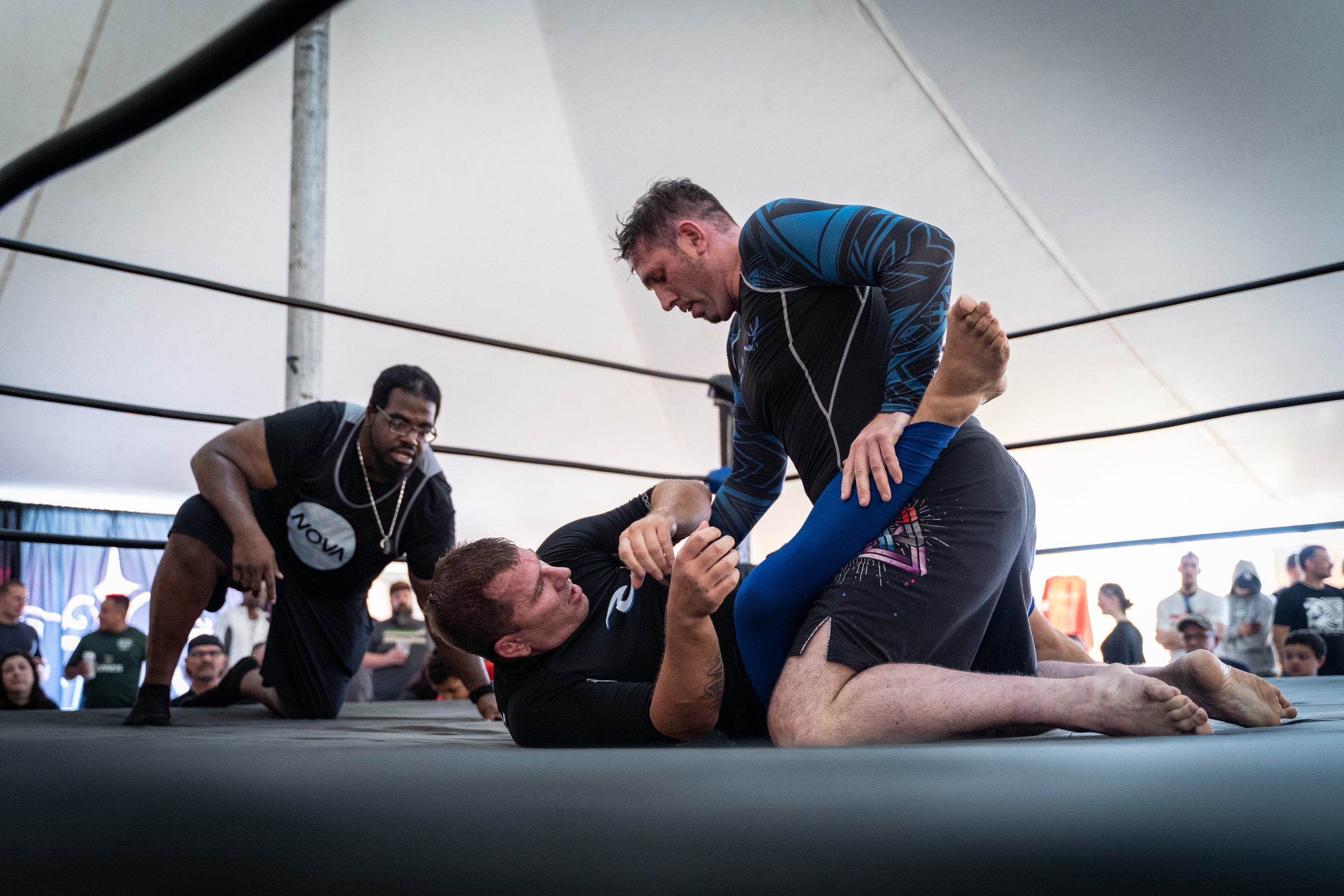
Grappling event with submission only rules. Both fighters had to have the personal injury insurance to participate.
Because benefits are paid directly to the insured athlete, the coverage can function as a financial buffer during recovery. For independent contractors — which most fighters are — that flexibility can matter more than traditional reimbursement-style insurance.
It is not uncommon for professional MMA athletes to purchase this type of supplemental accident insurance on their own, independent of any promotion requirement, simply to manage personal risk.
How Coverage Functions -
This type of policy is supplemental accident insurance. It is not major medical insurance and does not replace a primary health plan. Instead, it pays fixed cash benefits directly to the insured individual after a covered accidental injury.
Benefits may apply to emergency treatment, hospital confinement, surgical procedures, therapy sessions, imaging such as CT or MRI, ambulance transportation, and certain medical devices. There is also a sports-related enhancement that can increase certain payouts when injuries occur during organized athletic activity.
Because payment is made directly to the insured athlete rather than to a provider, the funds can be used for deductibles, copays, travel, rehabilitation expenses, or general financial obligations during downtime.
Documentation for Promoters and Managers -
When promotions or management teams require proof of coverage, enrollment verification and itemized reports can be coordinated through Chris Martin at JiuJitsuInsurance.com (who operates under NPN #7335986 and in California under #4116908) for the purpose of any contract compliance.
Important Disclosure -
JiuJitsuInsurance.com is not an insurance company. We are an independent insurance brokerage specializing in the combat sports market (who operates under NPN #7335986 and in California under #4116908). Coverage is provided by licensed insurance carriers and is subject to underwriting approval, state availability, benefit schedules, and policy terms.
Athletes and promoters should always review official summary descriptions, policy forms, and exclusions before enrolling. For detailed benefit summaries and exclusions, message us for a quote today.

5 Reasons Jiu Jitsu Athletes Need Personal Injury Insurance.
Every grappler should have an injury insurance program if they train Jiu Jitsu. Here are 5 reasons why.....
Brazilian Jiu Jitsu (BJJ) is an intense and exhilarating martial art that challenges both the body and mind. However, like any sport, it carries a high risk of injury. Whether you’re a seasoned grappler or a newbie on the mats, having injury insurance is a crucial aspect of getting you back on the mats after injury. Supplemental injury insurance (think like AFLAC) provides the injured grappler with the cash they need to get treatment for injuries so that they don’t have to put off medical care. Here are five compelling reasons why every Jiu Jitsu athlete should consider investing in injury insurance for about $25 per month:
1. Injuries Are Inevitable
Injury is an inherent part of BJJ. The sport involves a range of dynamic movements, joint locks, and throws that put considerable strain on the body. It's not a matter of if you’ll get injured, but when. According to studies, BJJ athletes experience injuries at a higher rate than participants in other sports. A personal injury insurance plan, often available for just $25 per month, is a no-brainer. This minimal investment can help cover medical expenses from injuries sustained on the mats. Given the frequency of injuries in BJJ, having this insurance is a proactive measure to ensure you’re financially protected when accidents happen.

2. Indemnity Plans Provide Direct Cash Benefits
One of the standout features of many injury insurance plans is that they are indemnity plans. Unlike traditional health insurance which often deals with direct billing and may involve complex reimbursement processes between insurance companies and medical clinics, indemnity insurance plans send you cash directly based on the schedule of benefits that the insurance plan lists as covered services and conditions. This means that even if you have other insurance coverage, these plans provide additional financial support. You receive the cash payout to cover medical bills, or you can use it as you see fit if there are no immediate medical bills. This flexibility ensures that you’re not left out of pocket or struggling with medical expenses during recovery.
3. Coverage Beyond Your Home State
Many BJJ athletes travel frequently, whether for competitions, seminars, or training camps. One common pitfall of standard health insurance is that it may not cover injuries sustained outside of your insurance network, or home state. Injury insurance plans often provide 24/7 coverage, regardless of your location. This means that whether you’re traveling across the country or in some cases internationally, you’re protected. Knowing that you have coverage no matter where you are gives you peace of mind and allows you to focus on your training and performance without worrying about potential medical costs.
4. Comprehensive Coverage for All Activities
Injury insurance plans for BJJ athletes don’t just cover injuries sustained during training or competition. Many of these policies are designed to cover a wide range of scenarios, both on and off the mats. Whether you’re injured while working at your day job, participating in recreational activities, or even during everyday activities, these injury insurance plans offer 24/7 protection. This comprehensive coverage ensures that you’re not left exposed to financial burdens from injuries from BJJ as well as for injuries unrelated to jiu jitsu. These programs provide a valuable safety net that extends beyond your time on the mats, offering reassurance in various aspects of your life.

5. Added Protection with Accidental Death Benefits
Most BJJ athletes focus primarily on the physical aspects of their training but often overlook the importance of life insurance. Many personal injury insurance plans include accidental death benefits, providing an added layer of protection. While the primary function of these plans is to cover medical expenses, the inclusion of accidental death coverage ensures that you and your loved ones are financially safeguarded in the event of a tragic accident. This extra benefit offers peace of mind, knowing that you’re not only covered for medical costs but also have some level of financial support for your family if the unexpected happens.
Conclusion
Injury insurance should be a consideration for every Jiu Jitsu athlete. The nature of the sport makes injuries a common occurrence, and having the right insurance can make a significant difference in managing those injuries effectively. With indemnity insurance plans offering direct cash benefits, coverage that extends beyond your home state, and protection for a variety of activities, injury insurance provides comprehensive support for everyone.
Investing in injury insurance is not just about protecting yourself financially; it’s about ensuring you can continue pursuing your passion for BJJ with confidence without worrying about medical bills if you get hurt. For a small monthly fee, you gain peace of mind and financial protection that can help you focus on what you love most—training and competing in Brazilian Jiu Jitsu.
Promotional banner showing two Brazilian Jiu-Jitsu athletes grappling, with text promoting a personal injury plan from JiuJitsuInsurance.com for $30 per month and a QR code to sign up.

Medical Bills in Jiu Jitsu: Liability & Insurance Explained
The article explores the responsibility for medical bills when a training partner is injured in jiu-jitsu from a question that came up on the Chewjitsu YouTube channel. It acknowledges that accidents and injuries are inevitable in the sport, emphasizing the need for risk management and safe training practices. The article suggests that grapplers should have specific injury policies and supplemental insurance programs to cover medical expenses and time off work. Having personal injury insurance for jiu-jitsu is highly recommended to ensure adequate coverage and protect against financial burdens resulting from injuries sustained during training.
Who's responsible for medical bills when we injure a training partner in jiujitsu?
That is an excellent question proposed on the Chewjitsu’s podcast YouTube channel:
“A lot of people have sent me messages recently (mostly white belts and a few blue belts) that said that recently had a situation where they were rolling and then their training partner got injured during that roll. And they feel terrible about it, they feel awful and responsible for it and they don’t know how to proceed. Because they’re like “Man I feel awful about the situation, what should I do? Am I responsible for this, should I pay for their medical bills? What should I be doing now that this person got injured because I’ve taken them off the mats for you know 2 weeks, 3 months, whatever it might be depending on the situation”
Am I responsible for medical bills?
Chewy does a good job of putting the perspective on the assumption of risk. He understands that for the most part, we’re all there to train and accidents or injuries are going to happen. He does a great job of summarizing the fact of the sport as a whole: “it’s not a matter of if, it’s a matter of when somebody’s going to get hurt in their training environment.”
Of course, we can work to control and mitigate risks. That is very important in any Jiu Jitsu school, controlling the environment to prevent injuries. Still, Chewy is absolutely right, people are going to get hurt in the gym.
From a business owner's standpoint, the gym owner needs to look at this from a risk management perspective. The fact is Jiu Jitsu is highly competitive and the chances of injury can be higher when compared to other sports. This is especially true when compared to sports with less contact or sudden movements. It is also equally important for each individual participant that gets on the mat to understand these realities of the sport. Accidents and injuries are going to happen, and they should look to train as safely as possible. Knowing how to pay for those medical bills when and if we get injured is also important.
How can insurance help when injuries happen in jiu jitsu?
Medical services such as physiotherapists and doctors can be pricey, not to mention the inability to work that may arise. Getting hurt and treating injuries costs money. My suggestion for every single grappler is to have specific injury policies to cover this.
These supplemental insurance programs apply on and off the mats, covering practitioners even when they are not training. They provide coverage when you are at home, or on the job to help offset the cost associated with medical bills and time off of work.
Even if you have other insurance this accident injury program works as a supplemental payer and will still apply. Therefore, we believe every grappler on the mat should have a Jiu Jitsu personal injury insurance policy. In fact, training without health insurance is a risk.
Is training BJJ without health insurance a bad idea?
We do not think you should stop training jiu jitsu just because you don’t have health insurance. Instead this article provides tips to treating injuries and covers ways for you to pay those bills without traditional health insurance.
Protect yourself on and off the mats. Get affordable personal injury coverage for Jiu-Jitsu athletes starting at only $30/month from JiuJitsuInsurance.com

training BJJ without health insurance. bad idea?
We do not think you should stop training jiu jitsu just because you don’t have health insurance. Instead this article provides tips to treating injuries and covers ways for you to pay those bills without traditional health insurance.
We don't think that you should stop training Jiu Jitsu solely because you don't have health insurance. While health insurance can provide financial protection in the event of an injury, it is not necessary to participate in the sport of jiu jitsu.
However, it is important for individuals to be aware of the risks associated with participating in any sport, including Jiu Jitsu, and to take steps to minimize their risk of injury. This may include wearing protective gear, learning proper techniques, adjusting training principles, and gradually building up their strength and endurance.
Grapplers who do not have health insurance should also take steps to manage the cost of treatment in the event of an injury. This may include seeking out low-cost options, negotiating payment plans with providers, considering alternative therapies, or picking up personal injury insurance for around $25 per month.
Ultimately, the decision to continue training Jiu Jitsu should be based on a careful consideration of the individual's health, fitness, and personal preferences, as well as their risk tolerance and financial resources.
What to expect to pay for care without health insurance?
The cost of treating an injury without health insurance can vary greatly depending on the severity of the injury, the type of treatment required, and the location where the treatment is sought. For example, the cost of an emergency room visit can range from $150 to $3,000 or more, while the cost of physical therapy sessions can range from $50 to $200 or more per session. The cost of surgery can be even higher, ranging from several thousand to tens of thousands of dollars.
It's also important to note that many medical providers offer payment plans or may be willing to negotiate fees for uninsured patients, so it's always a good idea to reach out and ask about options for lowering the cost of treatment.
Either way treatment for an injury should not be put off because of the fear of medical bills without health insurance. If paying medical bills will be a deterrent for you in getting treatment for a bjj injury then we might suggest you consider purchasing a personal injury insurance program for around $25 per month that will help you pay those bills.
Supplemental injury insurance as an alternative:
Supplemental injury insurance is a type of insurance that provides additional coverage specifically for injury-related expenses. It is designed to complement and supplement a primary health insurance policy, which may have limitations or exclusions for certain types of injuries or treatments, however these programs can be purchased without health insurance.
Supplemental injury insurance can provide benefits for a wide range of injuries, including those sustained during athletic activities, such as grappling. The policy may cover expenses such as medical bills, rehabilitation costs, lost wages, and other out-of-pocket expenses related to an injury. The coverage and benefits of a supplemental injury insurance policy can vary greatly as some policies cover more than others so just ask for a “policy detail” when you review the policy.
For grapplers who are concerned about the cost of treating an injury, a supplemental injury insurance policy can provide peace of mind and financial protection in the event of an injury which in the end will help them get back on the mats faster after injury.
Protect yourself on and off the mats. Get affordable personal injury coverage for Jiu-Jitsu athletes starting at only $30/month from JiuJitsuInsurance.com

The Origins of Personal Combat Sports Insurance
The evolution of insurance for combat sports and mixed martial arts have changed rapidly.
How did these policies originate? And what actually are the benefits of a combat sports insurance policy?
Thanks to the efforts of mixed martial arts athlete Jeremy Augusta, combat sport athletes now have the opportunity to protect their greatest asset—their physical well-being.
We are able to find insurance for almost anything these days. Our homes, our cars, and even our lives are all protected. Heidi Klum has an insurance policy on her legs. Bruce Springsteen insures his vocal cords. We can get health coverage on our pets. Up until recently though, combat sports athletes were on their own when it came to sports-related injuries. Fortunately, we now have the option of combat sports insurance.
How did these policies originate? And what actually are the benefits of a combat sports insurance policy?
Thanks to the efforts of mixed martial arts athlete Jeremy Augusta, combat sport athletes now have the opportunity to protect their greatest asset—their physical well-being.
Combat Sports Insurance: The Beginning
In 2010, Jeremy Augusta managed to negotiate with insurance companies and establish low-cost fighter insurance programs for combat athletes. For around $20 per month, a combat athlete was finally able to obtain an insurance policy to help with the costs resulting from those injuries that are always bound to happen. Even better, these policies offer year-round protection, whether the injury occurred on the mats, in the cage, or even at home.
In other words, whether the injury happened during a competition, or in the gym while practicing, or even on the job, the athlete will still be protected. Most fighters keep full-time jobs in addition to fighting, and many combat athletes are hands-on, skilled laborers. And, due to the high risk of their sport, insurance premiums have always been priced through the roof. Combat sports insurance policies give fighters the peace of mind they need. They can focus on their skills instead of thinking about an impending financial crisis.
This insurance for the fighters would, of course, make sure the fighter is covered for any medical expenses incurred if there is an injury in the ring on the day of the fight. But, just as importantly, this policy would also cover that fighter’s medical bills if they got hurt anytime during the month they are covered under the policy—at home, at work, anywhere.

Combat Sports Insurance in Action
Aside from the affordable price, what are the benefits an athlete will see from a combat sports insurance policy?
The beauty of these plans is that they pay cash directly to the athlete, allowing them to better manage their own treatment plan. The athlete can pay their doctor, cover the cost of a prescription, or even use the money to offset the burden of loss of income due to the extra time taken off work.
The unique feature of a combat sports insurance plan is that the plan is truly designed to help the fighter, not just satisfy the minimum insurance requirements required by state commissions and event promoters. Instead, these supplemental policies provide fighters the additional protection of much-needed cash when they file an injury claim. Once that check arrives in the mail, a fighter can instantly reap the benefits—and these benefits are above and beyond any payments from other insurance companies.
Finding affordable insurance is a challenge. These personal injury plans are designed to help any combat athlete. And, with no exclusion for prize fighting, a combat sports insurance plan is especially important for a mixed martial artist who may have struggled to find a good personal injury policy elsewhere.

Follow us on social media, share, tag, and earn free Jiu Jitsu insurance swag.
Combat Sports Insurance: The Implementation
The first time that an independent MMA promoter provided his roster with an individual combat sports insurance plan was back in July of 2011. Tim McTee of Imperial Fighting “changed the game” when announced that he would be providing both his professional and amateur fighters with combat sports insurance. He saw the value in protecting his fighters—offering them much-needed peace of mind—and knew that this investment would allow his athletes to take their combat careers, and his organization, to the next level.
McTee stated, “To us, the reward totally outweighs the risk, and helps to build longevity for the fighter. Not only for their fight career, but also as a fighter for our company. If we can offer the fighters more, take better care of them, and give them the best platform to showcase their skills…… we all win. As far as the policy goes, it’s an accidental policy. If they get hurt while training they will be covered. If they trip coming out of the gym and break their ankle, they are covered. Stitches, ruptured orbitals, it’s all covered"
Combat athletes put their heart and soul into their careers. They put their bodies on the line and risk their livelihood every day. A combat sports insurance policy will provide them with added security they are looking for.
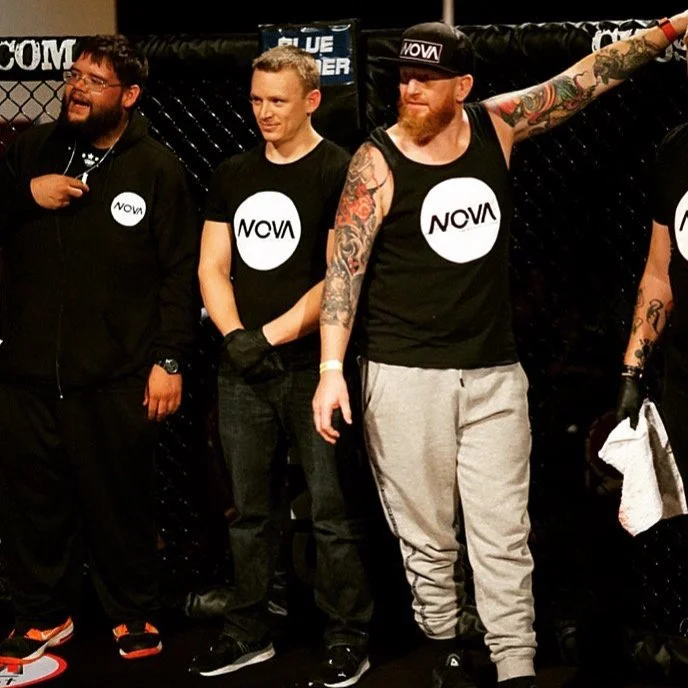
Chris Martin (with hat) is one of our combat sports insurance agents with over 20 years of insurance experience & 15 plus years of mixed martial arts.
Combat Sports Insurance Today
Although Jeremy Augusta sold his combat sports insurance business several years ago, these personal insurance programs are still available and can be found through a company dedicated to helping combat sport athletes, JiuJitsuInsurance.com. Mixed martial artists, as well as jiu-jitsu and other combat sport athletes, can find affordable insurance programs that cover them 24 hours a day, on or off the BJJ mats, in or out of the MMA octagon, and on or off the job. These combat sports plans pay cash directly to the athlete to help them manage their injuries and pay for the medical care they need.
JiuJitsuInsurance.com was founded by Chris Martin, who has spent nearly two decades on the mats practicing martial arts. He began with a passion for traditional boxing and later branched out to include muay thai, bjj, and mixed martial arts in his practice. He and all of his associates still practice combat sports. As a result, they are uniquely qualified to understand the needs of combat athletes and help them find the best insurance plan for their individual situations.
The skilled brokers at JiuJitsuInsurance.com are in your corner for all your combat sports insurance needs. Reach out today so we can get started on finding the best plan for you.
Protect yourself on and off the mats. Get affordable personal injury coverage for Jiu-Jitsu athletes starting at only $30/month from JiuJitsuInsurance.com
A Guide to Extending Your Fighting Career with Insurance.
If you are a jiu jitsu fighter, injuries are inevitable. That means that paying for medical bills is an unavoidable part of training and fighting. Unfortunately, there is no way to know how much those medical bills will cost until after you have already been injured and treated.
Large medical bills can bankrupt you, and leaving injuries untreated will end your competition career. If competing is an essential part of your life, then carrying jiu jitsu insurance coverage should be a top priority. When you are insured you have a better chance of extending your days fighting.
Types of Jiu Jitsu Insurance
There are three types of low cost insurance programs every Brazilian jiu jitsu athlete needs to know about:
Accident & Injury Plans
This type of plan sends you a check every time you have to see a doctor for an accident or injury. You can use this check to pay your medical bills, or use it for other expenses and it does not matter if you have any other coverage or not. These plans usually also include a life insurance policy. Accident and injury insurance is inexpensive, with an average cost of only $8-$25 per month.
Hospitalization Plans
The hospitalization plan pays you a lump sum payment for each day you are in the hospital. You can use this money however you wish. This plan will pay you a lump sum benefit even if you have other health insurance coverage. Hospitalization plans cost between $10 and $30 a month.

Income Insurance Plans
These plans send you monthly payments when you are out of work because of health problems. Short term disability insurance pays out quickly so that you can take care of yourself and pay your bills. Long term disability kicks in if you become permanently disabled. You will need to talk to an insurance agent to determine the price of these plans because they are usually based on your age and income.
Which Type Of Jiu Jitsu Insurance Should I Buy?
If you are older or have pre-existing medical conditions, you should purchase an accident and injury insurance plan. This plan does not require any medical underwriting or medical questions at the time of application. This means anyone will get accepted for one of these insurance plans, no matter if they have other underlying health issues or not.
If you have don’t have traditional health insurance coverage, you should definitely invest in a hospitalization plan. Even if you have health insurance, you usually are responsible for large deductibles and uncovered expenses if you are hospitalized. This type of insurance makes sense for everyone.
If you are young and healthy, you can lock in a very low rate for disability insurance. The disability plans offered through employers are often light on benefits, so it is better to buy your own income protection plan with the assistance of an insurance broker. This will guarantee that you’re getting a good plan that will help replace your lost income when you need it.
In an ideal world, every jiu jitsu fighter would have all three types of supplemental insurance as well as a traditional health insurance plan. Jiu jitsu is a high risk sport, whether you are a weekend warrior or competitive athlete. Injuries will happen, so you need to be fully prepared to face the costs of treatment and recovery if you want to get back on the mats quickly after getting hurt.
What Is The Difference Between Traditional Health Insurance and Jiu Jitsu Insurance?
Traditional health insurance plans do not pay all of your medical bills, and they do not provide you money to cover your normal bills during recovery. When you use traditional major medical plans, you can only see approved doctors and receive approved treatments. Traditional health plans also only pay money direct to the doctors, and usually leave you to still owe money.
While we always recommend that fighters have traditional health insurance, it is only a partial solution to major financial loss. Supplemental jiu jitsu insurance plans fill in the gaps so that you are not left in medical debt. These plans pay out directly to you, and they pay out quickly. Jiu jitsu insurance gives you cash in hand to deal with the day to day expenses of being injured.
Position Yourself For Recovery
Jiu Jitsu teaches you to control the frame and always position yourself for recovery. Even if you win every fight, an injury outside of the ring could take you down, ruining your finances and your fighting career. If you want to live the jiu jitsu lifestyle, you must carry the lessons you learn on the mat into the rest of your life.
In order to position yourself for recovery from injuries, you need to talk to a licensed insurance professional who also has a deep knowledge of the sport. We’re here to help, and we’re always just a phone call away.
Real-Life Examples Of Jiu Jitsu Injuries
Accidents are inevitable. You can suffer an injury even if you are not on the mat. One real-life example of this is Dean Lister. Dean was walking back home after getting food one day after work. On the way back to his home, he was struck by a vehicle.

This tragic event left Dean out of work for several months because he could not travel and teach seminars. Because he was out of work for an extended period, the medical and personal debt began to pile up rapidly.
Supplemental insurance plans pay out directly to you, and these plans pay out quickly. It does not matter if you are injured on or off the mat. These policies allow you to keep paying your bills and covering your expenses, even when you are out of work.
It is an unfortunate reality, but many combat sports athletes cannot afford medical treatment in the likely event of an injury. Miriam Nakamoto is a world champion kickboxer. She is one of the millions of people who cannot afford healthcare. A knee injury has kept this woman financially struggling and out of competition since 2013.
In an interview with Joe Rogan, she discusses the realities of life since then. Several months later Miriam Nakamoto received a blessing when she learned that Joe Rogan was willing to pay for the entire medical procedure for her knee. However, most of us will not be so lucky. Without jiu jitsu insurance, most fighters will not receive the medical care they need.
Gabriel Duniz was a gifted fighter. At the young age of 15, this boy was skilled enough to be granted a pass to compete at the adult level. During one of his fights, he became the victim of one of the most lethal injuries in sports. He suffered a spinal injury.
As a result of the injury, he severely damaged his third and fourth vertebrates. After undergoing two surgeries to realign the spine and remove bone fragments, doctors are still unsure if Gabriel will regain movement in the limbs.
What would happen to you if you were permanently disabled in a fight or during training? Qualifying for disability payments in the US takes years. Income protection insurance for short term disability is designed to pay out quickly. If your short term disability becomes permanent, long term disability insurance will send you payments for the rest of your life. Get protected today!
Frequently Asked Questions About Brazilian Jiu Jitsu Insurance
Is Jiu Jitsu Insurance Expensive?
This depends on the type of insurance you purchase. You can spend as little as $8 a month. Many fighters choose to budget $50 to $100 a month for supplemental insurance. This guarantees that they will receive fast payments every time they face a medical setback. Scott Sievewright is a Milwaukee, WI based BJJ athlete who purchased two of these plans for under $50 per month and when he tore his ACL not only did these plans pay 100% of all his medical bills but they paid him an extra $1000 bucks on top of everything. You can read all about Scott and his insurance polices in this blog post, click here >>.
What Is The Best Jiu Jitsu Insurance Plan For Me?
That is determined by your budget and your needs. It is always better to carry some form of jiu jitsu insurance when fighting. Contact us for a free consultation, and we will help you to determine the best plans for your specific needs.
Do These Plans Pay Out To Me or To My Doctors?
These plans pay you directly. A check will be mailed to your home. Supplemental insurance pays out quickly, so you get the money when you need it most. You may decide to use the money to pay medical bills, cover rent, or buy groceries. The money is yours to spend however you want.
Can I Become Permanently Disabled While Participating In This Sport?
Jiu Jitsu is a high risk sport. Every fighter will be injured at some point during their fighting career. While most fighters recover from injuries, some fighters do not fully recover and become permanently disabled. If you are serious about fighting, you also need to be serious about financial planning for these risks.
How Do I Buy Jiu Jitsu Insurance?
You need to speak to a licensed insurance agent who is also familiar with the sport. An agent can help you to identify your financial needs, determine how much coverage you need, and help you pick the best insurance policies. Give us a call today, we will give you a free consultation!
Protect yourself on and off the mats. Get affordable personal injury coverage for Jiu-Jitsu athletes starting at only $30/month from JiuJitsuInsurance.com
Torn ACL to BJJ Medalist in 12 Months – Scott Sievewright
I am here with Scott Sievewright, on February 28th, two days after the grappling event at Fuji Brazilian jiu jitsu tournament that he attended and competed in.
Scott is the owner of Primal MMA gym in Milwaukee, WI. He is also a policy holder of Jiujitsuinsurance.com. He has an interesting story because he had an injury not too long ago that required urgent medical treatment.
He has multiple insurance policies with us and because of our insurance programs that we him enrolled into, he was able to get treatment right away for his injury, and get back on the mats in time for the Fuji BJJ tournament. Scott had a successful tournament, and in fact, got second place in both of his adult divisions!
Here is an interview with Scott detailing his recovery process after his torn ACL (without surgery) and how his jiu jitsu insurance coverage paid all of his medical bills 100% as well as paid him extra cash to use during his recovery from this injury.

So Scott, how was the Fuji Brazilian jiu jitsu tournament in Milwaukee? How was your experience?
Actually, it is the first time I've done Fuji and I was very impressed with how well organized and smoothly it ran. They have their own software, which updated all the competitors where they were supposed to be, and when they were to be expected. I came away with nothing but a good perspective.
The Fuji BJJ competition in Milwaukee was well run. I was also there at jujitsuinsurance.com vendor table, so I can also attest to that. It went very smoothly and it looks like you took two silver medals, congratulations on that.
However, you're coming off a pretty serious injury. Today is February 28th, 2022, when was that injury and what was it?
Okay, so I wasn't thrilled with the two silver medals, but I was thrilled to be back on the mats. It’s been exactly one year since I hurt my knee during a training session. After an MRI, I found out I tore my ACL, two menisci, and had some other damage in the ligaments.
How, how did that injury happen? During grappling practice?
Through grappling practice. Yep. I zigged when the other guy zagged and felt the big dreaded pop.
And this was from a take down?
This was from a take down, yes.
So you just felt your knee pop?
I felt my knee pop immediately and the swelling began pretty shortly after.
How long did it take you until you got medical care?
Well, first of all, because my regular medical insurance wasn't particularly good, it was a short term insurance policy that I had with a high deductible, so I went the usual route of asking friends and people who had a little bit of experience before I finally got myself to a PT.
I got to a PT within a few days after the injury. Of course they couldn’t really tell you what's going on there, but over time as I didn't heal as quickly as I thought, the pain didn't go away as early as I thought, and the functionality didn't come back, so I finally decided to go and see an orthopedic surgeon and get an MRI.
And how many days after the accident was that MRI done? Do you remember?
I did a little “wait and see”, I did a lot of reading and educating myself, but I think it was almost one month after the initial pop.
Okay, after the visits to the doctors, the rehabilitation and also the MRI, what was the final diagnosis?
So again, the diagnosis was a partial tear of the ACL, which meant surgery was an option for me or rehab. It's kind of a coin toss, a wait and see kind of thing, which I decided to do.
I thought I'd give the rehab a good go first. So as far as medical attention was concerned, I went to a PT regularly, I saw my doctor once and I got the MRI just to confirm.
And when was this accident again?
The accident was in February, 2021.
So this has been basically one year?
Exactly one year.
And how long did it take before you started, after your accident going through PT? How long did it take before you started feeling a bit more confident on the mats?
Well, I decided to take it slowly. I turned 45 this year, so I'm no spring chicken. But I guess three months. I was pretty much incapacitated for that time. I do work as a coach in the martial arts business, so that was tough. And then I had some rehab on the side and I gradually, gradually started to get a little bit more….…
A bit more mobility or confidence?
A little bit more mobility and confidence. I think the mobility came back before the confidence. I would say from month zero to three no action. Three to six, I just found myself in very comfortable positions with people I trusted. Six to nine months, I started to get a little bit more into it, getting some of my confidence, and movement back. The last couple of months have for the most part, been back to relatively a hundred percent.
And so you're a brown belt and you were competing in the adult expert No-gi division, correct?
Yes.
What weight class?
170 pounds. And yeah, I went to the adult division. I lied about my age.
And so one year later we have you back now. the most, the most interesting detail is you had two, not one, but two jujitsu insurance policies with us.
Two accident - injury policies on top of the low cost major medical insurance. And the reason we doubled up on the accident injury policy was because we saw that there was a gap in your short term medical plan with almost a $10,000 out of pocket before the insurance company would pay anything.
So for just a couple extra dollars, we were able to put you in accident, injury policies, and both of those policies paid you directly cash benefits after you filed a claim for those injuries.
Do you remember what your total medical bills were from the doctor visits and the MRI? About roughly what was the total cost of your medical bills? And then what was the amount of money you got back from the insurance company to reimburse you for those medical bills?
Sure. Just a little bit about the insurance. I come from the UK, where we have all our medical needs taken care of, so I'm not too familiar with the American insurance system. But when I opened the gym and became self-employed, I had to buy for the first time my own insurance policy, which was a short term insurance policy. I had a very high deductible out of pocket, which was of course a concern, but I knew it would cover anything catastrophic which is why I picked that one.
This was when my friend introduced me to the jiu jitsu insurance policies and spoke to me about how these programs work as supplements to my medical plan. And I thought that might be a good way to protect myself from any kind of garden variety of small injury bills that I might incur, which wouldn't have been covered under my short term policy. I'm always hoping never to be injured but it is part of my job to be on the mats and be mobile so I figured I needed to have this coverage.
From the initial injury, from my PT, I was paying out of pocket 100%. I think I had about six visits to the PT, which I paid about $100 bucks each. Or maybe $80 bucks each. So that came in around $500 cash out of pocket for my PT. I then went to the doctors for an MRI. Between the billing coming through and going to the doctor and MRI, that came through, gonna say around $1000 dollars, just under $1000.
So, all in all, $1,500?
Yeah, just short of $1,500 for everything.
So after you git those bills you and I filed the claims together for the two accident - injury insurance plans, and both of those insurance companies paid you back directly. Do you remember the total amount you received back?
Yeah, the checks came in a kind of series. I filled out the information packets and sent them off and I didn't know what to expect.
I only had to give a very, very brief explanation of what the injury was and of course provide some documentation of the card expenses. Then the checks started to come in and they came in over a period of about 8 to 12 weeks.
I don't recall any particular order. I had three checks for almost $250. I had one check for $930 bucks and I had another one for $700 and some change. There were also a couple of $50 checks too. So I think all in all, I came away with about $2,600 in just cash checks sent straight to me.
$1,500 in medical bills, but $2,600 in checks. So you came out a couple dollars ahead. The cost for those accident injury plans was just, one of them was about $50 bucks per month for both plans.
Would you say it was well worth your investment? And if so, did having those insurance companies give you more confidence that you'd be able to go and get care quicker because you knew you would be covered?
Well, initially I was concerned about any pushback it might have got because of the injury and because I got the injury in training, but I didn't receive any pushback whatsoever. And so I was pleasantly surprised when the check started coming through. And yeah, I mean, it's not life changing money, but 1500 bucks out my own pocket and the uncertainty of extra care, this jujitsu insurance really, really helped with my reimbursement.
I'd rather I've not been injured, but I actually came out a little bit on top financially and plan never to go into training or on the mats again without the insurance to be quite honest. $50 - $60 bucks a month, just to have that peace of mind, I think is a no-brainer for all combat facilities, regardless of your insurance.
Congratulations Scott on your road to recovery, and getting back on the mats. This is the great success story of how having the right insurance coverage gives grapplers in our community the resources and cash they need to get the care required to get themselves back on the mats quicker.
I think I'd like to add Chris, I don't think it matters what your main insurance policy is. These plans are add-ons. It's a supplemental medical plan, not really an alternative. So for me to know, I can cover some of my early bills in the unfortunate event I do get in an accident, at least I have some money coming back to me. I think it's money well spent. It's certainly something as a gym owner I encourage all my students to get.
I'm pretty passionate about sharing the word and getting this information out there to the grappling community. No one is more skeptical than me about insurance plans and the insurance companies themselves, not to mention knowing how poorly the American healthcare system is run. But as I said, I am very much an advocate for Jujitsuinsurance and going forward, I expect this just to be a monthly payment .
I'm happy that it all worked out for you. Thanks and congratulations.
Protect yourself on and off the mats. Get affordable personal injury coverage for Jiu-Jitsu athletes starting at only $30/month from JiuJitsuInsurance.com

5 Reasons To Get A Personal Injury Insurance Policy If You Train BJJ.
For those of us spending our lives on the mats, many will get injured doing what we love. Most of the time that injury requires medical treatment of some sort.
I have been training Jiu Jitsu since 2008 and have been injured several times. Although I was always covered by a major medical health insurance policy, it didn’t seem to matter— my medical bills just kept piling up. Let’s be honest— Jiu Jitsu is a rough sport, and if you practice consistently you are going to hurt. Or should I say, “if you practice consistently you are always going to be injured?” Brazilian Jiu Jitsu, Gentle Art my ass!
HAHAA.
By no means am discouraging anyone from taking up Jiu Jitsu for fear of injury! However, what I am saying is this: If you practice Jiu Jitsu, you need to take care of your body. The unfortunate reality is that a lot of BJJ practitioners neglect their injuries for fear of drowning in unanticipated medical debt. This problem could be easily addressed with education and knowledge on getting proper medical treatment in addition to having the right insurance protection that will pay for that medical treatment.
In an effort to shed some light on the subject, you will find below a list of reasons to considering enrolling in one of these supplemental injury plans even (we call it Jiu Jitsu Insurance) if you have an existing health insurance policy.
BJJ tip from “The Crippler".
Why Get A Personal Jiu Jitsu Insurance Policy?
You might say, “I have a major medical health insurance already, so why would I need to buy an additional insurance plan for my injuries?” Here are some of the reasons someone who already has a health insurance plan might consider adding an accident - injury insurance policy to their protection:
Reason #1: You may be on the hook for thousands of dollars with your major medical plan.
If you look at the way most major medical policies are designed, it’s easy to see in the “summary of benefits” that the consumer is on the hook for most upfront medical expenses as a result from any injury. For example, if you look at your own summary of benefits for your health insurance plan, you will see items listed in rows such as emergency room visits, hospital stays, urgent care visits, and medical imaging. Next to each row is a corresponding column labeled either “deductible” or “co-insurance.”
Deductible and coinsurance percentages show the patient’s responsibility to pay before the health insurance company pays for any expenses. The average deductible in the United States is about $2,500 per person and the average out-of-pocket average is around $5000. For this example, let’s say your plan is like the average I just mentioned. That means if you sustain an injury and seek medical treatment, you have to pay the first $2,500 for your services before the insurance company pays anything.
However, unlike traditional health insurance, Jiu Jitsu insurance plans (aka injury plans) will pay you directly when you seek treatment for an injury or accident. That way you're not stuck paying the entire bill from the treatment provider. Whether or not you have health insurance coverage, these plans will pay you and you can do whatever you want with the tax-free check.
Reason #2: Jiu Jitsu coverage polices allow you to see anyone.
When you’re injured, there’s no time to waste searching for a reliable doctor who is considered “in-network.”
Most traditional health insurance policies will have restricted networks that you must go to for medical care, otherwise your medical services may not covered. On the contrary, a jiu jitsu insurance plan will give you the flexibility to see any licensed Doctor, anytime you need medical care.
Jiu Jitsu Insurance plans don’t work like traditional health insurance plans in the sense that you don’t need to show an ID card at the time or service. Instead, you will submit a claim after service and the insurance company will send a check made payable to you, which you can use to pay your medical bills or pocket the tax-free check if you have another insurance plan pays for you bills.
These insurance plans will make out a tax-free check payable to you so that you never need to worry about network restrictions and the possible penalties for going to an out-of-network provider. This will save you time and money.
Reason #3: Your current health insurance policy may not cover the unique, injury-specific treatment you need.
There is a high probability of sustaining an injury while practicing jiu jitsu. Higher than any other recreation sport or martial art due to the amount of time spent practicing as well as competing.
A recently conducted medical study addresses the prevalence of injuries during BJJ training. The study reads that prevalence of injuries in training is significant because athletes spend more time in training than in competition.The study also proves that the average BJJ athlete participates in BJJ training approximately four days per week but only competes twice per year.
Some say, “It’s rare to earn a blue belt without a couple of injuries along that way,” and I totally agree with that statement, which is why I believe a jiu jitsu insurance plan is invaluable to any BJJ practitioner.

Credit for photo by Joshua Dover. Joshua Dover pictured here at Scramble BJJ & Wrestling in Rome, GA after training.
Many Jiu Jitsu athletes look beyond traditional medical treatments for healing their injuries. Some of these alternative therapies include acupuncture, cryotherapy, red/blue light therapy, ice baths, and massage. Most of the time these treatments are not covered by health insurance. As BJJ practitioners, we are all aware of these treatments that will get us back on the mat faster, but without coverage the cost can really add up. However, since with a fixed expense injury plan you will be sent a check directly, you can use that money to pay for the cost of these services not covered by traditional health insurance.
As a matter of fact, see reason #4 below as to why you might even consider purchasing two or three of these programs from different insurance providers!
Reason #4: When you double-down on an injury plan you get double the benefits.
With traditional health insurance you might think, “Why not just get two medical insurance plans, so that they can each work to cover what the other will not?” While it’s a nice thought, that’s unfortunately, that’s not the way it works out.
Most major medical policies coordinate with each other to determine who should be the “primary payer” and who will be the “secondary payer.” Simply put— they are going to fight over who is going to pay the bills and only one of them is going to cover your costs.
On the other hand, with the accident-injury policies, it is not uncommon for people to purchase multiple supplemental plans if they are active and can foresee that injuries are going to happen.
Jiu Jitsu insurance plans are going to pay you directly no matter what kind of insurance you currently have. It’s common for active BJJ athletes to purchase multiple of these insurance plans because they know that the policy is going to pay them out directly. A jiu jitsu practitioner is much more likely to file a claim than the average insurance customer enrolled into these programs. But don’t worry! The insurance companies don’t discriminate against BJJ practitioners! You will pay the exact same monthly fee to be enrolled in these programs as the other people enrolled in these plans.
Some jiu jitsu coaches purchase multiple policies and use the funds they receive from the insurance companies to pay other coaches to run their classes while they recover. That’s a great example of how having multiple injury polices that pay you directly when injured could be use as a hybrid “short-term disability” policy. Although these programs are not meant to be considered short term disability, the proceeds that you receive from the insurance could be used to make up any unanticipated lost wages while treating your injury.
At the end of the day, nobody wants to get injured or hurt, but if you practice jiu jitsu, it’s nearly inevitable. Treatment of injuries costs not only money, but time as well. Having multiple accident-injury policies may save you tremendously on both during your recovery period.
Reason #5: Jiu Jitsu plans provide extra financial protection that heath insurance won't provide.
Traditional health insurance plan don’t provide benefits payable to your beneficiaries, as if you were to pass away— that is what life insurance is for. However, Jiu Jitsu insurance plans can act as a hybrid-type of insurance policy that not only pays the insured medical payments for injury and accidents, but also provides an extra layer of coverage with accidental life insurance benefits.
For example, some accident-injury insurance policies offered at jiujitsuinsurance.com have a built in accidental life insurance policy that will pay your beneficiary of choice a lump-sum benefit, in the event you were to pass away suddenly due to accident or injury. The lump-sum of cash, tax-free benefits, is typically in the range of $5,000 to $150,000, maybe even more depending on the insurance policy in which you enroll.
To have a policy like this adds an extra layer of protection for your family at the cost of just a few extra dollars per month. As healthy as many Jiu Jitsu athletes are, accidental deaths do happen and are actually the third leading cause of death in the United States. Life insurance may be used for surviving beneficiaries to replace income at death, pay for funeral expenses, and other debts.
At it’s core, jiu jitsu insurance plans are meant to pay for medical bills, however the added life protection for around $25 per month is definitely worth the peace of mind. At the end of the day it is important to have a health insurance plan to cover any catastrophic accident or injury however it is rare to find a health insurance plan that covers the upfront costs for treating and healing an injury. So, what’s the solution?
Click here >> to learn more about affordable personal injury insurance programs that helps the bjj community manage their medical costs as well as their financial and physical well-being. Learn more click here>>.
Already injured and just finding us now? No worries, check out the article we wrote about ways to progress in bjj when you’re injured. Check it out >>
Study mentioned in this article: click here to read study.>>