

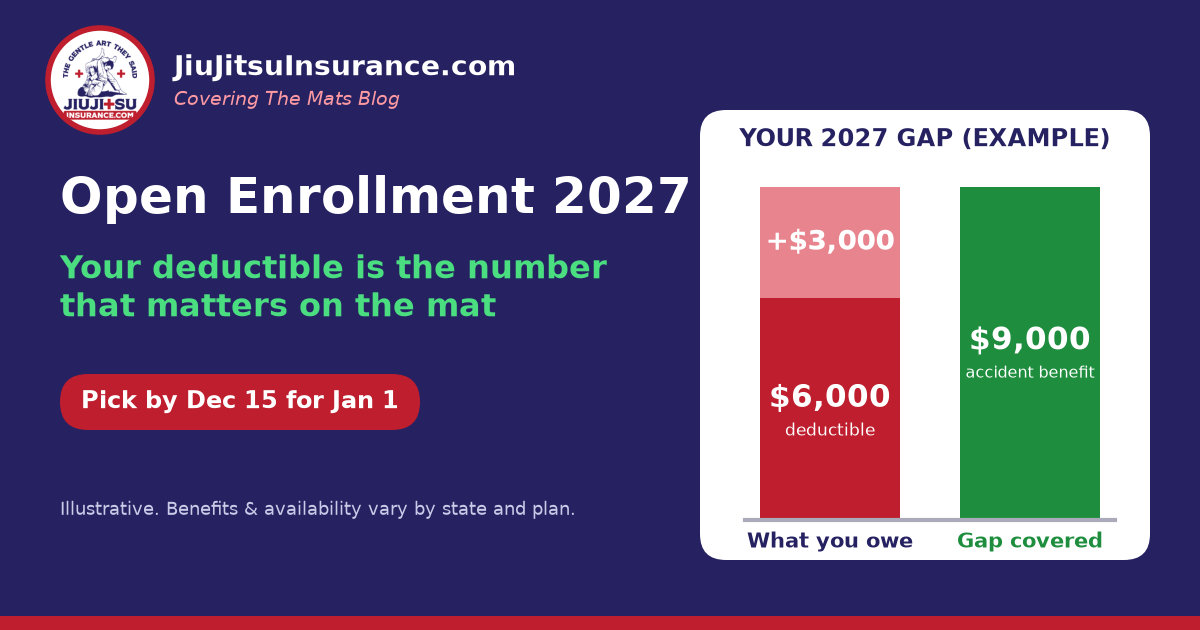
Open Enrollment 2027: Your Deductible Is the Number That Matters on the Mat
Most people pick a health plan by the premium, but on the mat your deductible decides what an injury costs you. Here are the 2027 open enrollment dates, how to find your total exposure, and how to match an accident benefit to your deductible gap.
By Chris Martin, Founder, JiuJitsuInsurance.com | Covering The Mats Blog
One bad roll, one big bill
I've trained jiu-jitsu since 2008, and I've always carried major medical insurance. Even so, I've still paid somewhere between $2,000 and $6,000 a year out of my own pocket for medical bills. Having health insurance and being protected from a big injury bill are two different things.
Open enrollment is the one time each year most of us pick a health plan, and most people pick by the monthly premium. On the mats, the number that actually decides how much an injury costs you is your deductible, and your out-of-pocket maximum right behind it.
Give me five minutes and you'll know your 2027 exposure and how to cover it.
Open enrollment 2027: the dates that matter
- Nov 1, 2026: Open enrollment opens on HealthCare.gov.
- Dec 15, 2026: Deadline to pick a plan that starts Jan 1, 2027.
- Jan 15, 2027: Open enrollment ends. Plans picked Dec 16 through Jan 15 start Feb 1.
- State-run exchanges may have different dates, so check yours.
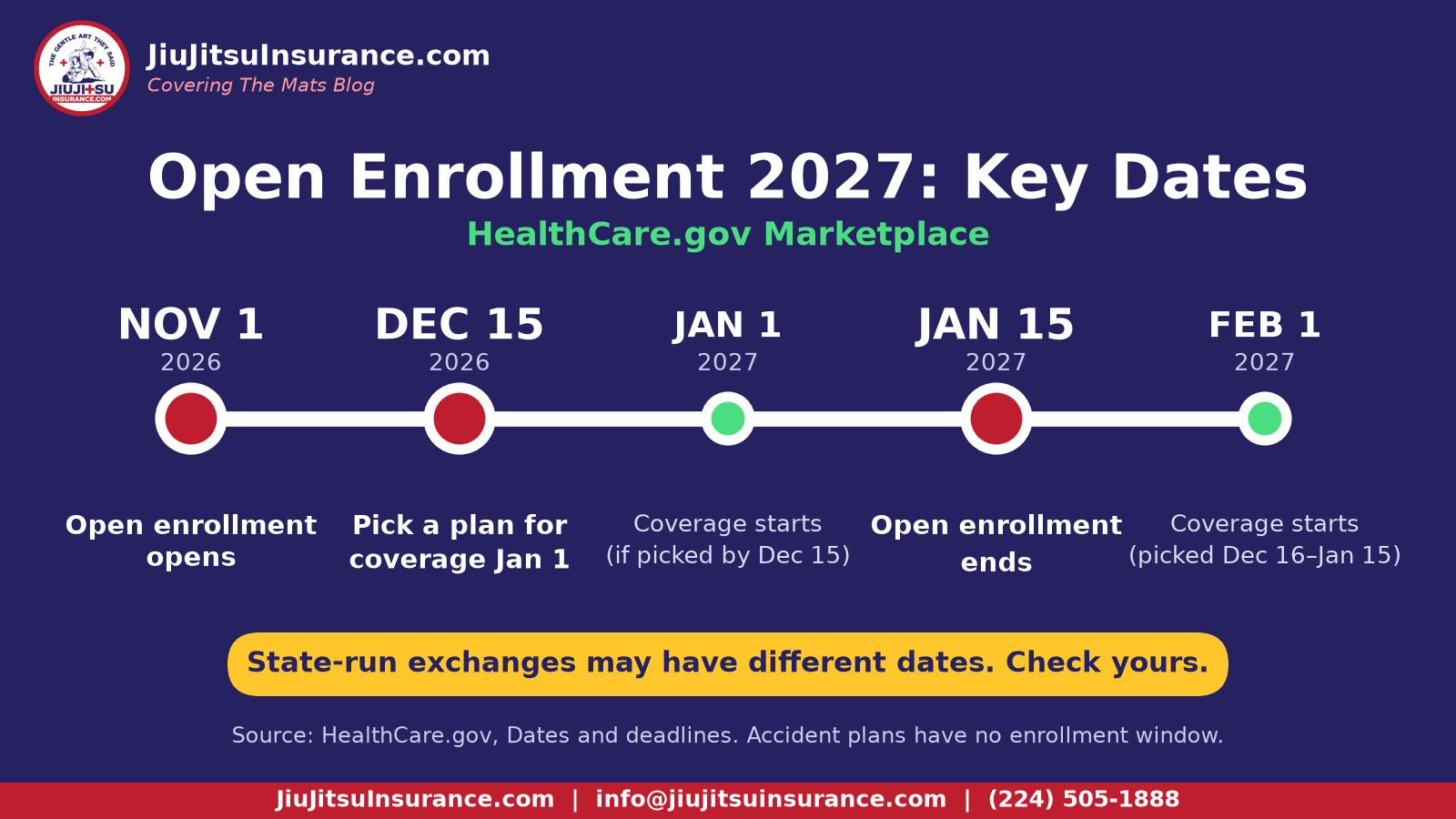
HealthCare.gov open enrollment dates for 2027 coverage. State-run exchanges may have different dates, so check yours.
A quick note on who we are: JiuJitsuInsurance.com is an accident and injury insurance brokerage. We don't enroll Marketplace health plans. Choose your health plan through HealthCare.gov, your state's exchange, or your employer. What we help with is the gap that plan leaves behind.
The number nobody checks: your total exposure
- Deductible: what you pay before your health plan starts sharing the cost.
- Out-of-pocket maximum: the most you'll pay in a year for covered care. After you hit it, the plan pays 100%.
Here's an illustrative example:
$6,000 deductible + $3,000 more in coinsurance and copays = $9,000 out of your pocket before your plan pays 100%.
Deductibles of $2,500 to $8,000 or more are common. The injuries that blow through them are the ones we see every week in the academy: torn ACLs, shoulder dislocations, fractures, and the ER visit, imaging, and physical therapy that come with them.

Hypothetical example: a $6,000 deductible plus $3,000 in coinsurance and copays equals $9,000 in total exposure. Actual deductibles and benefits vary by plan and state.
Callout: A lower premium usually means a higher deductible, and a higher deductible means a bigger gap.
How accident injury insurance fills the gap
The plans we offer are 24-hour accident plans. They're not built only for jiu-jitsu. We call it "jiu-jitsu insurance" because these plans don't exclude jiu-jitsu or other recreational martial arts, so they cover you on and off the mats: training, at home, on the weekend.
One important difference on work injuries usig two programs that we write insurance coverage with:
- Washington National accident plans cover injuries on or off the job.
- Companion Life Flex doesn't cover work injuries that workers' comp covers.
Pairing the two fills that gap.
There are two kinds of accident plans:
- Reimbursement (Companion Life Flex): an excess plan that pays after your health insurance, toward what you owe.
- Cash, or indemnity (Washington National, AFLAC): pays you directly, and you decide where the money goes: deductible, rent, or lost time off work.
These are accident-only plans. They don't cover illness, routine care, or ongoing conditions, and they're not a replacement for major medical. They're built to sit next to it.
Match your benefit to your 2027 deductible
The simple rule: choose an accident benefit close to your deductible, or close to your total exposure if you want the whole gap covered.
| Your 2027 deductible / exposure (example) | Accident benefit to consider (example) |
|---|---|
| About $5,000 | $5,000 |
| About $6,000 | $6,000 |
| About $9,000 ($6k deductible + $3k out-of-pocket) | $9,000 |
| $10,000 or more | $10,000 |
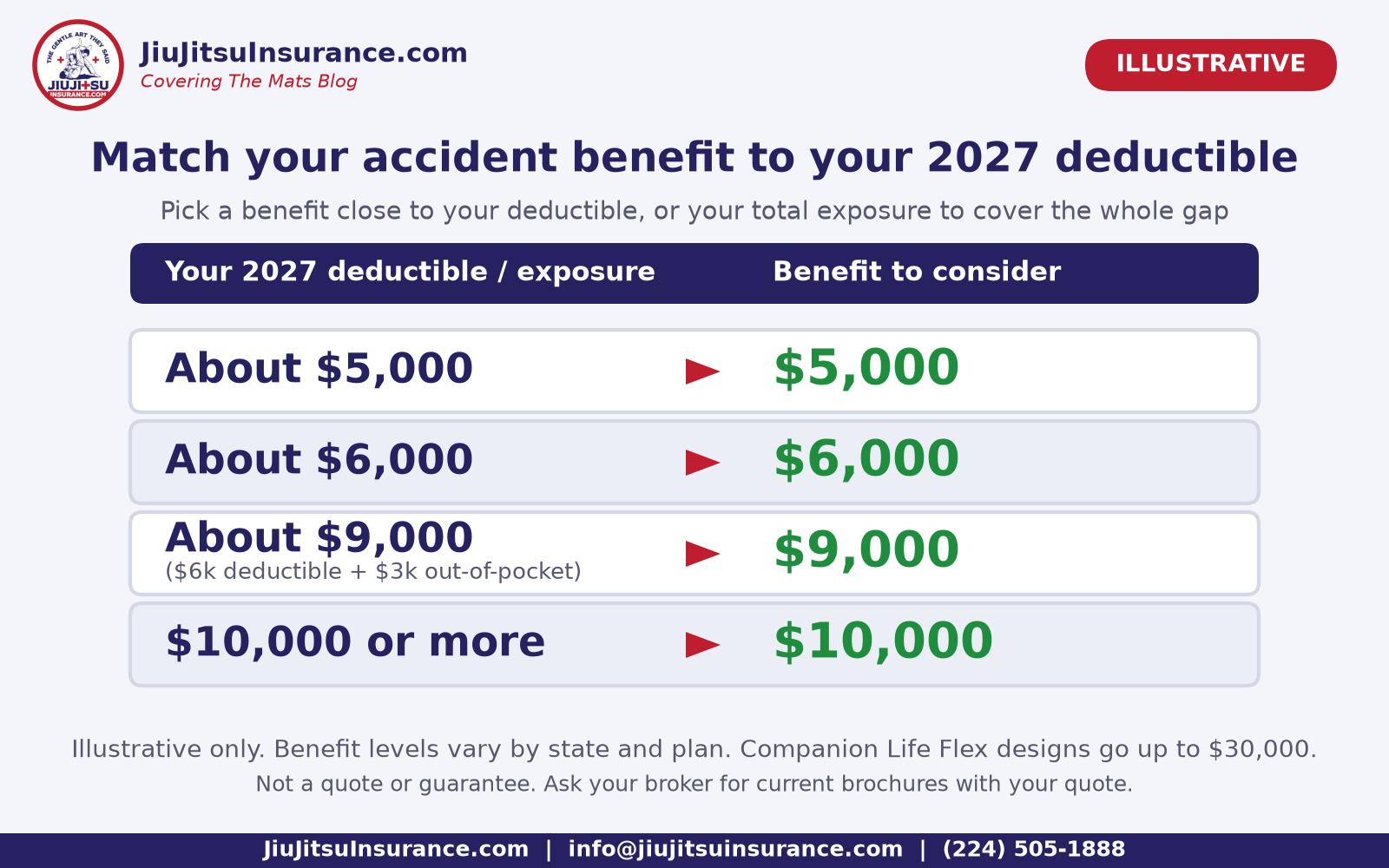
Illustrative benefit matching. Benefit levels vary by state and plan, and Companion Life Flex designs go up to $30,000.
*Illustrative only. Benefit levels vary by state and plan, and Flex designs go up to $30,000.
Using the example above, a $9,000 benefit lines up with the $9,000 exposure, so a covered accident doesn't come out of your savings.
Want more protection? You can stack plans. A Companion Life Flex plan plus a Washington National plan plus AFLAC can cover the bill and put cash in your hand at the same time. I walk through a forearm fracture example in Best-Paying Accident Plans for Martial Artists in 2027, and the two-plan setup in BJJ Accident Insurance with a Flexible Health Plan.
Your situation, your stack
- High-deductible plan: match your accident benefit to the gap, then add a cash plan for lost time.
- No health insurance: strongly consider getting major medical during open enrollment. In the meantime, higher accident limits (up to $30,000) can help with accidents only. More in Martial Arts Injury Insurance for Uninsured Athletes.
- Coach or self-employed: protect your income with accident disability and cash plans. See Insurance for Independent Jiu-Jitsu Coaches.
- You compete for pay: start with AFLAC. Companion Life Flex and the Washington National accident plans cover recreational martial arts but not paid competitors.
State availability and timing
Companion Life Flex is available in 30 states plus DC, and Washington National and AFLAC cover most of the others.
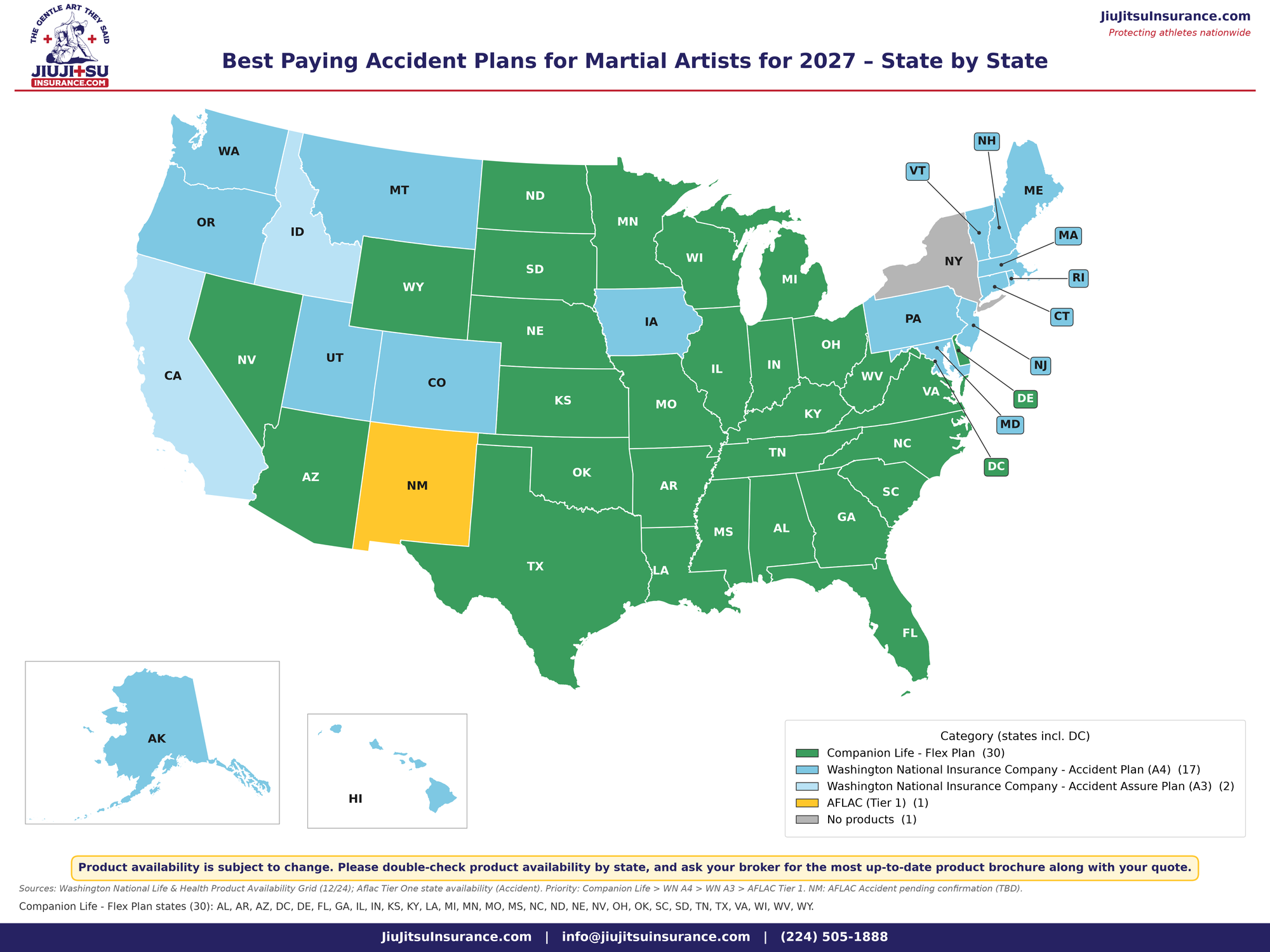
Best Paying Accident Plans for Martial Artists for 2027, state by state. Availability varies and is subject to change.
There's no open-enrollment window for accident plans. Coverage typically starts 24 to 72 hours after you enroll, so you can line it up to start Jan 1 alongside your new health plan, or start any time of year. Details in our insurance plan FAQ.
For gym owners: protect your members, too
If you run an academy, there are group gym accident policies that a lot of owners don't know about. Learn more on our group gym policy page . And please share this post with your members before Dec 15. Our gym share kit makes it easy.
FAQ
Do I need health insurance to buy an accident plan? No. But accident plans cover accidents only, so major medical is still the foundation.
Can I have both? Yes. Cash plans pay regardless of your other coverage, and Flex is excess coverage that pays after your health insurance.
Are tournaments covered? Amateur competition generally isn't excluded. Paid competition is excluded on Companion Life Flex and Washington National, so paid competitors should look at AFLAC. Confirm the details for your state.
What if I miss Dec 15? On HealthCare.gov, you can still enroll until Jan 15 for coverage starting Feb 1. Accident plans are available year-round.
Do you sell ACA plans? We focus on accident and injury coverage.
Get your 2027 deductible check
Tell us your 2027 deductible and out-of-pocket max, and we'll show you the accident benefit that covers your gap.
Prefer to talk? Call (224) 505-1888 or email info@jiujitsuinsurance.com.
While you're here, enter our Fuji raffle.
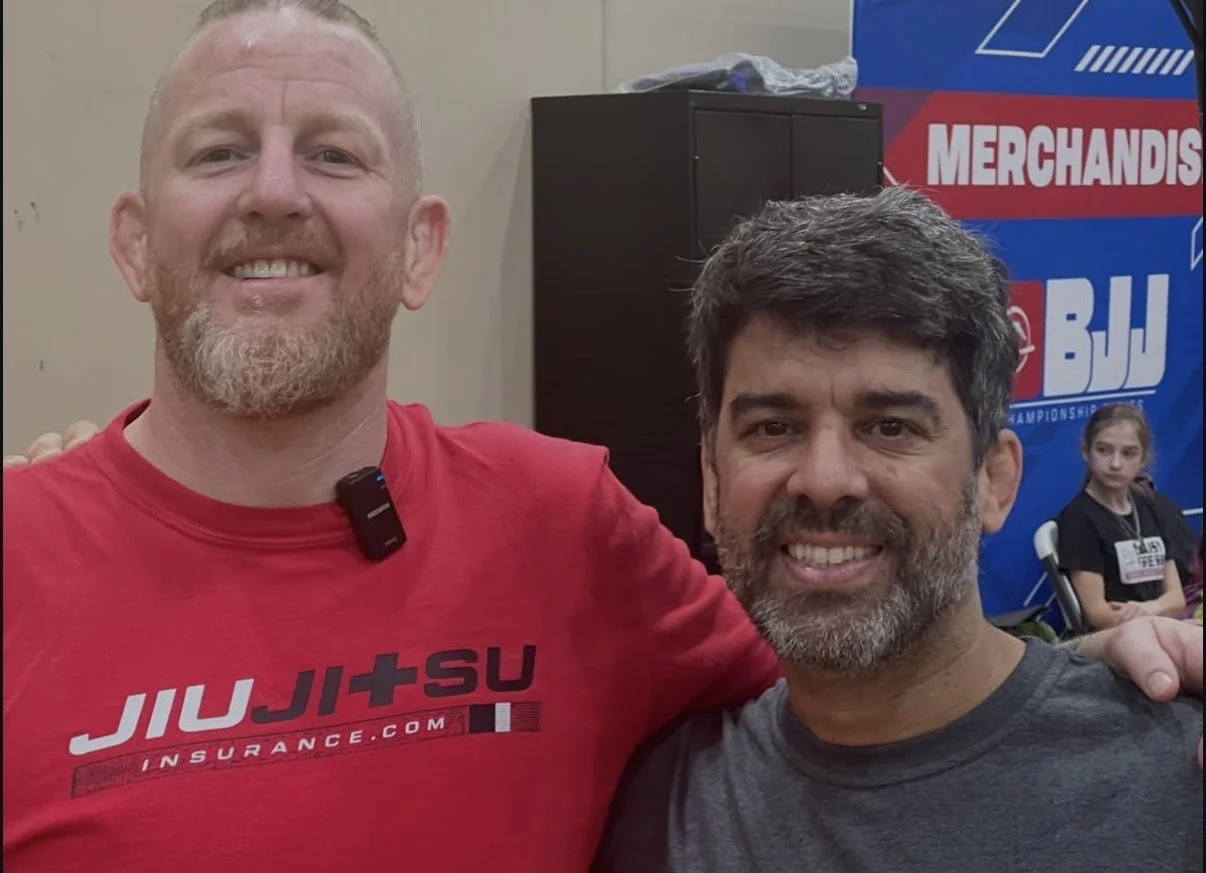
Chris Martin at a Fuji BJJ event with Felipe Costa in Illinois.
Product availability varies by state and is subject to change. Ask your broker for an up-to-date product brochure with your quote. This post is general information, not a contract or a quote. Benefits, availability, exclusions, and prices vary by state, age, and plan. JiuJitsuInsurance.com is a licensed insurance brokerage, not an insurer. NPN 7335986.

I Get This Call a Lot: What Uninsured Athletes Want to Know About Martial Arts Injury Insurance
A 30-year-old with no health insurance wanted to start jiu-jitsu, but the gym waiver asked for proof of coverage. Here is what we walked him through.

The gym waiver is often where uninsured athletes first get stuck.
Stuck on a Gym Waiver That Asks for Proof of Insurance?
A guy called me the other night. Born in 1996, so right around 30 years old. No health insurance at all. Software professional. He’d been thinking for a long time about trying jiu-jitsu, boxing, or Muay Thai. The gym waiver asked for proof of insurance, and that stopped him. He’d never carried coverage in the U.S. before and didn’t know where to start.
That demographic shows up often. A lot of people in their late 20s and early 30s — especially if they’re self-employed or simply don’t have an employer plan — either can’t find affordable major medical or don’t want to pay several hundred dollars a month for coverage they feel they barely use. They’re healthy, active, and mainly worried about one risk: getting hurt and facing a large medical bill with no help.
He found our site while researching. Like many people, he assumed the name “Jiu-Jitsu Insurance” meant the coverage was only for Brazilian jiu-jitsu. That was the first thing we cleared up.
Not Just for BJJ: Why Jiu-Jitsu Insurance Exists
We are a brokerage, not an insurance company. Jiu-Jitsu Insurance is a 50-state brokerage. We hold contracts in every state and work with multiple carriers. Our focus is finding accident and injury plans that generally do not exclude the recreational combat sports and training most of our clients actually do.
Most standard policies carve out or limit martial arts. We specifically look for the ones written with a broader approach so hobbyists training in jiu-jitsu, boxing, Muay Thai, and similar activities are not automatically left out. That is the reason the brand exists and why people in this exact situation land on us.
Combat Sports Accident Insurance Varies by State
Not every plan is available in every state. Options vary. The only way we can tell you what is currently offered is if you give us a ZIP code. From there we check the programs we have access to in that state and walk through the general features that fit recreational training.
We never quote or enroll anyone without first confirming what is actually available where they live.

Plans and pricing depend on what's offered in your state.
Accident Plan vs. Major Medical: What These Plans Are
On this call we walked through the same points I cover with most uninsured athletes.
These are supplemental accident and injury plans, not major medical. They generally focus on medical expenses that result from covered accidents and injuries. They are not designed for routine care, illness, or ongoing medical needs. That limited scope is also why they tend to cost far less than comprehensive health insurance.
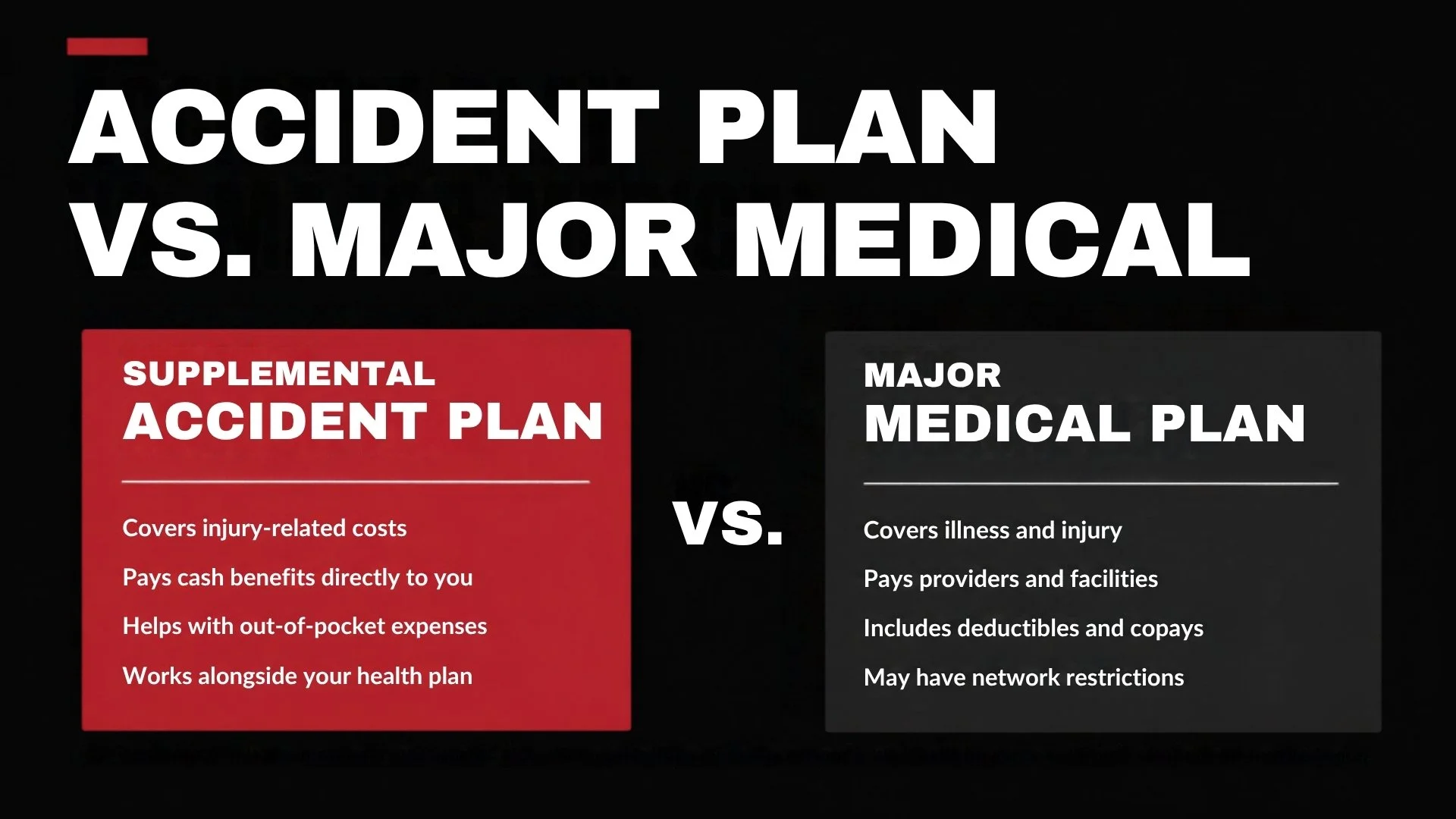
Accident plans focus on covered injuries, not routine care or illness.
How Much Accident Coverage Do You Need Without Health Insurance?
When someone has no other medical coverage, we often look at higher accident medical expense benefit amounts so the plan can respond to a larger portion of potential bills. If the person already has major medical, we can usually customize the accident benefit to better align with their deductible instead. Exact benefits and costs always depend on the products available in their state.
These plans can sometimes work alongside major medical if you add it later (for example, helping with a deductible).
How Claims Work: Treatment, Bills, Reimbursement
You can usually seek treatment where you choose.
After treatment you submit a claim with the medical bills. If the claim is approved under the plan’s terms, the company reimburses you and you use those funds toward your costs.
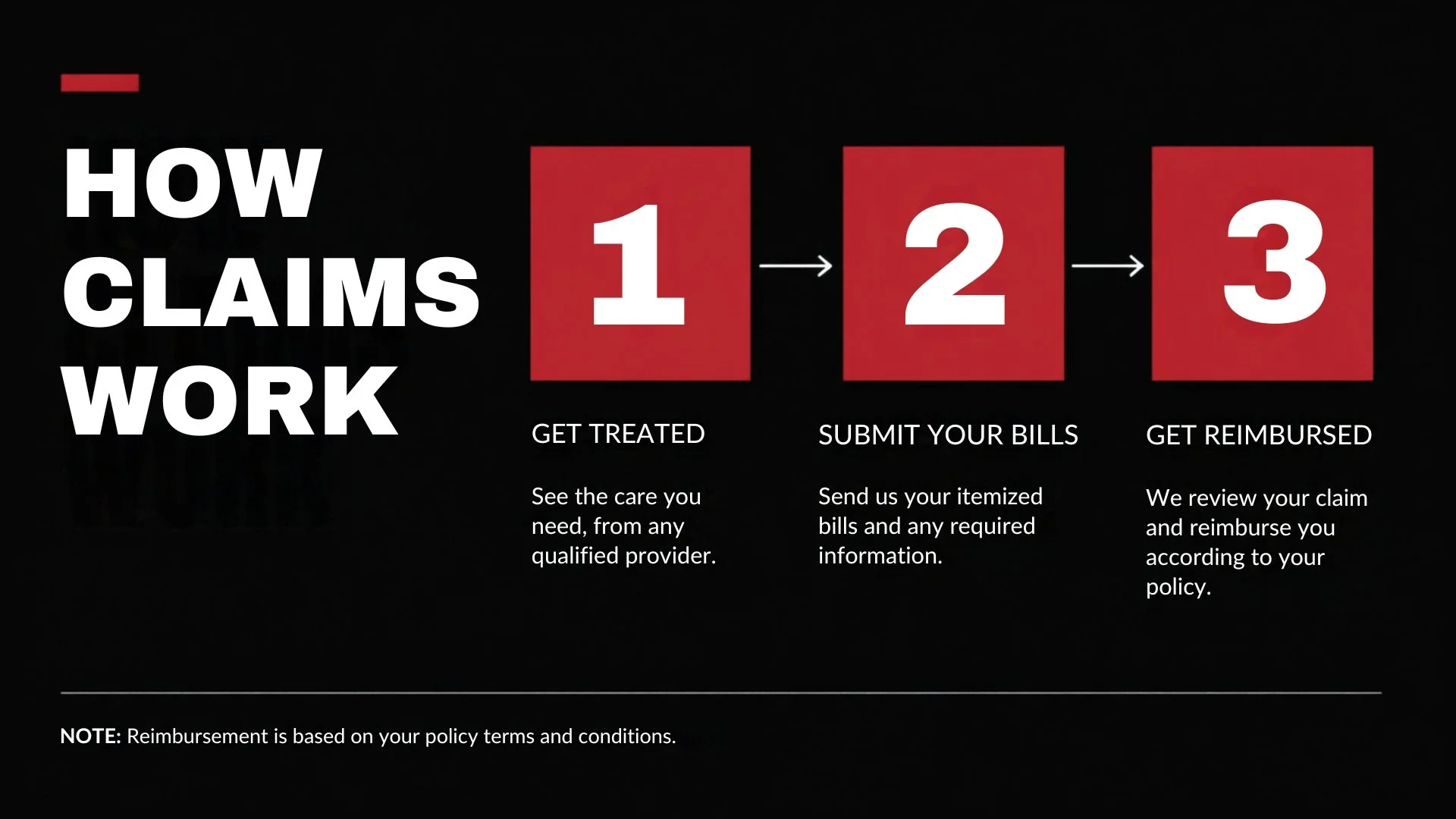
Approved claims reimburse you under the plan's terms.
What Martial Arts Injury Plans Generally Cover
For recreational athletes they generally respond to injuries that happen during training in jiu-jitsu, boxing, Muay Thai, and similar activities, as well as related fitness such as yoga or dance, and everyday accidents outside the gym.
He also asked whether the same type of coverage would apply if he tried different martial arts or even yoga and dance. These broader accident plans are generally written to respond to injuries from the activities recreational athletes actually do, not just one sport. That is the whole point of the search we do as a brokerage.
Pro Fighters and Other Exclusions
These plans generally do not cover professional athletes who are paid to compete, but we do have an injury plan from Aflac that does not exclude pro fighting. If that AFLAC plan is available in your state you can get the quote for that plan here:
Other high-risk activities are often excluded as well. Exact exclusions appear in each policy and can vary by carrier and state. No plan can guarantee that every injury will be covered. Coverage always depends on the specific terms, the facts of what happened, and the claim review process. Once we create your quote, we will send you a list of coverage exclusions based on the company and policy available in your state.
A Real Example: $30,000 in Accident Coverage for About $42 a Month
One example quote. Benefits, costs and availability vary by state, carrier and individual.
On this particular quote we also included access to 24/7 virtual urgent care, virtual primary care, and virtual mental health with no copay through the association membership.
That combination with the $30,000 accident medical expense benefit brought the total monthly cost to just over $42. The virtual care piece is useful for many people who want a way to talk to a provider quickly without always having to go into an office, and the accident plan is designed to help cover the first $30,000 in medical bills resulting from covered accidental injuries.
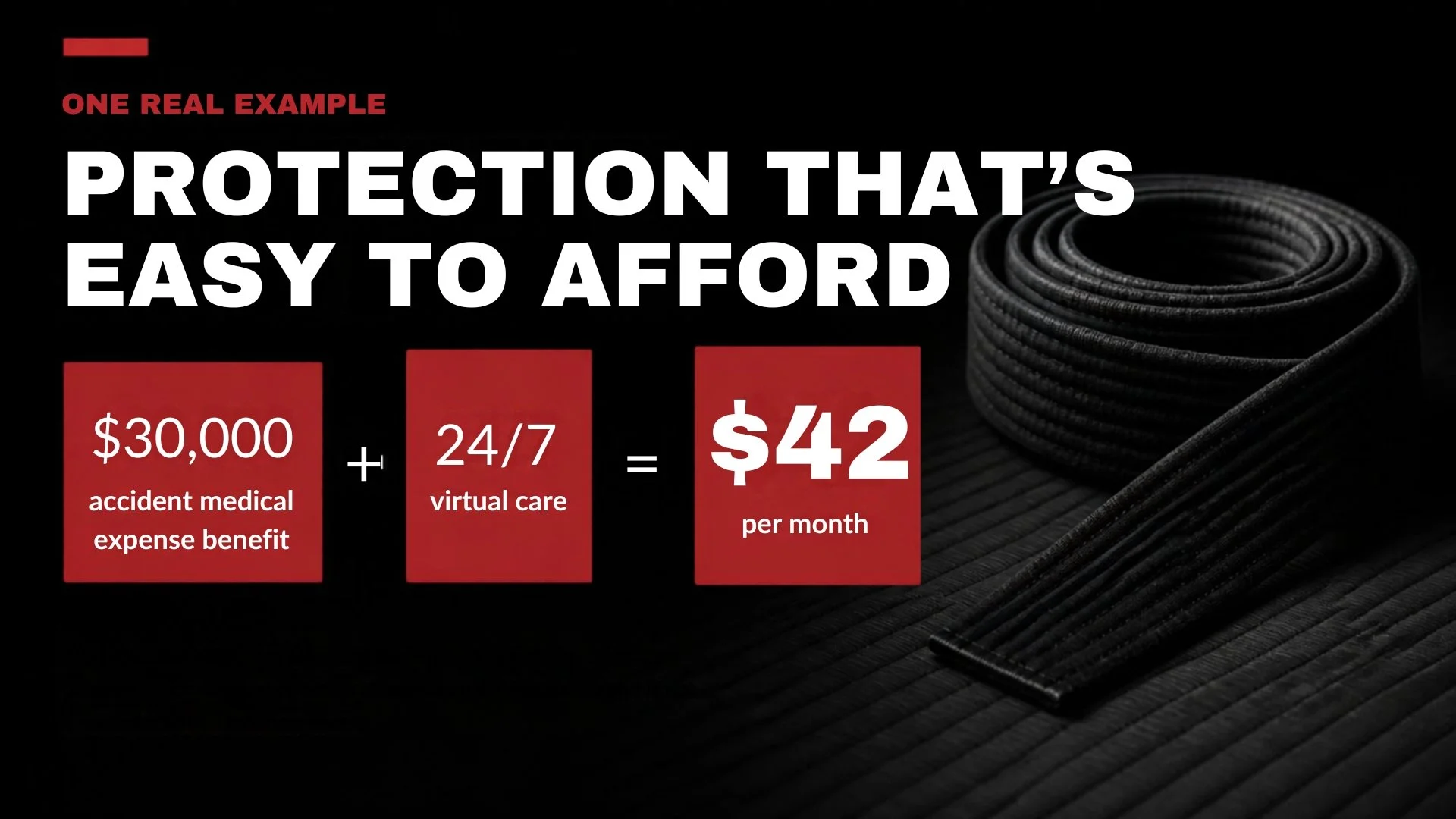
One example quote; your benefits and cost will vary.
Get Covered Before You Train
By the end of the call he understood the difference between major medical and these supplemental accident plans, why the brand name exists, that availability is state-specific, and how the benefit amount can be approached differently depending on whether someone already has other coverage. I told him I would email the information and the quote link so he could review everything when he was ready. He said that was all he needed and he would go through it.
That’s how most of these conversations end. Someone who was stuck on a gym waiver because they had no coverage and didn’t know where to look leaves with a clearer picture of the options that may be available in their state for recreational training.
If you’re in a similar spot — uninsured or under-insured, thinking about starting jiu-jitsu, boxing, Muay Thai, or another combat sport, and the waiver has you paused — the first step is simply giving us your ZIP code. We’ll check what’s currently available where you live and explain the general differences so you can decide what makes sense for you.
Getting the information before you train is the practical move. Once an injury has already happened, the options become much more limited.
If you'd like us to check what accident and injury options may currently be available in your state, start here:
Coach or gym owner? See insurance for BJJ coaches and gym liability coverage.
This article is for general informational purposes only and does not constitute insurance advice, an offer of coverage, or a guarantee that any specific plan, benefit, or coverage will be available to you. Accident and injury insurance products, benefits, exclusions, limitations, costs, and availability vary by state, carrier, and individual circumstances. Coverage is subject to the terms, conditions, and exclusions of the actual policy issued. Jiu-Jitsu Insurance is a licensed insurance brokerage and is not an insurance company. We do not underwrite policies. Nothing in this article should be interpreted as a promise or guarantee of coverage for any particular activity, injury, or claim. Always review the full policy documents and consult with a licensed agent regarding your specific situation.

Is This Accident Insurance Too Good to Be True for Jiu-Jitsu Athletes?
Every Brazilian Jiu-Jitsu athlete knows injuries are part of the journey, but many don't realize the financial impact can last longer than the recovery itself. In this article, Chris Martin of JiuJitsuInsurance.com explains how accident medical expense coverage works, why he personally enrolled in the plan, and how athletes can customize protection for training injuries, hospital stays, lost income, and more. Watch the video walkthrough and learn how to get a quote in just a few minutes.
Written By - Chris Martin (Founder of JiuJitsuInsurance.com)
If you've trained Brazilian Jiu-Jitsu for any length of time, you already know one thing:
Injuries happen.
Whether it's a dislocated shoulder, broken finger, torn meniscus, rib injury, or an unexpected trip to the emergency room, even the safest athletes can find themselves facing medical bills after an accident on the mats.
Most athletes assume their health insurance will take care of everything. Unfortunately, that's often not the case.
High deductibles, copays, coinsurance, physical therapy expenses, and time away from work can quickly turn a training injury into a financial burden.
That's why I recently enrolled in one of the new accident injury programs now available through JiuJitsuInsurance.com that we just started offering in 2026.
In the video below, I walk through exactly how the quoting process works and show you how to build a plan that fits your needs and budget.
Watch: How to Get a Quote
*This new program underwritten by Companion Life is now available in the following states: AL, AR, AZ, DC, DE, FL, GA, IL, IN, KS, KY, LA, MI, MN, MS, MO, NC, ND, NE, NV, OH, OK, SC, SD, TN, TX, VA, WI, WV, WY.
This is a video that shows how to get covered today.
In this video, I demonstrate how easy it is to:
Get an instant quote
Select your effective date
Choose your accident medical expense benefit level
Add optional disability coverage
Add optional hospital and critical illness benefits (where available)
What Is Accident Injury Insurance?
Accident injury insurance is designed to help pay covered medical expenses resulting from a new accidental injury.
Unlike traditional health insurance, these plans can help provide benefits from the first dollar of covered expenses, subject to policy terms and limits.
For many athletes, the goal is simple:
Protect yourself from the unexpected costs associated with training injuries.
Why This Matters for Jiu-Jitsu Athletes

Brad at Misfits BJJ in St. Charles learns about the new plans and can’t believe it.
Let's face it.
Jiu-Jitsu is one of the most physically demanding sports in the world.
Even if you're careful, accidents happen:
Torn ACLs
Shoulder dislocations
Broken hands and fingers
Knee injuries
Rib injuries
Neck injuries
Emergency room visits
Physical therapy
Many athletes carry health insurance with deductibles ranging from $2,500 to $8,000 or more.
That means even after paying monthly premiums, you may still owe thousands before your major medical plan begins paying.
Building Coverage Around Your Deductible
One strategy is to select an accident benefit level that aligns with your health insurance deductible.
For example:
If your health insurance deductible is $5,000, you might consider a $5,000 accident medical expense benefit.
If you experience a covered accident, the benefit may help offset medical expenses that would otherwise come out of your own pocket.
This can be especially valuable for athletes who train several times per week or compete regularly.
*This new program underwritten by Companion Life is now available in the following states: AL, AR, AZ, DC, DE, FL, GA, IL, IN, KS, KY, LA, MI, MN, MS, MO, NC, ND, NE, NV, OH, OK, SC, SD, TN, TX, VA, WI, WV, WY.
What If You Don't Have Health Insurance?
Many independent contractors, coaches, gym owners, and self-employed athletes either have limited health coverage or no major medical insurance at all.
In that situation, some athletes choose higher accident medical expense limits to provide additional protection against unexpected injuries.
Available benefit levels vary by state and may provide up to $30,000 in accident medical expense benefits.

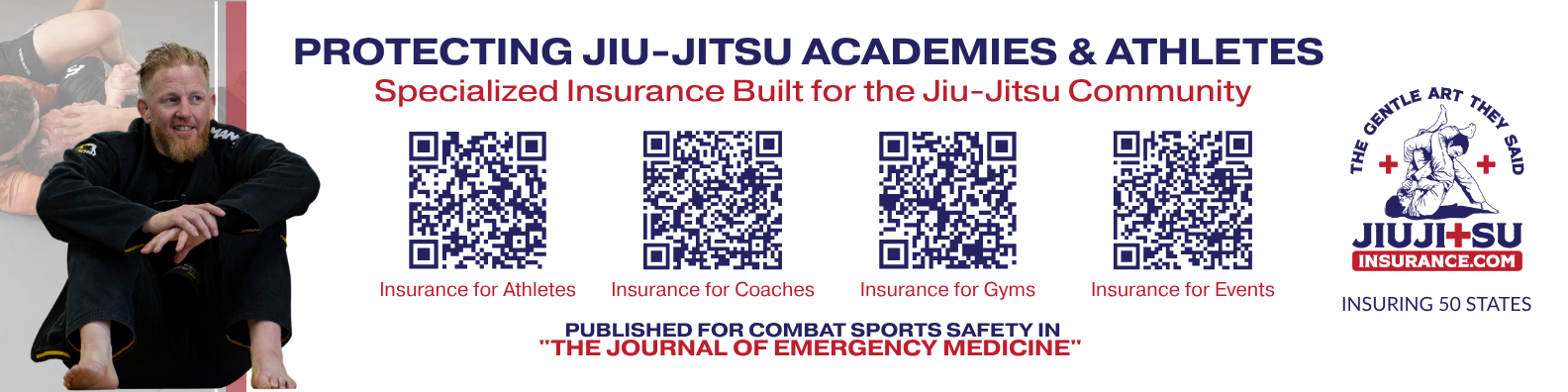
Jiu Jitsu Insurance Banner at Fuji BJJ event.
Don't Forget Income Protection
One of the most overlooked risks for athletes is lost income.
If an injury prevents you from working, the medical bills are only part of the problem.
You may also lose:
Coaching income
Personal training income
Business revenue
Contractor earnings
Teaching opportunities
Depending on your state and eligibility, optional accident disability benefits may be available to provide weekly income benefits if a covered injury prevents you from working.
Hospital Benefits and Critical Illness Coverage
Depending on your state, additional benefits may be available including:
Hospital Indemnity Benefits
These benefits may provide cash payments for covered hospital stays due to sickness.
For example, if you develop a serious infection requiring hospitalization, these benefits may help offset out-of-pocket costs and lost income.
Emergency Room Benefits
Cash benefits may be available for covered emergency room visits due to sickness.
Doctor Visit Benefits
Some plans include benefits for physician office visits and urgent care treatment.
Critical Illness Coverage
Depending on state availability, coverage may be available for certain critical illnesses including:
Heart Attack
Stroke
Invasive Cancer
Major Organ Transplant
These benefits can provide lump-sum cash payments that may be used however you choose.
Why I Purchased This Plan Myself
As someone who has trained Brazilian Jiu-Jitsu for years and works with martial artists every day, I understand that injuries are part of the journey.
While no insurance policy can prevent an injury from happening, having financial protection in place can make recovery much less stressful.
That's why I personally purchased this coverage for myself.
The enrollment process was straightforward, the monthly cost was affordable, and it gave me an additional layer of protection beyond my existing coverage.
Get Your Quote Today
If you're interested in seeing your options, you can get a quote online in just a few minutes.
*This new program underwritten by Companion Life is now available in the following states: AL, AR, AZ, DC, DE, FL, GA, IL, IN, KS, KY, LA, MI, MN, MS, MO, NC, ND, NE, NV, OH, OK, SC, SD, TN, TX, VA, WI, WV, WY. QUOTE LINK
All other states get a quote here by clicking here »
You can save your quote, review your options, and enroll entirely online.
If you have questions, feel free to contact our team.
Chris Martin
Founder, JiuJitsuInsurance.com
Phone: 224-505-1888
National Producer Number (NPN): 7335986
California License: 4116908

Chris Martin at Fuji Jiu Jitsu event educating the community about injury plans.


Important Disclosure
The information provided in this article and video is for educational purposes only and is not a contract of insurance, coverage guarantee, or binding quote.
Benefits, exclusions, limitations, waiting periods, state availability, eligibility requirements, and premium amounts vary by state and individual circumstances.
Please review all policy documents, certificates, and brochures carefully before enrolling. Coverage is subject to underwriting approval and policy terms and conditions.
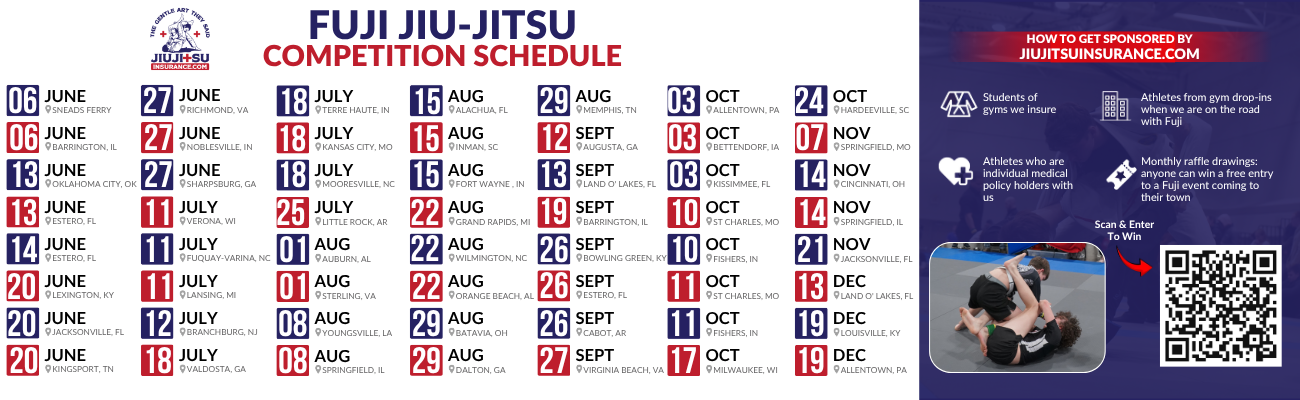

Affordable Health Insurance for BJJ Athletes: How to Stack Two Plans Under $200/Month
One phone call after the Fuji BJJ event in St. Charles reminded me how exposed most grapplers really are. A coach from Gracie Barra Missouri faced a $4,000 ACL bill his insurance wouldn't touch — and it didn't have to happen. Here's how stacking two affordable indemnity plans could have covered every cent, and how you can protect yourself for under $200/month.
Most grapplers train hard but leave themselves financially exposed. Here's a simple two-plan stack that pays you cash when injuries happen — starting at just $30/month.

Filmed live at the Fuji BJJ Event in St. Charles — talking about the most affordable health coverage options for grapplers, martial artists, and BJJ athletes who either have no insurance or want to fill the gaps in their current plan.
The Insurance Gap in BJJ
After a recent event at the Fuji BJJ event in St. Charles, I got a call from an athlete who had no health insurance. He grabbed a flyer from our booth and asked about the $30/month accident insurance program. It's a conversation I have all the time — and the stakes couldn't be higher.
Consider this real-world example: a coach from Gracie Barra Missouri blew out what may have been his ACL. His medical insurance didn't cover his $4,000 deductible. He paid every cent out of pocket — when two simple, affordable plans could have covered it entirely and potentially put money back in his pocket.
That's the gap. And it's one that almost every BJJ athlete is vulnerable to.
Disclaimer: Coverage details, payouts, and limitations vary by program. Always review your policy certificate and benefit statements for exact details.

What Is Indemnity Insurance? (And Why Every Athlete Needs It)
Indemnity insurance is simple: it sends cash directly to you — not to a hospital, not to a provider network. You receive a check and use it however you need.
It's a fixed-cost benefit plan. You know exactly what you pay each month and exactly what triggers a payout. It doesn't replace comprehensive health insurance — it fills the gaps that comprehensive insurance leaves open, like high deductibles and out-of-pocket maximums.
Crucially, you can legally stack multiple indemnity plans and file separate claims to each. Both pay independently. Both send you cash.
Plan 1 — The Level 4 Indemnity Plan (~$30/Month)
This is the plan everyone who trains should have. At around $30/month, it's the foundation of any smart athlete insurance stack.
Cash sent directly to you for accident and injury treatment
Covers emergency room visits
No provider network restrictions
Works alongside any existing health insurance plan
Especially valuable for covering high deductibles ($2,000–$4,000 range)
Plan 2 — The Flexible Health Plan (~$94–$160/Month)
Underwritten by Companion Life, this plan is fully customizable. You choose your benefit levels to fit your needs and budget. Here's what a well-configured plan looks like:

How to Stack Both Plans — The Real Strategy
Here's where the math gets interesting. Both plans are indemnity contracts. Both pay cash directly to you. And you can file separate claims to each one independently.
Let's revisit the Gracie Baja coach's scenario with the stacked plans:
ACL surgery + rehab bill: ~$4,000 out-of-pocket (after insurance deductible)
Level 4 indemnity plan payout: $2,000–$4,000+ in cash directly to him
Flexible health plan accidental medical payout: up to $30,000 (in his case $4000)
Net result: He would have covered his entire bill — and potentially profited from having the indemnity plan in addition to the flexible health plan.
This is completely legal. Indemnity contracts pay you regardless of what other coverage you have. Stacking is a smart, legitimate strategy — not a loophole.
Disclaimer: Coverage details, payouts, and limitations vary by program. Always review your policy certificate and benefit statements for exact details.
Who Should Get This Coverage?
This stack is ideal for:
BJJ athletes and grapplers with no current health insurance
Athletes with high-deductible health plans ($2,000+ deductibles)
Gym owners and coaches who want to protect their income if injured
Anyone training in a contact sport who wants financial peace of mind


Frequently Asked Questions
-
Indemnity plans are event-triggered — they pay when an accident occurs, not based on your health history. Most do not require medical underwriting for the accident and injury benefits.
-
Yes. Indemnity plans are supplemental by design. They pay you directly and do not interfere with other coverage. You can stack them with employer plans, marketplace plans, or Medicare.
-
That alone provides meaningful protection and is a great starting point. You can add the flexible health plan later or customize it as your needs change.
Get Your Free Custom Quote Today
Under $200/month. Fully customizable. Cash payouts when you need them most.
I just need your name, phone number, and email to build your quote.
Disclaimer: Coverage details, payouts, and limitations vary by program. Always review your policy certificate and benefit statements for exact details.


Training Jiu Jitsu Without Health Insurance: The Risks
This article shares Dorian's Jiu Jitsu journey (without insurance). Inspired by testimonials from guys like Joe Rogan, Dorian became passionate about bjj but suffered a severe knee injury during a tournament. Without coverage, he couldn't afford proper treatment, leading to lingering issues and inconsistency in training. The article highlights the importance of insurance for martial artists and recommends our affordable programs for comprehensive protection on and off the mats.
Jiu Jitsu, a martial art known for its physical and mental benefits, has attracted countless enthusiasts seeking to embark on a rewarding journey. One such individual, Dorian, found himself captivated by Jiu Jitsu after hearing about its positive impact on the "Joe Rogan Experience" podcast. He started his journey as a white belt and quickly progressed to a blue belt, competing in numerous tournaments and falling in love with the sport. However, Dorian's story took a turn for the worse when he suffered an injury during a competition. Sadly, he lacked health insurance at the time, leading to a series of untreated injuries that ultimately impacted his ability to stay consistent in training. At JiuJitsuInsurance.com, we believe in the importance of protecting Jiu Jitsu practitioners from unforeseen injuries and their potential consequences, which is why we offer tailored insurance plans for BJJ athletes like Dorian to ensure a safer and more sustainable journey on the mats. Here is a recap of Dorian’s personal journey from his podcast - The Dorian Develops Podcast.

The Passionate Journey:
Dorian's Brazilian jiu jitsu (BJJ) journey began with the inspiring words of others who spoke highly of the sport's transformative power. Intrigued by their testimonials, he decided to give it a try and was hooked from the very first class. He felt the adrenaline and exhaustion, the unmistakable signs of a legitimate martial art that left him yearning for more (that post-roll high). Eager to progress, Dorian swiftly moved from white to blue belt in just 13 months and immersed himself in countless competitions, relishing the camaraderie and challenges the sport offered.
The Turning Point:
Dorian's passion for Jiu Jitsu came to a halt when he encountered a setback during a blue belt competition at the Master Worlds. Paired with a more advanced opponent, he suffered a severe injury to his knee and faced the harsh reality of not having health insurance to cover the medical expenses. Unable to afford an MRI, he settled for a general doctor's "rough idea" of the injury, which led to improper treatment. Despite taking time off to recover, Dorian found himself in constant pain, unable to maintain a consistent training routine.
Lingering Injuries and Regrets:
Over the years, Dorian accumulated various untreated injuries, from finger dislocations and rib injuries, to neck and back strains. Each neglected injury added to his physical discomfort, affecting his overall well-being and limiting his time on the mats. In Dorian’s case, the failure to seek proper medical attention when these injuries first occurred, had led to more serious and lingering health issues.
The Importance of Insurance:
Dorian's story serves as a cautionary tale for all Jiu Jitsu enthusiasts. While pursuing our passions, we must be prepared for the unexpected. The lack of health insurance not only prevented Dorian from receiving immediate and proper treatment for his injuries, but also impacted his ability to continue training and enjoying the sport he loved. Thankfully, there is a solution - individual injury insurance programs designed specifically for athletes like him.
The JiuJitsuInsurance.com Solution:
At JiuJitsuInsurance.com, we understand the unique needs of the grappling community and the importance of safeguarding practitioners against unforeseen injuries. Our insurance programs provide peace of mind by offering cash benefits directly to the insured when injuries occur. With coverage for medical treatments, scans, and physiotherapy, our plans ensure that you can choose the best care without worrying about financial strain.
Affordable Protection for Jiu Jitsu Athletes:
Contrary to popular belief, comprehensive insurance coverage for Jiu Jitsu practitioners that cover their injuries from bjj traiing is not an exorbitant expense. The insurance programs that cover injuries and accidents for individuals (whether they grappler or not) start at around $25 per month and some of the programs include accidental death life insurance, providing an extra layer of financial protection for your loved ones. These coverage typically will cover you for injuries that happen both on and off the mats.
Conclusion:
Dorian's journey in Jiu Jitsu is a testament to the passion and dedication that many practitioners share for this incredible martial art. However, his unfortunate experience highlights the need for proactive measures to protect ourselves from unexpected injuries. At JiuJitsuInsurance.com, we encourage all Jiu Jitsu enthusiasts to consider the value of insurance coverage, which can make a significant difference in the face of adversity. Let Dorian's story serve as a reminder that with the right insurance protection, you can prolong your training and continue pursuing your passion for Jiu Jitsu without unnecessary worries.
Don't wait for an injury to occur; protect yourself today! To learn more about our tailored insurance plans >> CLICK HERE.
Remember, accidents happen in Jiu Jitsu, but being prepared can make all the difference! Stay safe, stay insured, and keep rolling!
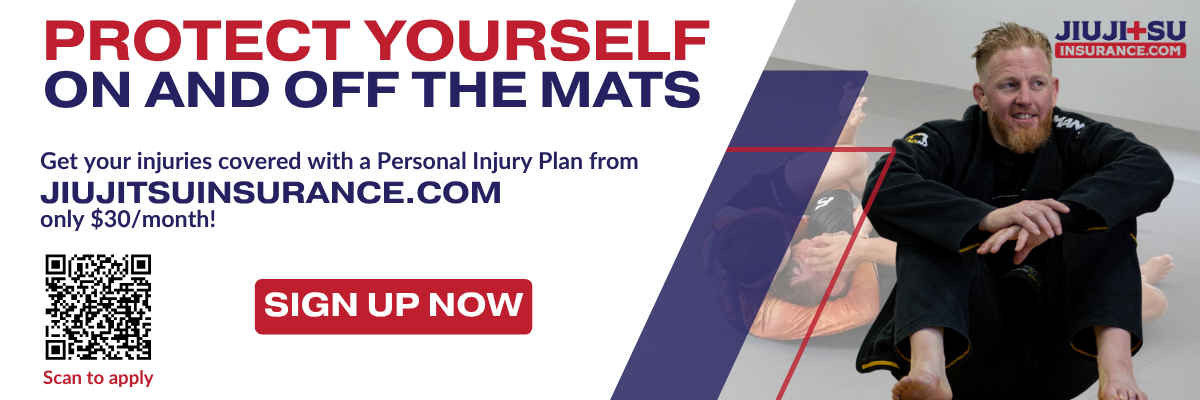
Protect yourself on and off the mats. Get affordable personal injury coverage for Jiu-Jitsu athletes starting at only $30/month from JiuJitsuInsurance.com

training BJJ without health insurance. bad idea?
We do not think you should stop training jiu jitsu just because you don’t have health insurance. Instead this article provides tips to treating injuries and covers ways for you to pay those bills without traditional health insurance.
We don't think that you should stop training Jiu Jitsu solely because you don't have health insurance. While health insurance can provide financial protection in the event of an injury, it is not necessary to participate in the sport of jiu jitsu.
However, it is important for individuals to be aware of the risks associated with participating in any sport, including Jiu Jitsu, and to take steps to minimize their risk of injury. This may include wearing protective gear, learning proper techniques, adjusting training principles, and gradually building up their strength and endurance.
Grapplers who do not have health insurance should also take steps to manage the cost of treatment in the event of an injury. This may include seeking out low-cost options, negotiating payment plans with providers, considering alternative therapies, or picking up personal injury insurance for around $25 per month.
Ultimately, the decision to continue training Jiu Jitsu should be based on a careful consideration of the individual's health, fitness, and personal preferences, as well as their risk tolerance and financial resources.
What to expect to pay for care without health insurance?
The cost of treating an injury without health insurance can vary greatly depending on the severity of the injury, the type of treatment required, and the location where the treatment is sought. For example, the cost of an emergency room visit can range from $150 to $3,000 or more, while the cost of physical therapy sessions can range from $50 to $200 or more per session. The cost of surgery can be even higher, ranging from several thousand to tens of thousands of dollars.
It's also important to note that many medical providers offer payment plans or may be willing to negotiate fees for uninsured patients, so it's always a good idea to reach out and ask about options for lowering the cost of treatment.
Either way treatment for an injury should not be put off because of the fear of medical bills without health insurance. If paying medical bills will be a deterrent for you in getting treatment for a bjj injury then we might suggest you consider purchasing a personal injury insurance program for around $25 per month that will help you pay those bills.
Supplemental injury insurance as an alternative:
Supplemental injury insurance is a type of insurance that provides additional coverage specifically for injury-related expenses. It is designed to complement and supplement a primary health insurance policy, which may have limitations or exclusions for certain types of injuries or treatments, however these programs can be purchased without health insurance.
Supplemental injury insurance can provide benefits for a wide range of injuries, including those sustained during athletic activities, such as grappling. The policy may cover expenses such as medical bills, rehabilitation costs, lost wages, and other out-of-pocket expenses related to an injury. The coverage and benefits of a supplemental injury insurance policy can vary greatly as some policies cover more than others so just ask for a “policy detail” when you review the policy.
For grapplers who are concerned about the cost of treating an injury, a supplemental injury insurance policy can provide peace of mind and financial protection in the event of an injury which in the end will help them get back on the mats faster after injury.
Protect yourself on and off the mats. Get affordable personal injury coverage for Jiu-Jitsu athletes starting at only $30/month from JiuJitsuInsurance.com

5 Reasons To Get A Personal Injury Insurance Policy If You Train BJJ.
For those of us spending our lives on the mats, many will get injured doing what we love. Most of the time that injury requires medical treatment of some sort.
I have been training Jiu Jitsu since 2008 and have been injured several times. Although I was always covered by a major medical health insurance policy, it didn’t seem to matter— my medical bills just kept piling up. Let’s be honest— Jiu Jitsu is a rough sport, and if you practice consistently you are going to hurt. Or should I say, “if you practice consistently you are always going to be injured?” Brazilian Jiu Jitsu, Gentle Art my ass!
HAHAA.
By no means am discouraging anyone from taking up Jiu Jitsu for fear of injury! However, what I am saying is this: If you practice Jiu Jitsu, you need to take care of your body. The unfortunate reality is that a lot of BJJ practitioners neglect their injuries for fear of drowning in unanticipated medical debt. This problem could be easily addressed with education and knowledge on getting proper medical treatment in addition to having the right insurance protection that will pay for that medical treatment.
In an effort to shed some light on the subject, you will find below a list of reasons to considering enrolling in one of these supplemental injury plans even (we call it Jiu Jitsu Insurance) if you have an existing health insurance policy.
BJJ tip from “The Crippler".
Why Get A Personal Jiu Jitsu Insurance Policy?
You might say, “I have a major medical health insurance already, so why would I need to buy an additional insurance plan for my injuries?” Here are some of the reasons someone who already has a health insurance plan might consider adding an accident - injury insurance policy to their protection:
Reason #1: You may be on the hook for thousands of dollars with your major medical plan.
If you look at the way most major medical policies are designed, it’s easy to see in the “summary of benefits” that the consumer is on the hook for most upfront medical expenses as a result from any injury. For example, if you look at your own summary of benefits for your health insurance plan, you will see items listed in rows such as emergency room visits, hospital stays, urgent care visits, and medical imaging. Next to each row is a corresponding column labeled either “deductible” or “co-insurance.”
Deductible and coinsurance percentages show the patient’s responsibility to pay before the health insurance company pays for any expenses. The average deductible in the United States is about $2,500 per person and the average out-of-pocket average is around $5000. For this example, let’s say your plan is like the average I just mentioned. That means if you sustain an injury and seek medical treatment, you have to pay the first $2,500 for your services before the insurance company pays anything.
However, unlike traditional health insurance, Jiu Jitsu insurance plans (aka injury plans) will pay you directly when you seek treatment for an injury or accident. That way you're not stuck paying the entire bill from the treatment provider. Whether or not you have health insurance coverage, these plans will pay you and you can do whatever you want with the tax-free check.
Reason #2: Jiu Jitsu coverage polices allow you to see anyone.
When you’re injured, there’s no time to waste searching for a reliable doctor who is considered “in-network.”
Most traditional health insurance policies will have restricted networks that you must go to for medical care, otherwise your medical services may not covered. On the contrary, a jiu jitsu insurance plan will give you the flexibility to see any licensed Doctor, anytime you need medical care.
Jiu Jitsu Insurance plans don’t work like traditional health insurance plans in the sense that you don’t need to show an ID card at the time or service. Instead, you will submit a claim after service and the insurance company will send a check made payable to you, which you can use to pay your medical bills or pocket the tax-free check if you have another insurance plan pays for you bills.
These insurance plans will make out a tax-free check payable to you so that you never need to worry about network restrictions and the possible penalties for going to an out-of-network provider. This will save you time and money.
Reason #3: Your current health insurance policy may not cover the unique, injury-specific treatment you need.
There is a high probability of sustaining an injury while practicing jiu jitsu. Higher than any other recreation sport or martial art due to the amount of time spent practicing as well as competing.
A recently conducted medical study addresses the prevalence of injuries during BJJ training. The study reads that prevalence of injuries in training is significant because athletes spend more time in training than in competition.The study also proves that the average BJJ athlete participates in BJJ training approximately four days per week but only competes twice per year.
Some say, “It’s rare to earn a blue belt without a couple of injuries along that way,” and I totally agree with that statement, which is why I believe a jiu jitsu insurance plan is invaluable to any BJJ practitioner.

Credit for photo by Joshua Dover. Joshua Dover pictured here at Scramble BJJ & Wrestling in Rome, GA after training.
Many Jiu Jitsu athletes look beyond traditional medical treatments for healing their injuries. Some of these alternative therapies include acupuncture, cryotherapy, red/blue light therapy, ice baths, and massage. Most of the time these treatments are not covered by health insurance. As BJJ practitioners, we are all aware of these treatments that will get us back on the mat faster, but without coverage the cost can really add up. However, since with a fixed expense injury plan you will be sent a check directly, you can use that money to pay for the cost of these services not covered by traditional health insurance.
As a matter of fact, see reason #4 below as to why you might even consider purchasing two or three of these programs from different insurance providers!
Reason #4: When you double-down on an injury plan you get double the benefits.
With traditional health insurance you might think, “Why not just get two medical insurance plans, so that they can each work to cover what the other will not?” While it’s a nice thought, that’s unfortunately, that’s not the way it works out.
Most major medical policies coordinate with each other to determine who should be the “primary payer” and who will be the “secondary payer.” Simply put— they are going to fight over who is going to pay the bills and only one of them is going to cover your costs.
On the other hand, with the accident-injury policies, it is not uncommon for people to purchase multiple supplemental plans if they are active and can foresee that injuries are going to happen.
Jiu Jitsu insurance plans are going to pay you directly no matter what kind of insurance you currently have. It’s common for active BJJ athletes to purchase multiple of these insurance plans because they know that the policy is going to pay them out directly. A jiu jitsu practitioner is much more likely to file a claim than the average insurance customer enrolled into these programs. But don’t worry! The insurance companies don’t discriminate against BJJ practitioners! You will pay the exact same monthly fee to be enrolled in these programs as the other people enrolled in these plans.
Some jiu jitsu coaches purchase multiple policies and use the funds they receive from the insurance companies to pay other coaches to run their classes while they recover. That’s a great example of how having multiple injury polices that pay you directly when injured could be use as a hybrid “short-term disability” policy. Although these programs are not meant to be considered short term disability, the proceeds that you receive from the insurance could be used to make up any unanticipated lost wages while treating your injury.
At the end of the day, nobody wants to get injured or hurt, but if you practice jiu jitsu, it’s nearly inevitable. Treatment of injuries costs not only money, but time as well. Having multiple accident-injury policies may save you tremendously on both during your recovery period.
Reason #5: Jiu Jitsu plans provide extra financial protection that heath insurance won't provide.
Traditional health insurance plan don’t provide benefits payable to your beneficiaries, as if you were to pass away— that is what life insurance is for. However, Jiu Jitsu insurance plans can act as a hybrid-type of insurance policy that not only pays the insured medical payments for injury and accidents, but also provides an extra layer of coverage with accidental life insurance benefits.
For example, some accident-injury insurance policies offered at jiujitsuinsurance.com have a built in accidental life insurance policy that will pay your beneficiary of choice a lump-sum benefit, in the event you were to pass away suddenly due to accident or injury. The lump-sum of cash, tax-free benefits, is typically in the range of $5,000 to $150,000, maybe even more depending on the insurance policy in which you enroll.
To have a policy like this adds an extra layer of protection for your family at the cost of just a few extra dollars per month. As healthy as many Jiu Jitsu athletes are, accidental deaths do happen and are actually the third leading cause of death in the United States. Life insurance may be used for surviving beneficiaries to replace income at death, pay for funeral expenses, and other debts.
At it’s core, jiu jitsu insurance plans are meant to pay for medical bills, however the added life protection for around $25 per month is definitely worth the peace of mind. At the end of the day it is important to have a health insurance plan to cover any catastrophic accident or injury however it is rare to find a health insurance plan that covers the upfront costs for treating and healing an injury. So, what’s the solution?
Click here >> to learn more about affordable personal injury insurance programs that helps the bjj community manage their medical costs as well as their financial and physical well-being. Learn more click here>>.
Already injured and just finding us now? No worries, check out the article we wrote about ways to progress in bjj when you’re injured. Check it out >>
Study mentioned in this article: click here to read study.>>