


How Do Pro Grappling Athletes & Promoters buy Injury Insurance?
As professional grappling grows through promotions like UFC BJJ and the Professional Grappling Federation, more athletes and promoters are evaluating how injury insurance works beyond event day. While grappling may not be regulated like MMA, competing for prize money is often considered professional exposure by insurance carriers. Many athletes now carry supplemental accident coverage that does not exclude training or prize fighting — and often maintain it even after contracts expire. This article explains how that structure works, what it covers, and why 24/7 accident protection has become part of professional risk management in modern grappling.
A Practical Overview for Professional Competitors, Managers, and Event Organizers -

Professional grapplers who compete for cash money.
Professional grappling continues to mature as a business. Athletes are competing for prize money under promotions such as UFC BJJ, theProfessional Grappling Federation, and organizations connected to Scientific Wrestling. As the competitive level rises, so does the need for clearer conversations around injury exposure and insurance structure.
One of the most common questions from both athletes and promoters is simple:
Where do professional grapplers obtain injury insurance that applies to training, competition, and prize fighting?
This article outlines how that typically works from a risk management standpoint.
Regulation vs. Risk Classification -
In many states, submission-only grappling is not regulated by athletic commissions in the same way professional MMA is. That regulatory distinction has helped the sport expand.
Insurance underwriting, however, focuses less on regulation and more on compensation. When an athlete competes for prize money, insurers typically classify that exposure as professional participation. That classification affects how policies respond and whether exclusions apply.
In other words, even if grappling is not formally regulated, it can still be viewed as professional risk when compensation is involved.
What Promoters Usually Insure -
Promoters generally secure event-based coverage. This often includes general liability for the event and a form of blanket accidental medical coverage tied to that specific competition.
Those policies are structured to protect the event and the organization. They are not designed to provide long-term, year-round protection for individual athletes.
For professional grapplers, most injury exposure occurs in training camps, daily sparring, strength work, and other random accidents — not just on event day. That reality has led some promotions and management teams to require athletes to carry their own 24/7 accident coverage during the term of their contracts.
The Supplemental Plan Often Used in This Space -
The plan most commonly referenced within professional grappling circles is the Aflac Elite Accident Insurance Plan.
It is important to clarify that this policy was not created specifically for Brazilian Jiu-Jitsu or MMA athletes. It was designed for the general public to help offset out-of-pocket medical expenses following accidental injuries.
Its relevance to combat sports stems from policy language. A review of the form shows that it does not exclude injuries from training, organized competition, or prize fighting. That absence of exclusions is what makes it applicable to professional grapplers competing under organizations such as UFC BJJ and the PGF BJJ to name a few.

Why Many Athletes Keep the Coverage After Contracts Expire -
An interesting pattern has developed among professional athletes. Even when coverage is initially required by a promotion or management contract, many competitors choose to maintain the policy long after the contract ends.
The reason is practical.
Many professional grapplers and MMA fighters do not have employer-sponsored health insurance. Even those who do often face high deductibles and out-of-pocket costs. Supplemental accident plans of this type generally cost around $35 per month on average (based on state availability), which makes them financially accessible compared to the potential cost of an injury.
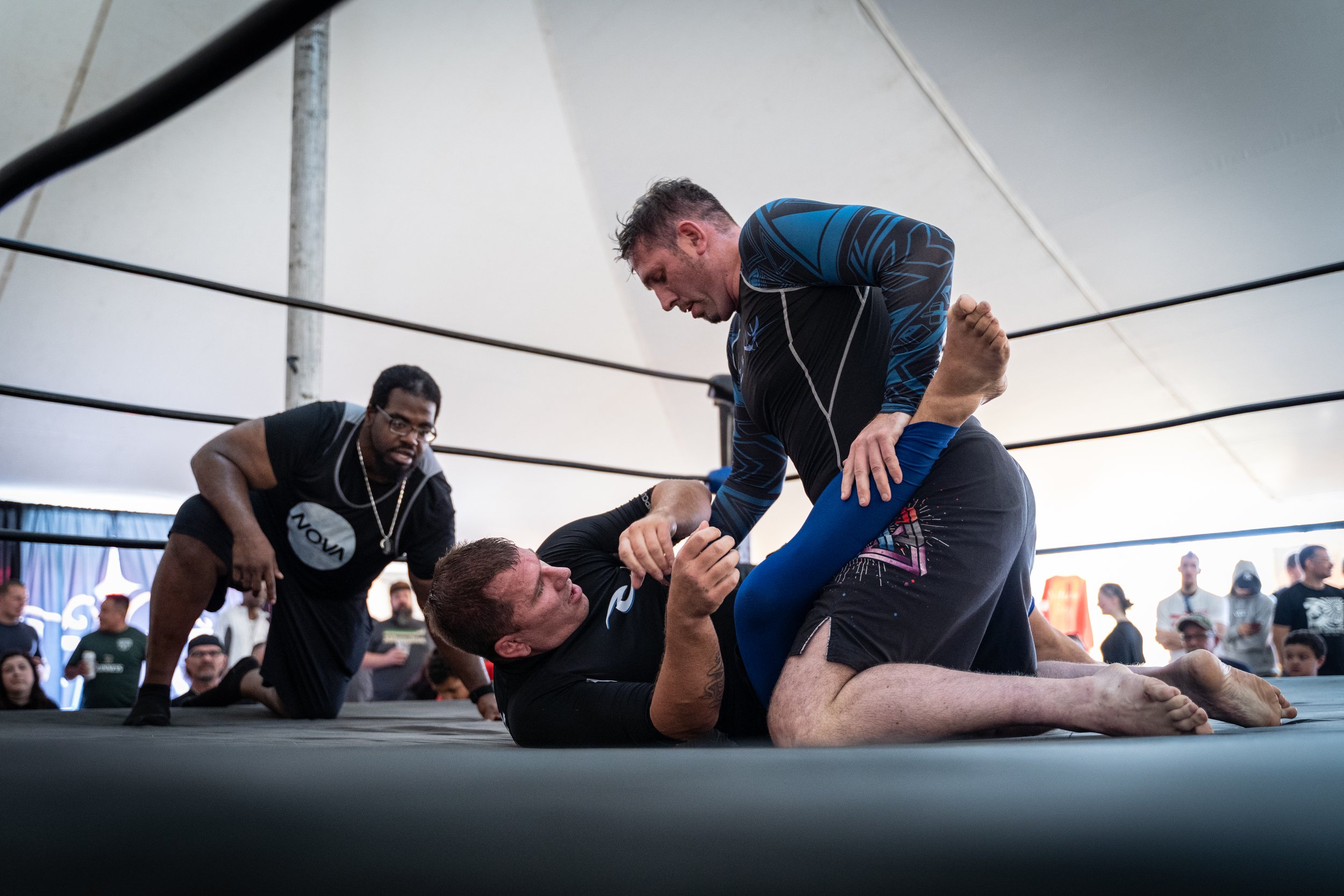
Grappling event with submission only rules. Both fighters had to have the personal injury insurance to participate.
Because benefits are paid directly to the insured athlete, the coverage can function as a financial buffer during recovery. For independent contractors — which most fighters are — that flexibility can matter more than traditional reimbursement-style insurance.
It is not uncommon for professional MMA athletes to purchase this type of supplemental accident insurance on their own, independent of any promotion requirement, simply to manage personal risk.
How Coverage Functions -
This type of policy is supplemental accident insurance. It is not major medical insurance and does not replace a primary health plan. Instead, it pays fixed cash benefits directly to the insured individual after a covered accidental injury.
Benefits may apply to emergency treatment, hospital confinement, surgical procedures, therapy sessions, imaging such as CT or MRI, ambulance transportation, and certain medical devices. There is also a sports-related enhancement that can increase certain payouts when injuries occur during organized athletic activity.
Because payment is made directly to the insured athlete rather than to a provider, the funds can be used for deductibles, copays, travel, rehabilitation expenses, or general financial obligations during downtime.
Documentation for Promoters and Managers -
When promotions or management teams require proof of coverage, enrollment verification and itemized reports can be coordinated through Chris Martin at JiuJitsuInsurance.com (who operates under NPN #7335986 and in California under #4116908) for the purpose of any contract compliance.
Important Disclosure -
JiuJitsuInsurance.com is not an insurance company. We are an independent insurance brokerage specializing in the combat sports market (who operates under NPN #7335986 and in California under #4116908). Coverage is provided by licensed insurance carriers and is subject to underwriting approval, state availability, benefit schedules, and policy terms.
Athletes and promoters should always review official summary descriptions, policy forms, and exclusions before enrolling. For detailed benefit summaries and exclusions, message us for a quote today.


Revamping Safety: A New Era of Risk Management in BJJ.
The Brazilian Jiu Jitsu (BJJ) industry has undergone a significant transformation in the aftermath of a groundbreaking $46 million lawsuit against Del Mar Brazilian Jiu Jitsu. This legal case has prompted gym owners to reassess their operational practices and prioritize risk management within their training environments. In response to the evolving landscape, this article emphasizes the importance of comprehensive risk management plans, explores the necessity of adapting protocols and procedures, and highlights the insights of renowned instructor John Danaher on creating a safe training environment through the concept of control. By incorporating these strategies, gym owners can navigate this new era and foster a safer Brazilian Jiu-Jitsu community.
The landscape of the Brazilian Jiu Jitsu (BJJ) industry experienced a seismic shift following the recent $46 million lawsuit against Del Mar Brazilian Jiu Jitsu. The repercussions of this landmark case have been far- reaching, impacting how gym owners operate and how they perceive and manage risks within their training environments. It has raised questions about established practices, and heightened scrutiny, and compelled gym owners to revisit their risk management plans.
Importance of Risk Management in Brazilian Jiu-Jitsu Gyms
We are keenly aware of the significant role that risk management plays in Brazilian Jiu-Jitsu gyms. Our perspective is that a comprehensive risk management plan must be thoroughly conceptualized, well documented, and regularly reviewed with all gym personnel, including coaches and other employees. This approach highlights the complex responsibilities of gym owners in devising, continually refining, and effectively communicating risk management strategies.
Creating a conducive training environment that is safe, healthy, and beneficial for trainers and trainees alike is largely the responsibility of the owners. Understanding that risk awareness is a collective duty beyond simple knowledge and adherence is essential. In this setting, coaching staff and gym employees are equally vital in ensuring the successful implementation of these risk management plans.
A New Era of Protocols and Procedures
The recent Del Mar lawsuit has instigated a transformational shift, encouraging gym owners to reconsider their conventional operational practices. While previously employed strategies may have been successful, adaptation and innovation are now paramount. This legal development has required a comprehensive review of gym policies, leading to an amplified focus on potential juror viewpoints.
At JiuJitsuInsurance.com, we strongly believe that Brazilian Jiu-Jitsu gym owners need to reassess their operations in light of this lawsuit. The legal action has ushered in new protocols and procedures that demand consideration. Understanding the judicial viewpoint from which gym operations might be assessed has never been more crucial.
Without question, this emerging era of protocols and procedures underscores the significance of sensible risk management in Brazilian Jiu-Jitsu gyms. As the industry grapples with these changes, gym owners, coaches, and trainers must equip themselves with the necessary knowledge, strategies, and resources to manage risks responsibly and effectively.
Utilizing Outside Resources for Risk Management
In the wake of the Del Mar lawsuit, now's a great time to draw wisdom from others in the sport for risk management. The Jiu-Jitsu community has access to a multitude of resources, many of them available right at our fingertips. For instance, YouTube offers extensive content from seasoned practitioners who share invaluable insights into reducing risks at the gym. A standout voice amidst these is that of John Danaher, renowned Brazilian Jiu-Jitsu and mixed martial arts instructor and coach from New Zealand, recognized for his authoritative and strategic approach to injury prevention.
John Danaher on Reducing Injury Risk in Brazilian Jiu Jitsu
John Danaher's perspective on risk management in Brazilian Jiu-Jitsu gyms sheds light on how the culture and environment within these spaces play a critical role in mitigating injury risk. His philosophy pivots on a singular keyword - 'control.’
John Danaher says that there is one word he uses to describe how you can manage the culture and the environment in your gym to reduce the risk of student injury. The more controlled the movement and even the minds of Jiu-Jitsu practitioners, the lower the injury rate.
In this ethos, control is twofold; it refers to the physical control of movement during training, but it also emphasizes mental control, specifically the ability to regulate emotions, competitiveness, and the overall mindset during a match or practice.
How Control Impacts Injury Rates
John Danaher elaborates on control: "If you make control rather than outcome the central focus of both yourself and your training partners, you will find injury rates, particularly small-scale injury and severe injuries, go down over time."
This indicates that a shift in focus can make a world of difference. Prioritizing control of the body and mind over the outcome of a match or session results in fewer injuries over time. This means fostering a gym culture that prizes mutual respect and self-control, understanding that these are the building blocks of a safe training environment.
Gym culture plays an outsized role in injury prevention. If both gym owners and practitioners committed to fostering an environment where control and safety are at the helm, the impact on injury rates will be profound. The idea is not just about winning or mastering techniques but about learning, growing, and practicing in a way that values every individual's safety and well-being.
By integrating such strategies and philosophies into their risk management plans, gym owners can mitigate the likelihood of incidents and cultivate a culture that puts safety first. John Danaher's insights can serve as a guidepost in this endeavor, helping owners and coaches shape the ethos of their gyms.
Turning Risk into Control: The Future of Brazilian Jiu-Jitsu Gyms
The Del Mar Brazilian Jiu Jitsu lawsuit marks a turning point in the industry, compelling gym owners to reevaluate their risk management plans. John's assertion that "control rather than outcome" must be the central focus in the gym culture for injury rates to reduce over time rings louder now more than ever. Gym owners need to be proactive in creating safer environments for their students and staff. This not only ensures their well-being but also reduces legal risks. Should you need guidance on liability insurance or other methods to minimize risk in your gym, do not hesitate to reach out.
Together, we can create a safer Brazilian Jiu-Jitsu community.

The Del Mar Jiu-Jitsu Case: Implications for Martial Arts Liability & Insurance.
This article delves into the significance of the Del Mar Jiu-Jitsu case and its implications for martial arts liability and insurance. Attorney Gabe D'Antonio's comprehensive overview of the jury verdict provides valuable insights into the reasoning behind the ruling. Moreover, the article highlights essential risk management strategies for gym owners, emphasizes the importance of appropriate insurance coverage, and stresses the need for gyms to regularly review and update their risk management plans.

Protect yourself on and off the mats. Get affordable personal injury coverage for Jiu-Jitsu athletes starting at only $30/month from JiuJitsuInsurance.com